Get Full Government Meeting Transcripts, Videos, & Alerts Forever!
Get email alerts on the K12 Budget And Programs topic
No spam. Unsubscribe anytime.
DOE outlines student achievement gains, literacy and math initiatives and requests funding increases
Summary
Superintendent Ellen Weaver briefed the committee on NAEP gains, statewide literacy training, Palmetto Math launch, Read to Succeed implementation, a phone‑policy survey, and outlined multiple budget requests including $20 million recurring for consumables and a one‑time math adoption.
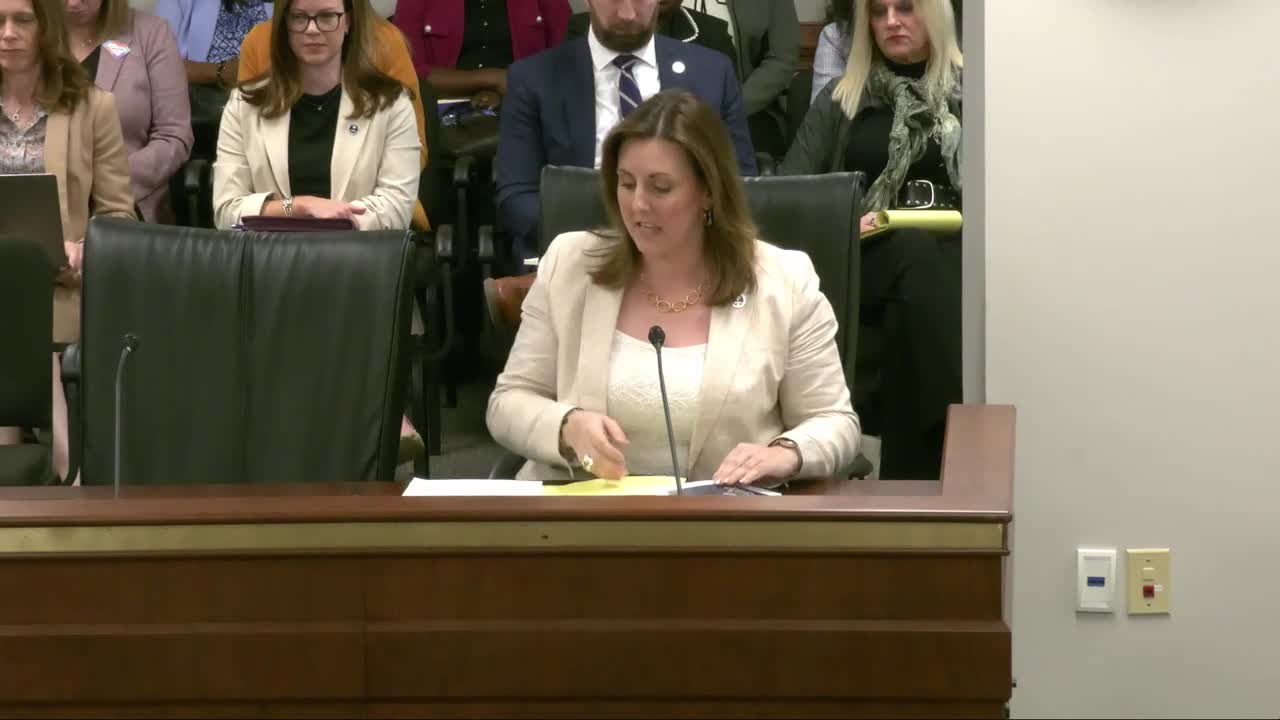
Superintendent Ellen Weaver told the K‑12 Finance Subcommittee that South Carolina is showing encouraging trajectories on national and state assessments and asked the committee to consider a package of recurring and one‑time funding requests to sustain and expand that work.
Weaver highlighted recent NAEP results and state assessment gains. She said South Carolina’s fourth‑grade math scale‑score change ranked in the top three nationally and reading among the top five by scale‑score change, and that state summative assessments showed a 7% increase in ELA and a 2% increase in math for grades three through eight.
On literacy, Weaver said almost 20,000 K‑3 educators have completed or nearly completed the state’s “Letters” training in the past two years. She credited the Read to Succeed 2 Act and related state investments for expanding teacher training and early intervention, including summer reading camps funded in the House budget.
Weaver described the Palmetto Math project, funded in last year’s budget, which deploys state instructional coaches and identifies pilot sites for high‑intensity tutoring and math interventions. She said the department used $3,780,000 in one phase of high‑intensity tutoring grants and plans to target remaining funds to Palmetto Math schools.
On curriculum and materials, Weaver said the department requests $20,000,000 in recurring funds for consumable instructional materials — cursive handbooks and year‑to‑year copies — and a one‑time nonrecurring appropriation for a math adoption that will provide materials aligned to the 2023 math standards for roughly the next decade. She noted digital components may be included in some adopted materials and agreed to provide the committee more specific age‑level detail about any digital components.
A substantial portion of the hearing focused on the role of technology in classrooms. When a senator raised concerns about “digital resources” and the effect of screen use on young children, Weaver said the department supports a strategic, evidence‑based approach: “We need to use technology where it’s appropriate and jettison it where it’s not,” she said, noting one example where an AI writing tutor provided individualized feedback in a sixth‑grade classroom while the core materials remained in print.
Weaver also briefed the committee on programmatic and compensation initiatives. She reported $55,000,000 referenced as a strategic compensation effort in recent budget cycles, and said the department allocated a $5,000,000 pilot round that funded 36 schools from 18 applicants across 30 districts; the department will monitor implementation to evaluate models. She asked the committee to consider an increase of $200,000,000 to the state aid to classroom line to produce an average $3,000 raise across pay scales and reiterated a statewide goal of a $50,000 minimum starting salary.
Other requests included $30,000,000 for the Education Scholarship Trust Fund per existing statute, funding for career and technical education in rural communities, a proposal to seed an education infrastructure bank for school construction and facilities in high‑need areas, continued recurring funding for school safety upgrades (the department previously received $20,000,000 and is requesting a recurring line), a $35,000,000 bus lease purchase line to maintain a 15‑year replacement cycle, and additional dollars for increased operating costs for the new department building.
Senators pressed for budget detail and asked about classified positions; the department said it had not requested additional FTEs but would follow up on line‑item composition and the year‑to‑year delta shown in the budget control documents. Weaver also described early feedback on the phone‑policy “Free to Focus.” She said a teacher survey found 92% support among respondents for a classroom cell‑phone restriction and that anecdotal reports show changes in school culture, with more in‑school social activity and reduced filming of fights.
Weaver closed by noting the department’s unified goal of 75% of students at or above grade level by 2030 and asked the committee to consider the funding package as a mix of investments in literacy, math, teacher compensation and safe school infrastructure.