Get Full Government Meeting Transcripts, Videos, & Alerts Forever!
Get email alerts on the Aging Services topic
No spam. Unsubscribe anytime.
Department of Aging seeks $19 million for home services, $15 million authorization for federal match
Summary
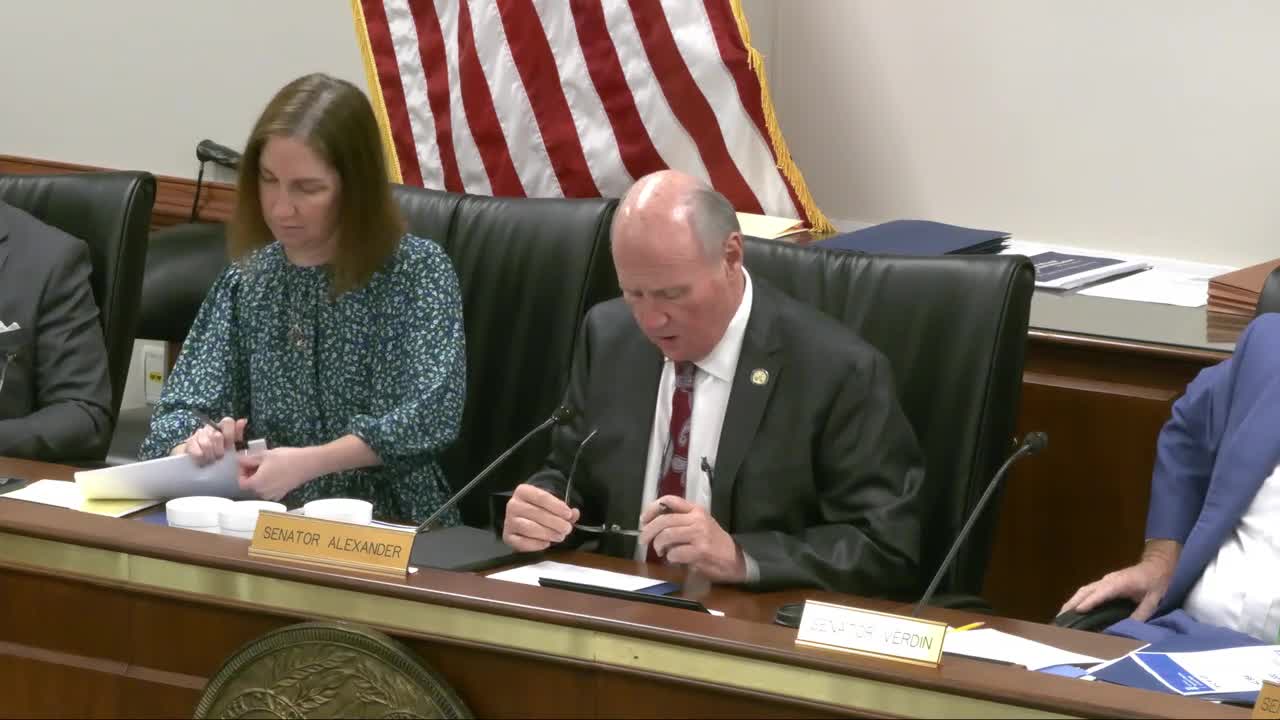
The Department of Aging told the Senate Finance Committee Health and Human Services Subcommittee on March 19 that it needs new state funding to preserve federal grants and expand services for South Carolina seniors.
The Department of Aging told the Senate Finance Committee Health and Human Services Subcommittee on March 19 that it needs new state funding to preserve federal grants and expand services for South Carolina seniors.
Department director Connie Munn told committee members the agency’s top requests include $15,000,000 in state authorization to maintain federal funding streams (which requires a $3,000,000 state match), and a $19,000,000 request to bolster home- and community-based services, among other items.
The funding request matters because the older-adult population is growing and the department said federal and one-time ARPA funds that expanded services after the pandemic are phasing out. “This allows us the opportunity not to have to come and ask for money … rather than coming back 2 or 3 times during the year to ask for the authorization,” Munn said, explaining the $15 million authorization would let the agency pursue discretionary federal grants without seeking repeated legislative approvals.
Munn described the $19 million ask as targeted at meal programs, transportation, home modifications, legal services and other supports administered through Area Agencies on Aging. She said those agencies provided the estimates that formed the request and that the department has adjusted its waiting-list process since 2022 to provide clearer, county-level data. “I would have to say it will not eliminate the waiting list,” Munn said of the $19 million, adding the funding would “tremendously” reduce wait times but not eliminate them entirely given demographic growth.
Committee members pressed for specifics. Senator Allen asked about the Office’s guardian ad litem request; the packet shows an agency request of roughly $79,449 to add a paid vulnerable-adult guardian ad litem position, increasing the state-paid complement from eight to nine. Munn said the guardian program also relies heavily on volunteers and that current paid staff are distributed statewide.
Munn described $527,000 requested to meet compliance with the final rule implementing the Older Americans Act, released in February 2024. That funding would pay for FTEs and other supports the department says are necessary to align state operations with federal requirements, including new emphases on legal assistance and veteran outreach.
She also detailed the Home Stabilization Program, expanded after a pilot HUD grant, saying the state-run program now serves every county and seeks funding for three state positions. Munn said the program completed minor home modifications on 130 homes at a cost of $604,000; she said the department estimates averted nursing-home costs of $14,490,000 for those households and characterized that as roughly a $13,000,000 net savings compared with institutional care.
Munn said roughly $4,000,000 of ARPA funds remain available through a no-cost extension to September 2025 and that ARPA flexibilities allowed the state and Area Agencies on Aging to try innovations (for example, weekend meals, food boxes, ride partnerships). She noted the department encouraged AAAs to use Older Americans Act funds for meals and transportation while using the state home- and community-based dollars for higher-cost home repairs and stabilization services.
Other requests included $550,000 in ombudsman allocations to expand long-term care ombudsman coverage statewide, $154,000 annually for shared services (data warehouse, internet and similar functions), a proposal to implement an e-learning and learning management system, and FTE rebalancing that would move five positions among funding sources to reflect work assignments.
Munn offered to provide the committee county-by-county waiting-list data and a handout breaking down the services and projected impact. Senator (Laurens) requested a tutorial on meal composition and nutrient content; Munn said meals procured under the Older Americans Act must meet one-third of the recommended daily allowance, and AAAs follow procurement guidelines and dietetic requirements.
The subcommittee did not take a formal vote during the presentation. The Department of Aging presenters included Munn and staff finance and legislative leads, and committee members asked for follow-up detail on waiting lists, meal quality and specific county impacts.
Looking ahead, Munn said the department is prepared to provide more detailed breakouts by county and service type to show precisely how requested funds would reduce waiting lists and expand services.