Get Full Government Meeting Transcripts, Videos, & Alerts Forever!
Get email alerts on the Energy Policy topic
No spam. Unsubscribe anytime.
Committee adopts subcommittee amendment and advances broad energy bill covering siting, procurement, small modular reactors and joint projects
Summary
The Senate committee advanced a comprehensive energy bill after adopting a subcommittee amendment that narrows some joint‑ownership language and preserves expedited permitting and IRP reforms, while removing a pilot authorization for small modular reactors via amendment.
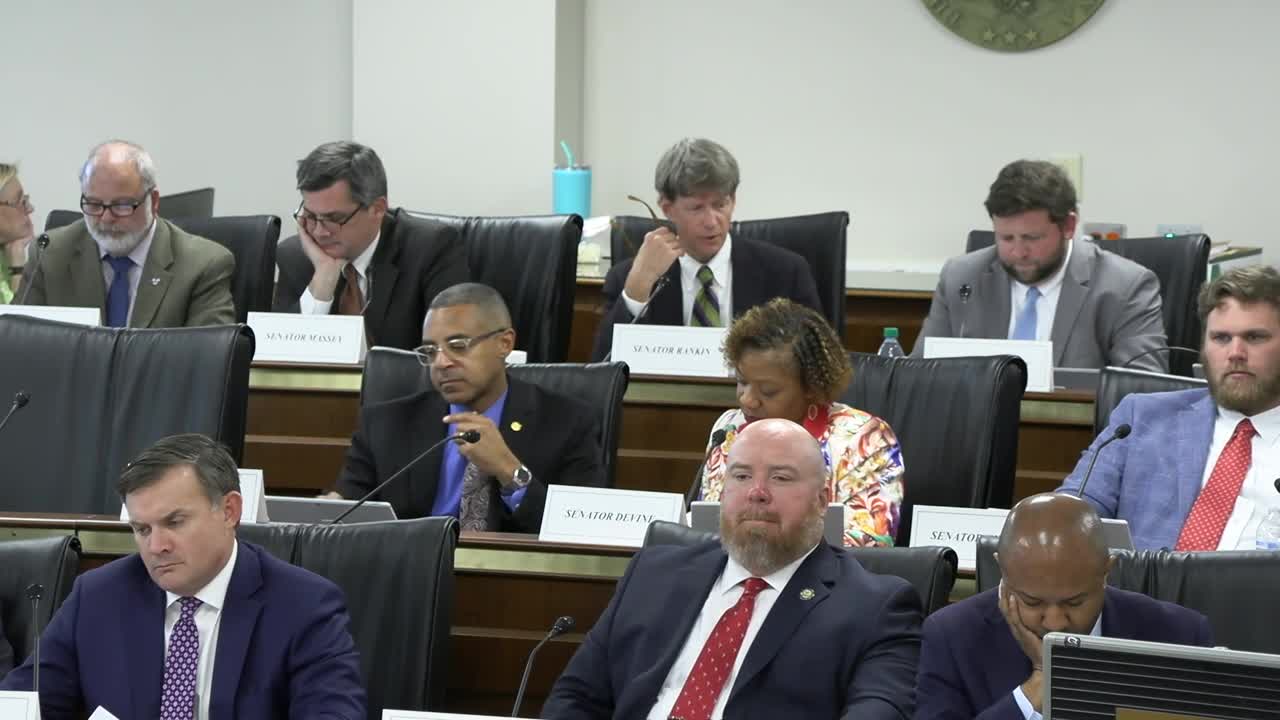
The Senate Judiciary Committee took up a comprehensive energy omnibus (identified in the hearing as 03/1200 / House Bill 3309) and adopted the subcommittee amendment as the working document before reporting the measure favorably.
Breeden, staff for the committee, walked members through the bill section by section. The legislation would expand statutory duties for the Public Service Commission (PSC); require procedural schedules and discovery limits for commission proceedings; create an Energy Policy and Research Institute housed at a university to prepare policy briefings; and encourage evaluation of specific generation projects — including joint projects between Santee Cooper and investor-owned utilities, energy storage, and hydrogen-capable generation.
Key provisions described on the record include: - Authorization for a narrowly defined joint resource: the subcommittee narrowed language so Santee Cooper may partner specifically with Dominion Energy on a proposed natural gas plant at the Kennedy's brownfield site rather than broadly authorizing any partnership. - A six-month agency permitting decision timeline for designated energy infrastructure applications, with a required pre-filing meeting and a mechanism to list application deficiencies. The amendment adopted by the subcommittee preserved an ability to extend the deadline by agreement in appropriate circumstances. - A pilot program reference for small modular reactors (SMRs) and encouragement of advanced nuclear development; however, Senator Ott offered and the committee adopted an amendment striking the SMR pilot authorization and converting it to a requirement that utilities report on the potential for such technologies. - An expansion of net-metering caps for nonresidential customers from 1,000 kW to 5,000 kW in one section. - Provisions for competitive procurement of renewable resources and changes to integrated resource plan (IRP) procedures and discovery schedules at the PSC.
Witnesses from utilities and balancing authorities — Keller Kasam (Dominion Energy South Carolina), Tiger Wells (Duke Energy South Carolina), Jimmy Staten (Santee Cooper), and John Fripp (Electric Cooperatives of South Carolina) — testified under oath. They described the bill as a means to provide regulatory clarity, shorten permitting and appellate timelines, and bring new generation online faster to meet rapid load growth. Santee Cooper and Dominion emphasized a joint gas-fired project at Kennedy's, citing existing transmission infrastructure at that brownfield site.
Committee members debated whether the bill would shift land-use control from counties to the state. A contested amendment (Senator Elliott’s amendment 2) that would have removed an acreage threshold for classification of a major utility facility (thereby leaving only a megawatt threshold) triggered extended debate; opponents said local land-use concerns and buffer requirements are best handled locally, while proponents said adding an acreage threshold would subject many solar projects to the siting act and slow deployment. The committee tabled Elliott’s amendment by recorded show-of-hands vote; the chair announced the tabling vote as 11–9 on the transcript.
Other amendments included Senator Ott’s measures: he successfully offered an amendment to study and report on the feasibility of using domestic wood products for electric generation, and an amendment to remove the SMR pilot program (replacing it with a reporting requirement). The committee adopted the subcommittee amendment as the working document and reported the bill favorably; senators indicated they expect many floor amendments.
The transcript records multiple technical questions about appeals procedures, who may intervene in expedited permit proceedings, and the relationship between state and federal authorities for projects that cross state lines. Several senators and witnesses urged that the Office of Regulatory Staff remain an active gatekeeper and that appeals preserve sufficient record for appellate review; staff and the committee said additional amendments on appeals procedure would be offered on the floor.