Get Full Government Meeting Transcripts, Videos, & Alerts Forever!
Get email alerts on the State Agriculture Budget topic
No spam. Unsubscribe anytime.
Georgia agriculture commissioner details budget requests for labs, hemp program, HPAI response and vehicle backlog
Summary
The Georgia Department of Agriculture presented FY26 funding requests to the Senate subcommittee on March 18, asking for new staff and equipment for hemp regulation, HPAI response, meat inspection, a new Atlanta regulatory lab and funds to address a vehicle backlog and seed-germinators at the Tifton lab.
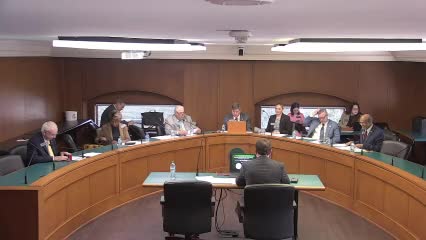
Commissioner (Georgia Department of Agriculture) told the Senate Appropriations Subcommittee on Agriculture and Natural Resources on March 18 that the department needs additional recurring and one-time funding to run existing programs and meet new responsibilities.
The department asked the committee to support the House-passed appropriations and also requested additional items including more staff for the hemp program, emergency management and avian influenza (HPAI) response equipment, meat inspection supervisors, funding for an Atlanta regulatory lab at the Atlanta Produce Terminal in Forest Park and money to replace a backlog of vehicles and add seed germinators at the Tifton lab.
Why it matters: the department oversees Georgia’s largest industry. Commissioner (Georgia Department of Agriculture) said investment in the agency is essential to maintain export markets, public health surveillance and food-safety capacity, and to support rural economic development tied to agriculture.
Most immediate asks and context • Safety24/Forestry grant loans: The commissioner said the agency reopened applications on March 12 after the FY amendment moved additional funds into the program. He reported the loan program had approved 239 applications for a total of $85,570,000 (approved as of that morning) and described an amended FY budget that raised total program funding to $285,000,000 (with $150,000,000 for Safety24 and $135,000,000 for the forestry grant program). "We have now approved 239 applications for a total of $85,570,000," he said.
• Avian influenza (HPAI): The commissioner said Georgia was HPAI free as of March 4, 2025, reopening export markets, but asked for $450,000 for emergency-management and HPAI-response equipment (foaming/depopulation units, CO2 units, cleaning & disinfecting units, generators, UTV/ATV equipment). He described how some items could be used for other emergencies.
• Hemp program: The department said its base hemp appropriation is approximately $550,000 (funding several investigators and a lawyer) and the House raised the governor's recommended funding to about $792,000. The commissioner said the agency originally requested roughly $1.37 million as the minimum needed to operate the hemp program and that hemp licensing has produced about $1.8 million so far into the treasury with an expected ongoing revenue of roughly $3.0 million annually from licensing. He asked for additional recurring funding to reach the earlier staffing target.
• Atlanta regulatory lab: The House included $20,000,000 for design and construction of a new Atlanta regulatory lab at the Atlanta Produce Terminal; the commissioner said the lab on Capitol Hill does not meet agency needs and asked the committee to fund the remaining half of the project.
• Meat inspection and companion-animal legal support: The House added two meat-inspector supervisor positions (~$189,000). The department asked for additional supervisors, an investigator, a deputy training coordinator and other staffing that would total roughly $470,000 more to reach a $6.65 million staffing request for meat inspection. The department separately requested a companion-animal legal specialist (~$109,000) to support administrative and enforcement work on animal abuse cases; that position was not included in the House budget.
• Vehicles and Tifton seed germinators: The commissioner said recent capital help reduced a vehicle backlog but a continuing need remains: $2.1 million would buy about 51 vehicles, he said. He also requested funds for a design study and equipment to add capacity for seed germinators at the Tifton lab, noting a single germinator failure can delay testing by weeks.
• Georgia Grown and the Center for Rural Prosperity Innovation: The commissioner supported a House transfer of funds (per HB 495) to move the Center for Rural Prosperity and Innovation into the Department of Agriculture and said an official transfer of the Georgia Grown program into the department would reflect where the program resides operationally; he said the Forestry Commission would remain a partner.
Discussion and next steps: Chairman Walker asked the commissioner to prioritize requests if the Senate moved in a different direction from the House and the commissioner agreed to follow up with a ranked scenario. Several senators pressed for detail on the hemp base budget, cost of HPAI response, and timing for distribution of USDA disaster relief funds; the commissioner said economic disaster assistance would start to be distributed the week of March 20 and natural disaster money would follow, but exact timing depends on federal allocations.
Ending: The commissioner closed by asking for the committee's “favorable consideration” of the House-passed items plus the department's additional asks, and offered to provide more precise priority scenarios to the chairman if the Senate revisits the budget.