Get Full Government Meeting Transcripts, Videos, & Alerts Forever!
Get email alerts on the Public Safety Police Report topic
No spam. Unsubscribe anytime.
Shelton police chief presents 2024 annual report showing lower-than-budget spending, steady calls and increased citations
Summary
Police Chief Chris Costad told the Shelton City Council study session that the department finished 2024 about $250,000 under its $4.1 million budget, reported roughly 12,588 calls for service and saw higher arrests and citations compared with 2023; he also summarized staffing, training, grants and professional-standards figures.
Police Chief Chris Costad told the Shelton City Council at its March 25 study session that the Shelton Police Department ended its 2024 budget year roughly $250,000 under its $4,100,000 appropriation, a shortfall the chief said was mainly attributable to staffing vacancies and reduced overtime.
"Last year, we had 12,588 calls for service," Police Chief Chris Costad said as he reviewed the department's annual statistics, and he noted that 465 of those were 911 calls. He also reported 645 arrests in 2024, up from 520 in 2023, and 637 citations issued in 2024 versus 364 the prior year.
The chief framed the budget and operational numbers together: the under‑spend came in part from open positions and lower overtime, and he said the department closed the year with 17 commissioned officers and two employee leads. Costad discussed recent recruitment and promotions, including three officers promoted to corporal to provide additional frontline supervision.
Costad described investigative and specialty units' activity last year: the detectives handled follow‑up on major crimes, detectives investigated an internet‑child‑exploitation matter in cooperation with a regional task force, and the department participated in a multi‑agency SWAT team and a canine program. He said one K‑9 will retire this year and replacements are being trained by Sergeant Diaz.
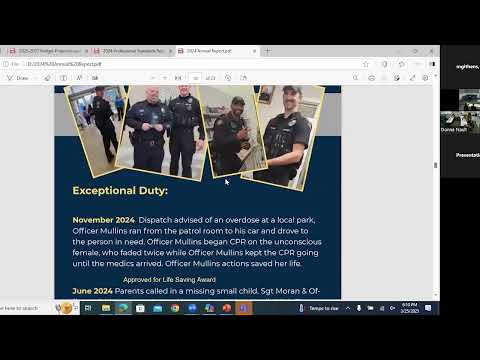
The department reported a modest increase in burglaries but no homicides in 2024. Costad also highlighted several community‑oriented incidents and awards, including a lifesaving CPR response by Officer Walton. He described community outreach efforts such as the Citizens Academy and National Night Out.
Costad itemized grants and donations the department received: about $20,400 from the Washington Auto Theft Prevention Authority to help buy cameras, a later additional $65,000 referenced by the chief, $1,607 from Sierra Pacific Industries for transport/wrap equipment, $41,000 from CJTC for reaccreditation, and a Department of Justice award for ballistic vests (amount reported by the chief). He said the department received more than $148,000 in grants and donations during the year.
On internal oversight, Costad presented the department's professional‑standards summary: four citizen/internal complaints in 2024 (two not sustained, one sustained and one incomplete), 21 uses of force and five vehicle pursuits in the year. He said most pursuits were discontinued by officers when continuing was judged too risky and that the department is monitoring racial/ethnic citation trends noted in the data.
Costad emphasized ongoing training: defensive tactics, less‑lethal and de‑escalation refreshers, internet‑based child‑exploitation training through a regional program, and annual training requirements for SWAT and K‑9 handlers.
Council members who spoke after the presentation praised the department's community interactions and professionalism. No formal council action followed the report; the presentation was provided for information and follow‑up questions.
The chief and staff supplied the council with the annual report and said they would bring forward lifesaving‑award documentation and further detail on grants when available.