Get Full Government Meeting Transcripts, Videos, & Alerts Forever!
Get email alerts on the Department Of Agriculture topic
No spam. Unsubscribe anytime.
Georgia agriculture commissioner asks Senate subcommittee for funding to shore up labs, hemp enforcement, HPAI response and vehicles
Summary
Commissioner Harper asked the Senate subcommittee on March 18 to support House budget additions and to fund new hires, emergency equipment and lab construction to sustain regulation and emergency response for Georgia agriculture.
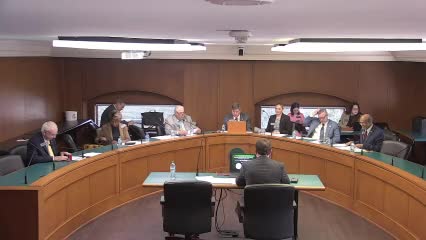
Commissioner Harper asked the Senate Appropriations subcommittee on Agriculture and Natural Resources on March 18 to sustain recent House increases to the Department of Agriculture budget and to consider additional funding for enforcement, emergency response equipment, laboratory capacity and agency vehicles.
Harper told the committee the department is organized into 22 divisions, issues about 70 licenses and funds its work with roughly an 80/20 split of state and federal funds. "We are HPAI free as of 03/04/2025," Harper said, noting that the state27s export markets are open again and that the department remains "not letting our guard down" on avian influenza monitoring and response.
Harper said loan and grant activity tied to the department27s disaster-response programs is proceeding. "We have now approved 239 applications for a total of $85,570,000," he said, and added that the agency reopened the application period on March 12 and that it "will stay open" for the additional funds the House provided.
Why it matters: the commissioner framed the requests as measures to protect Georgia27s largest industry and to ensure the agency has the capacity to carry out statutorily required emergency responses. Several items raised affect ongoing export-sensitive programs (avian influenza surveillance), licensing and regulatory enforcement (hemp), and infrastructure needed for food-safety testing (labs at Tifton and Atlanta).
Key House changes and agency asks - The House27s FY26 version added transfers for the Center for Rural Prosperity and Innovation (House Bill 495) and moved roughly $2.4 million into the agency27s consumer-protection division; Harper said the center27s work would align with the department27s marketing and rural-economy mission. - For the department27s safety and recovery programs, Harper said the amended FY25 budget and subsequent actions produced a $285 million package that allocates $150 million to the "safety 24" program and $135 million to a forestry grant program administered with the Georgia Forestry Commission and the development authority. - The House included $20,000,000 "for design and construction of a new Atlanta regulatory lab at the Atlanta Produce Terminal here at Forest Park," Harper said, adding that the House funding represented "about half of the money" the department sees as necessary and that the agency would ask the Senate to fund the remaining share.
Hemp program enforcement and licensing revenue Harper described the hemp program as a continuing budget pressure. He said the department currently has roughly $550,000 in base funding for hemp program staff (investigators, lawyers and licensing personnel) and that the House increased the governor27s recommendation to about $792,000. The department originally requested roughly $1.37 million as the minimum needed to operate the program fully.
Harper also discussed recent licensing revenue and projections: "We have brought in, either brought into the treasury or in process of bringing in about $1,800,000 in licensing revenue," he said, adding that the department expects "a little over $3,000,000 a year in revenue and hemp licensing fees" once outstanding applications are processed. He asked that part of licensing revenue be returned to the program to fund enforcement.
Avian influenza and emergency-equipment asks Harper described the state27s recent highly pathogenic avian influenza (HPAI) response and asked for $450,000 in emergency equipment funding to ensure the agency can respond to additional outbreaks without resource shortfalls. "That $450 is specifically for some additional equipment ... foaming units which are critical in incidents," Harper said, listing foaming units, CO2 units, cleaning-and-disinfecting (C&D) units and portable generators that can be used for multiple emergencies.
He said the department would use some equipment for other emergencies, and that Georgia Forestry supplied water tankers and other on-site resources during the Elbert County HPAI incident. Harper noted industry contributions to monitoring: "About 3 fourths of the funding, I think, at least 2 thirds anyway, comes from the industry itself. So this is a true public-private partnership."
Meat inspection, companion-animal specialist and staffing Harper said the House added two meat-inspector supervisor positions and that the department currently has about 86 meat-inspector positions with roughly eight vacancies. He said base pay for employees with four-year degrees has increased to approximately $42,000, up from about $37,000 when he took office, and said annualized pay adjustments would help hiring and retention.
The department asked for additional positions for the meat-inspection program (investigator, deputy training coordinator and others) and a $109,000 request for a legal specialist to assist with companion-animal abuse cases, combining regulatory administrative support and law-enforcement assistance.
Capital and operational needs: vehicles, labs and germinators Harper said last year27s funding addressed a portion of the department27s vehicle backlog, but he asked for an additional $2.1 million to buy 51 vehicles and annualize fleet replacement so the agency does not return repeatedly to request large lump sums. He also asked for funds for seed-germinators at the Tifton lab and a design study to add capacity there, arguing the lab experiences seasonal bottlenecks.
On laboratory capacity, Harper urged support for completing repairs and upgrades at the Tifton lab and for funding the second half of the Atlanta Produce Terminal regulatory lab so the agency can centralize testing where produce traffic and access make operational sense.
Electric vehicle program and regulatory readiness Harper said the department has used one-time funds to purchase equipment late in the prior year and is partnering with Georgia Tech to study monitoring options for electric-vehicle charger verification: "We are working through that now and ensuring that we are ready to go when that goes into effect. Currently, the effective date is January of next year," he said, adding that the department has not been budgeted continuing funds to operate the program.
Where the committee pressed for detail Committee members asked for a prioritized list if the Senate reverts to the governor27s cash position rather than the House27s bond-financed approach; Harper said he would consult staff and return with scenarios. Senators also questioned specifics on HPAI costs (Harper said response operations cost about $100,000 per week and that the Elbert County event cost about $325,000), loan-closing timing for safety 24 approvals (Harper said most loans close within 30 days after approval), and whether federal disaster block grants will flow quickly (Harper said the department expects some economic-disaster assistance to begin reaching producers by March 21 with additional natural-disaster block-grant distributions to follow).
Speakers - Commissioner Harper, Commissioner, Georgia Department of Agriculture, government - Director Sabo, Director, Georgia Forestry Commission, government - Chairman Walker, Chair, Senate Appropriations Subcommittee on Agriculture and Natural Resources, government - Senator Sams, Senator, committee member, government - Senator Goodman, Senator, committee member, government
Authorities - HB 495, fund transfers for the Center for Rural Prosperity and Innovation (referenced by Commissioner Harper) - Title 2 (state law), "the commissioner shall" emergency-response duties (referenced by Commissioner Harper)
Clarifying details - Safety 24 program: amended FY25 funding package described as $285,000,000 total; Harper said $150,000,000 would support the safety 24 program and $135,000,000 would support the forestry grant program - Loans approved as of the morning: 239 applications totaling $85,570,000 - HPAI: Georgia declared HPAI-free as of 03/04/2025, reopening export markets - Hemp licensing: department has collected or is processing about $1,800,000 in licensing revenue and expects "a little over $3,000,000 a year" when outstanding licenses are completed - Meat inspection: 86 positions authorized, about 8 vacancies; four-year-degree base pay approximately $42,000 after recent adjustments - Vehicles: $2.1 million would buy 51 vehicles (as estimated by commissioner) - Atlanta regulatory lab: House included $20,000,000 for design and construction at the Atlanta Produce Terminal (Forest Park); agency seeks remaining funds from Senate
Proper names - Georgia Department of Agriculture (agency) - Georgia Forestry Commission (agency) - Center for Rural Prosperity and Innovation (program) - Atlanta Produce Terminal (location) - Tifton lab (facility)
Searchable_tags:["agriculture","budget","hemp","avian_influenza","laboratory","vehicles","safety24","GeorgiaGrown"]
Provenance:{"transcript_segments":[{"block_id":"558.00995","local_start":0,"local_end":198,"evidence_excerpt":"First off, thank you all. As you mentioned, today's national ag day, this is national ag week and, definitely hope y'all enjoyed the Coke and, Georgia. It was our 150 years last year over this last year, Mr. Chairman, and we're the spotlight state at the Sunbelt Expo this year. So, so we've got a lot going on.","reason_code":"topicintro"},{"block_id":"3405.73","local_start":0,"local_end":36,"evidence_excerpt":"Alright. Well, thank you, mister chairman, members of the committee. Good job.","reason_code":"topicfinish"}]}
Salience:{"overall":0.85,"overall_justification":"Covers broad agency budget requests for Georgia's largest industry, potential multi-million-dollar capital and operational funding, and a current disease-response issue (HPAI).","impact_scope":"state","impact_scope_justification":"Funding affects statewide agricultural regulatory capacity, trade and emergency response.","attention_level":"high","attention_level_justification":"Contains time-sensitive disaster-response and budget items likely to shape the Senate27s appropriation decisions.","novelty":0.45,"novelty_justification":"Items mostly continue existing programs but include new asks and a major lab project request.","timeliness_urgency":0.80,"timeliness_urgency_justification":"HPAI status and loan approvals are active; budget decisions are imminent.","legal_significance":0.40,"legal_significance_justification":"References statutory emergency duties (Title 2) and HB495 fund transfers.","budgetary_significance":0.85,"budgetary_significance_justification":"Multiple multi-million-dollar capital and operating requests including laboratory construction and fleet replacement.","public_safety_risk":0.35,"public_safety_risk_justification":"HPAI response affects poultry industry and exports; emergency equipment purchases are precautionary.","affected_population_estimate":100000,"affected_population_estimate_justification":"Includes poultry industry workers, farmers regulated by hemp rules, and statewide agricultural supply chain.","affected_population_confidence":0.6,"affected_population_confidence_justification":"Estimate based on industry scale but not explicitly quantified in transcript.","budget_total_usd":285000000.0,"budget_total_usd_justification":"Commissioner cited a $285,000,000 package tied to safety24 and forestry grants; individual line-item asks add multi-million-dollar requests."}