Get Full Government Meeting Transcripts, Videos, & Alerts Forever!
Get email alerts on the Court Operations topic
No spam. Unsubscribe anytime.
County court judge urges higher pay for court reporter; commissioners to review compensation
Summary
Judge Jeff Duran told the Anderson County Commissioners Court on Jan. 27 that his court’s reporter is likely to leave because county-set pay lags neighboring jurisdictions. Commissioners asked staff to collect salary comparisons and put the item on a future agenda for action.
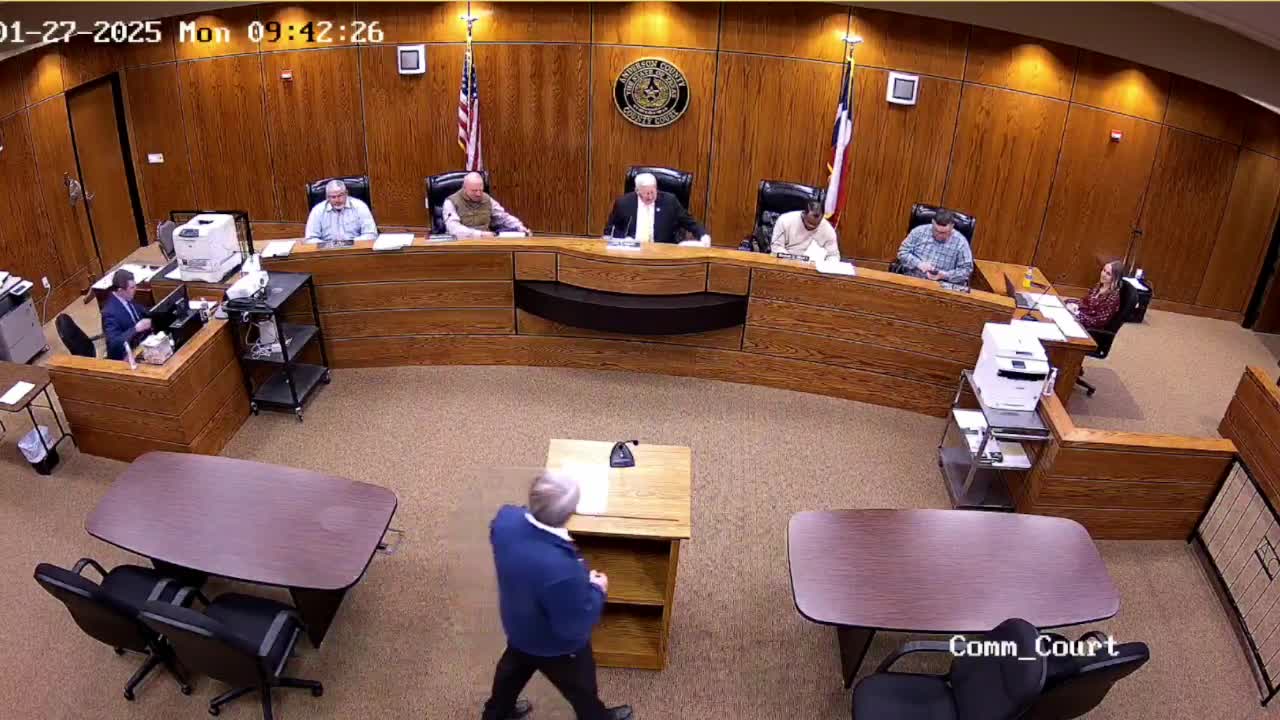
County Court at Law Judge Jeff Duran told the Anderson County Commissioners Court on Jan. 27 that his court is legally required to maintain a court reporter and that the current county-set pay is too low to retain experienced reporters.
“The county court law is a court of record and that means that we're legally required to have a court report. And you set the compensation for our court reporter,” Judge Jeff Duran said, explaining why he had brought the matter before the court.
Duran said his court’s reporter has been offered substantially higher pay elsewhere and that hiring or contracting to cover the position would be costly. He presented local comparator figures and told the court he could not recruit at the current salary. Commissioners did not change pay at the meeting; instead they asked staff to compile additional salary data and return the item on a future agenda for formal consideration.
Why it matters: County courts of record must produce accurate verbatim records for appeals; losing an experienced reporter can delay filings or require expensive contract reporters. Duran warned that contracting for court reporting could exceed the court’s current budget for the position.
Details and discussion: Duran said nearby counties pay materially more for equivalent positions, and he outlined two options if the county does not raise compensation: (1) attempt to hire at the present county rate (which he said would be unsuccessful), or (2) contract for reporting services, which he estimated could cost in the order of six figures. He described the job as highly specialized and said training and certification requirements make replacement difficult and time-consuming.
Commissioners asked staff (identified in the record as “Megan”) to gather a range of comparator salary figures and return with specific cost estimates and options (hiring vs. contracting and the budget amendment process needed to make changes). The court agreed to place the matter on a subsequent agenda for further consideration.
Clarifying details from the meeting included Duran’s on-the-record citations of neighboring-county figures (examples cited in the meeting: Houston County ~$77,000; Rusk ~$73,000; Cherokee ~$80,000; Burnett ~$93,000; Kerr ~$103,000; Caldwell ~$100,000) and a reported local reporter salary in the low-to-mid $60,000s. Duran gave an order-of-magnitude estimate for contracting the work at about $150,000 annually if a contract route were required. He also noted training programs exist (Trinity Valley was mentioned) but that the profession has a high attrition rate.
Discussion versus direction: The transcript records an extended discussion and no formal vote to change pay. The explicit next step recorded in the meeting was a direction to staff to collect detailed salary and cost comparisons and to place the item on the next court agenda.
Ending: Commissioners did not adopt an immediate salary change. The court asked staff to return with numbers and a proposed budget amendment or other options for formal action at a future meeting.