Get Full Government Meeting Transcripts, Videos, & Alerts Forever!
Get email alerts on the State Legislation topic
No spam. Unsubscribe anytime.
SeaTac council reviews state bills on paid leave, AI bargaining, firefighter presumption and rideshare protections
Summary
SeaTac City Council discussed a package of Washington state bills and gave staff direction to follow or support several items, including paid family medical leave and rideshare protections; members were divided over a bill that would require bargaining before cities implement artificial intelligence.
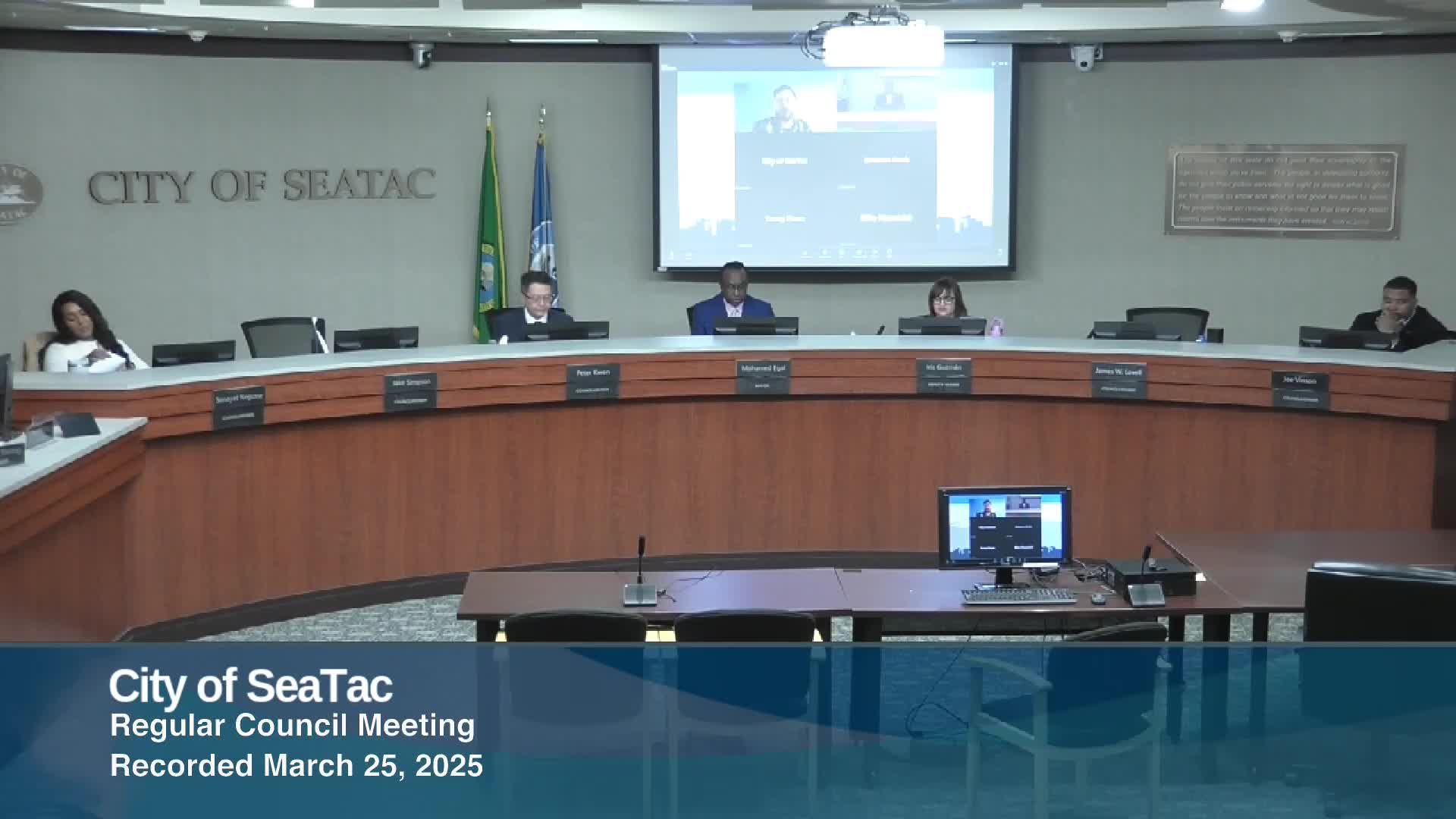
SeaTac City Council on March 18, 2025, reserved time to review several Washington state bills and gave staff direction to follow up with the city’s lobbyist and the Association of Washington Cities (AWC) where appropriate. City Manager Jonathan Yang asked the council whether it wanted SeaTac staff to pursue positions different from AWC on specific bills.
The council’s discussion focused on five bills raised by staff: House Bill 1213 (paid family medical leave), House Bill 1622 (bargaining over employer decisions to implement artificial intelligence), House Bill 1571 (expanded presumptive occupational illness protections for firefighters), House Bill 1332 and Senate Bill 5600 (measures to increase transparency and limit fees for transportation network company drivers). The council did not take formal votes on any of the bills but provided direction to staff.
Why it matters: The bills touch on workplace protections, public-safety workforce costs and the local economy. SeaTac has a large concentration of service-sector workers and ride-share drivers because of the airport; decisions by the Legislature or changes in AWC positions could affect city services, contracts and budget forecasts.
City Manager Jonathan Yang opened the discussion by asking for council direction, saying he had “wanted to reserve most of our time for you to weigh in on any key legislative Washington state legislative matters that you would like to provide direction to city staff to advocate for.” Council members then addressed the bills one at a time.
Paid family and medical leave (HB 1213). Staff described the bill as extending employment-protection rights and healthcare coverage during covered leave. Multiple council members voiced support. Councilmember Jake Simpson said the bill aligned with the council’s values and workforce priorities. Council direction: staff to coordinate with the city lobbyist and look for opportunities to amplify SeaTac’s support.
AI and collective bargaining (HB 1622). The bill would, as introduced, give labor unions the right to bargain over employers’ decisions to implement certain AI systems. AWC currently opposes the bill, arguing it would limit managerial decision-making and slow innovation. Council reaction was split. Several members, including Simpson, supported the principle that unions should be able to bargain over AI’s impacts on wages and jobs; Simpson said the city should “be setting an example” in how it works with labor when implementing new technology. Other members raised concerns that the bill as drafted could unduly limit cities’ ability to choose technologies and recommended seeking amendments that preserve municipal management authority. Council direction: staff to monitor HB 1622, convey council concerns to the lobbyist, and seek clarifying amendments as appropriate.
Firefighter presumptive illness protections (HB 1571). The bill would expand the list of occupational illnesses presumed to be job-related for firefighters, a change with potential fiscal impacts. Several council members expressed support on policy grounds but noted cost and budget implications. As one council member observed, presumptive illness statutes are “heavily medically laden” and adding conditions creates additional costs for the payers. Council direction: continue to track the bill and report back if it advances, with attention to fiscal implications and any requests for city positions.
Rideshare driver protections (HB 1332, SB 5600). Staff described the pair of bills as increasing transparency for transportation network companies (TNCs) and capping certain fees charged to drivers. Members representing SeaTac’s airport community emphasized that many residents are TNC drivers and supported the measures; one council member said transparency on per-trip deductions, tolls and miles “should already be available.” Council direction: staff to track the bills and support them if AWC does not take a position or if the council decides to amplify local support.
Process and next steps. Council members requested clearer administrative procedures for how individual members can place state-bill items on future agendas; several suggested requiring more than one council request for time-consuming items. City Manager Yang said he would work with the lobbyist and return with follow-up items and any opportunities to coordinate SeaTac’s positions with AWC or independently.
No formal votes were taken on the bills during the meeting; the council provided direction to staff and the city lobbyist instead.
Ending: Staff will return to the council with follow-up information, proposed positions where the council asked them, and any recommended amendments to administrative procedures to handle future bill-review requests.