Get Full Government Meeting Transcripts, Videos, & Alerts Forever!
Get email alerts on the Private Water Irrigation Wells topic
No spam. Unsubscribe anytime.
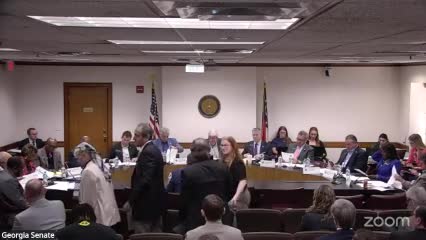
Committee adopts substitute allowing private irrigation wells; Piedmont Water expresses concerns
Summary
Senators approved a committee substitute for House Bill 449 that would allow property owners on certain surface-water systems to drill private wells for irrigation use under specified conditions.
The Senate Regulated Industries and Utilities Committee took up a House-origin bill concerning private surface-water utilities and customer options. Representative Rhodes presented a committee substitute to the House bill that narrows the proposal’s scope to surface-water providers and allows property owners to drill private wells for irrigation on their parcels under defined conditions.
Adam Schaefer, chief executive officer of Piedmont Water Company, opposed the House’s original approach and called the bill “an unnecessary, overreaching attempt to impose regulation on private water providers.” Schaefer said Piedmont Water and one other private company are unique in Georgia for having privately financed surface-water systems and that the company’s recent investments—including a $15 million surface-water treatment plant—were made to keep up with rapid local growth. Schaefer told the committee private investment allowed the company to build regional infrastructure and that imposing new regulation or price controls could force the company to reassess planned projects.
Senators and witnesses discussed specific technical and policy concerns. Committee members asked whether Piedmont’s systems provide required fire flow; Schaefer said roughly half the company’s customers receive fire protection and that the systems are designed using overhead storage tanks and hydraulics modeling to meet county minimums (the transcript references a 500 gallons-per-minute standard in those counties). Schaefer and other witnesses also described tiered conservation pricing, the company’s use of hydrant meters for construction water, and how summer irrigation demand can spike usage fivefold on some systems.
Piedmont and committee members also raised implementation questions about the substitute. Schaefer said wastewater billing and sewer collection complicate a private-well option because sewer charges are typically based on metered domestic water use; he asked how the committee’s substitute would measure or allocate sewage charges if an owner used well water for irrigation but remained tied to the public sewer system. Several senators suggested limiting the permitted private wells to nonpotable or irrigation-only uses and noted health department rules and local permitting would still apply; the chair accepted language to clarify irrigation/nonpotable use as a friendly amendment during the floor of the committee discussion.
Representative Rhodes said the substitute was intended to give property owners an option to drill an irrigation well on their parcel for personal use only and to avoid creating competitors to the private utility by prohibiting transfers or sales of well water. The transcript shows the committee approved the substitute (LC550632S) with an amendment that clarifies the well/irrigation language.
Votes and committee action - Motion to adopt committee substitute LC550632S as amended and report do pass: passed; recorded as passed with one senator recorded in opposition (Senator Gooch). The committee chair said the measure would move forward with the understanding that further refinements could be made on the floor.
Why this matters The substitute aims to balance private utility investments with homeowners’ options for irrigation supply in fast-growing lake and resort communities. Piedmont Water warned that the substitute raises operational complexities—especially for wastewater billing and system planning—and urged county and EPD review for well and septic interactions.
What’s next The committee approved the committee substitute as amended and the chair urged continued consultation between the bill sponsor, utility representatives and county officials to address technical details before the bill advances further.