Get Full Government Meeting Transcripts, Videos, & Alerts Forever!
Get email alerts on the Radiologist Assistant Licensure topic
No spam. Unsubscribe anytime.
Senate committee tables bill to license radiologist assistants amid supervision and timing concerns
Summary
Representative Hawkins presented House Bill 571 to license radiologist assistants, saying licensure would expand Georgia’s radiology workforce and speed access to diagnostic tests.
Representative Hawkins introduced House Bill 571 to create state licensure for radiologist assistants and described the measure as a workforce and access proposal to expand the radiology workforce in Georgia.
The bill would add licensure language to Georgia law (Title 43 was cited during discussion) to authorize the Composite Medical Board to license radiologist assistants, set training requirements and allow the board to define levels of supervision for procedures. Representative Hawkins said the Emerging model would recognize RAs who are currently trained but not licensed in Georgia, and that the regulation would “define the role” so radiologists could use midlevel providers to improve timeliness of diagnostic services.
Becky Ryals, representing the Georgia Radiological Society and the Georgia Society for Radiologic Technologists, told the committee licensing is intended to address workforce and hiring barriers: “There are imaging groups, there are hospitals who would like to hire radiologist assistants, but they're reluctant to do so without licensure.” She said RAs complete training beyond a radiologic technologist—typically two additional years of education and clinical training—and that a licensing path would align RAs with other midlevel providers who are credentialed through a board-approved protocol agreement.
Retired radiologist Bill Harrington and active radiologist Dr. Ali Sheikh testified for the bill but with distinct emphases. Harrington described RAs as an established, national midlevel role that provides a career path for technologists and said CMS has created billing modifiers that treat certain RA services similarly to other midlevel providers. Harrington said hospitals frequently require board-level credentialing or licensure for medical staff privileges and that licensure would ease hospital hiring and privileging of RAs.
Dr. Ali Sheikh, who practices in Houston County, told the committee the current bill language is too restrictive for many rural hospitals because it would require direct (on-site) or personal supervision for some procedures. Sheikh said his practice has relied on RAs under general supervision for many routine but time-sensitive procedures that often arise after hours, and he recommended replacing direct-supervision language with general-supervision language where clinically appropriate. He also asked the committee to push the licensure effective date from July 1, 2025 to January 1, 2026, citing the Composite Medical Board’s existing licensing backlog and the time needed to form advisory groups and issue licenses.
Committee members questioned how quickly the board could form, how many current RAs exist in Georgia, and whether the board should be required (a “shall”) rather than permitted (a “may”) to issue licenses when an applicant meets statutory requirements. Committee discussion repeatedly returned to three points recorded on the transcript: (1) the effective date (July 1, 2025) and whether the board can process applications in time; (2) whether supervision levels in the bill would limit practical use of RAs, especially in rural hospitals that lack on-site radiologists; and (3) whether licensure represents additional regulatory burden or, conversely, a necessary credential to allow hospitals to hire RAs.
Committee members heard technical clarifications during testimony: witnesses said fewer than 100 people in Georgia had completed RA training; CMS in 2023 created billing language that places RAs into the same modifier structure used for physician assistants and nurse practitioners, but witnesses said federal payment policy still needs legislative/administrative follow-up to operationalize payments nationwide. Witnesses also distinguished functions RAs do not perform: they do not make final diagnoses or issue prescriptions and they do not independently interpret imaging studies.
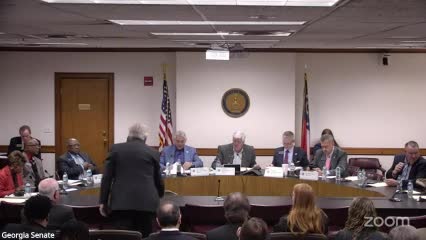
After questions and multiple suggested amendments, a committee member moved to table House Bill 571 to allow further refinement and negotiation. A second was recorded and the motion to table passed; the bill was formally tabled and the chair asked the sponsor to consult with committee members and return suggested language for the committee’s next meeting.
Votes at a glance - Motion to table House Bill 571: passed (tabled). No roll-call tally with named yea/nay votes was recorded in the transcript.
Why this matters Licensing would change how radiology practices and hospitals in Georgia hire and credential midlevel imaging staff. Supporters argued licensure will expand access to timely diagnostic procedures and create a career ladder for radiologic technologists; some rural practitioners warned that restrictive supervision language and a rapid July 1, 2025 effective date could reduce access unless amended.
What’s next Committee members asked the bill sponsor to work with senators and counsel to draft amendments addressing supervision levels and the effective date. The chair indicated the committee aimed to revisit refinements at a subsequent meeting.