Get Full Government Meeting Transcripts, Videos, & Alerts Forever!
Get email alerts on the School Wellbeing topic
No spam. Unsubscribe anytime.
CCHS leaders highlight Challenge Success results: less homework, more sleep, targeted supports for marginalized students
Summary
Co‑principals reported longitudinal Challenge Success survey results at Concord‑Carlisle High School showing reductions in average nightly homework and modest increases in student sleep; the work also identified gender‑nonconforming and other subgroups as an area for focused supports.
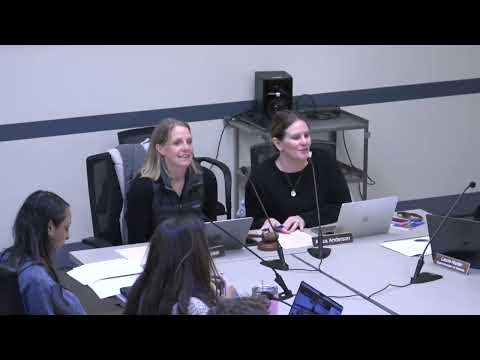
Concord‑Carlisle High School co‑principals Brian Miller and Katie Stahl presented highlights from the school’s Challenge Success survey on March 25, saying the program’s ongoing work is intended to reduce student overload, strengthen adult‑student connections and expand student resilience and belonging.
Miller and Stahl said the school has administered the Challenge Success survey multiple times over nearly a decade and is using longitudinal data to guide changes. They reported the average student‑reported time on homework fell from about 2.8 hours per evening in February 2016 to approximately 2.1 hours in the most recent survey. Average reported nightly sleep increased across waves, from about 6.7 hours in 2016 to about 7.1 hours in the latest administration, the principals said.
The presentation named three priority areas: a well‑balanced schedule, more caring and collaborative school culture, and stronger resilience and coping supports for students. The school highlighted specific initiatives linked to those goals: the FlexBlock schedule to give students work time during the day, “Fun Fridays” and hands‑on learning opportunities, a relationship‑mapping exercise that helped faculty identify students with fewer adult connections, and ongoing student‑led Challenge Success teams.
Miller and Stahl told the committee the survey also flagged disparities: gender non‑binary, gender‑queer and gender‑nonconforming students reported poorer outcomes on several measures and will be a focus of spring work. The school plans to meet with student groups including Spectrum and the Black Student Union and to convene their Challenge Success coach, Pam, for targeted follow‑up.
School leaders emphasized that the survey findings will inform calendar/timing changes (for example, continued limits on major homework over vacations) and encouraged parents to use simple strategies at home (Challenge Success uses an approach summarized as “playtime, downtime and family time”) to support student well‑being.
Quotable
“We were really proud to see ‘fun’ again appear as a top descriptor in 2024,” Katie Stahl said, reflecting the school’s emphasis on student joy and belonging.
What the school will do next
- Continue targeted supports for students identified with weaker adult connections. - Meet with student groups (Spectrum and BSU) to better understand the needs of gender‑diverse and students of color. - Continue to refine the bell schedule and academic workload with faculty input, and to bring parent‑facing guidance on balancing homework and healthy sleep.
The principals said they will return with further data and examples of programmatic adjustments later in the spring.