Get Full Government Meeting Transcripts, Videos, & Alerts Forever!
Get email alerts on the Housing Targets topic
No spam. Unsubscribe anytime.
Kitsap planning staff: county falls about 1,200 housing units short, gap concentrated under 50% area median income
Summary
Long-range planning staff briefed the Kitsap County Planning Commission on new state housing requirements, regional growth targets and a roughly 1,200-unit shortfall in the county’s 20-year housing capacity—primarily for households at 50% of area median income or below.
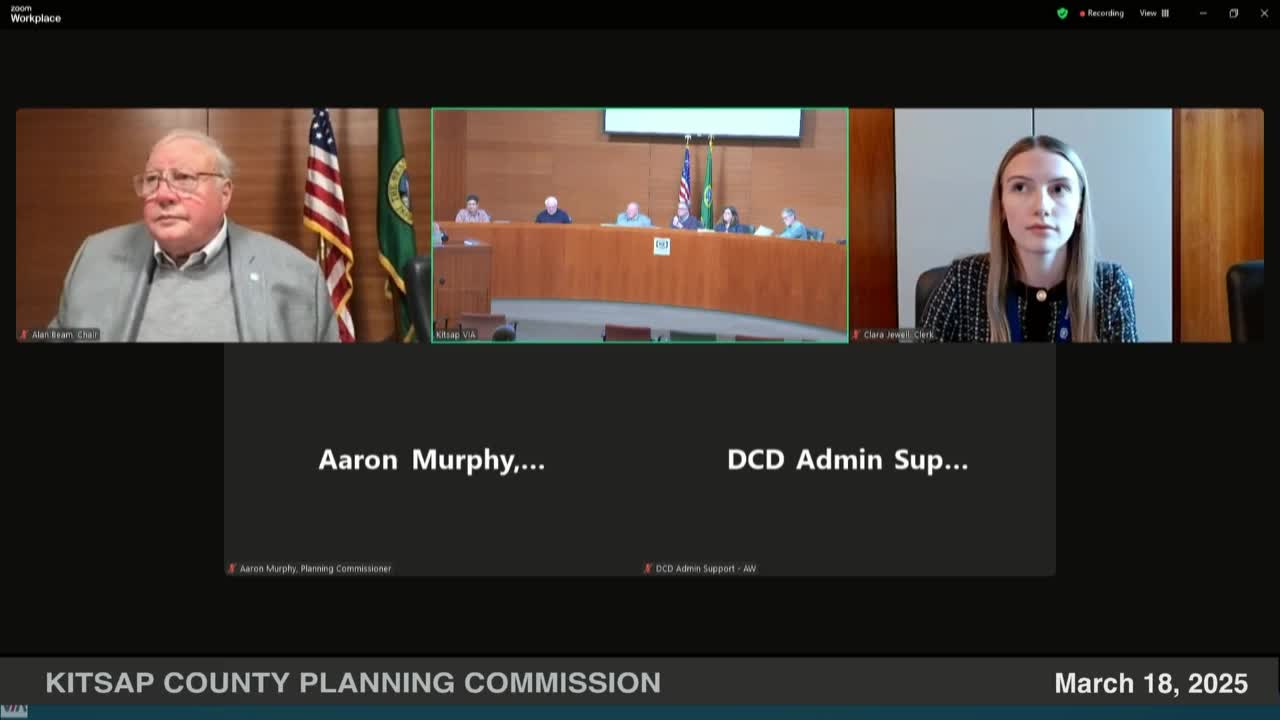
Planning staff told the Kitsap County Planning Commission on March 18 that the county’s comprehensive plan shows a shortfall of roughly 1,200 housing units compared with regional housing targets and that most of that shortage is for households at 50% of area median income and below.
“Part of this bill is about also providing for moderate density options in our urban growth areas,” said Colin Poff, long range planning supervisor, describing requirements in what he called “House Bill 12 20” and changes to Growth Management Act implementation that now require jurisdictions to show how they will provide housing for a range of income levels.
Poff said the state and regional rules and forecasts inform county targets: the Office of Financial Management provides population forecasts, the Puget Sound Regional Council issues Vision 2050 guidance for the region, and the Kitsap Regional Coordinating Council (KRCC) allocates housing targets among jurisdictions. Kitsap’s comprehensive plan uses a 20-year planning horizon and must demonstrate adequate capacity for projected population, employment and housing needs.
Poff summarized the county’s findings: the department’s capacity analysis, prepared as part of the comprehensive plan work, shows a gap of roughly 1,200 units between the county’s preferred alternative and the KRCC housing targets, with the “vast majority” of the shortfall in categories at or below 50% of area median income. He also relayed basic housing stock data from the plan: about 118,000 housing units in Kitsap County as of 2022, roughly 74% of which are detached housing, and an average household size of about 2.23 people.
Why it matters: Poff said the change in state law shifts the county’s role from encouraging affordable housing to documenting and accommodating housing at specified income levels and housing types, including permanent supportive and emergency housing. The county cannot usually build subsidized units itself, he noted, and instead aims to “create the conditions” for more diverse housing production while monitoring progress through annual reporting on building permits and other indicators.
Commissioners and members of the public pressed staff on specifics. Commissioner Aaron Murphy asked for “real world examples” of regulatory cost reductions that would lower the cost per unit and whether the county is doing enough to make it less expensive to develop housing. Poff pointed to the county’s permit review efficiency work and comp-plan-driven updates to bulk and dimensional standards, and said the county is implementing a permit-review efficiency program that responds to recent state permitting timeline legislation (discussed in the presentation as “Senate bill 5,290” and related statutes).
Public commenter “Mr. Palmer” asked staff to address who can afford units at median income, long-term wealth-building through homeownership versus renting, and why expedited permitting will allow Kitsap to meet targets when, he said, evidence shows expedited permitting “cannot be implemented in Kitsap County.” Poff said there is no expedited permitting program currently but the county is implementing a permit review efficiency program and will monitor permitting indicators, including multifamily permits and timeline metrics, and revisit the comp plan at the five-year check-in.
Poff also noted an outstanding appeal of the comprehensive plan that lists housing as an issue; appeals to the Growth Management Hearings Board can take up to 180 days for a compliance/noncompliance determination, he said, and the plan remains in effect while appeals proceed.
The presentation closed with staff reminding commissioners that a series of comp-plan code changes will take effect soon—reducing parking requirements, allowing a broader range of attached housing types and increasing heights and densities in some urban zones—and that monitoring and implementation remain priorities.
Next steps: staff said the county will continue annual monitoring, report building permit and multifamily activity, and use the five-year update to assess whether additional measures are needed if trends do not align with targets.