Get Full Government Meeting Transcripts, Videos, & Alerts Forever!
Get email alerts on the School Budget topic
No spam. Unsubscribe anytime.
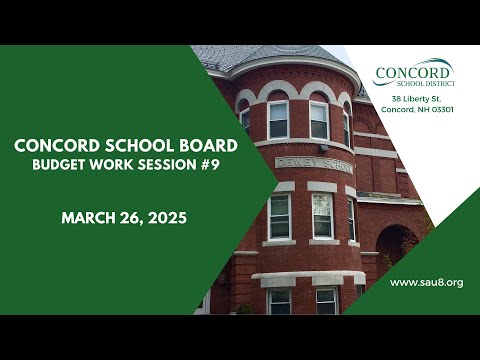
Concord School Board approves $120.97 million preliminary budget; removes middle‑school SRO and delays DEIJ director hire
Summary
At a budget work session, the Concord School Board voted unanimously to approve a preliminary $120,972,153 FY2025–26 budget after making three board-level changes: removing funding for a school resource officer at the middle school, removing funding for a director of DEIJ for the coming year, and adding $150,000 to building maintenance.
The Concord School Board on [date not specified] approved a preliminary fiscal year 2025–26 budget totaling $120,972,153 after three board-level adjustments: removal of funding for a school resource officer (SRO) at the middle school, removal of funding for a director of diversity, equity, inclusion and justice (DEIJ) for the coming year, and an added $150,000 for building maintenance.
The vote to approve the preliminary budget was unanimous. Board members approved a motion that set the all‑funds budget at $120,972,153 and a general fund budget of $111,487,137, with total local taxes of $70,499,760 and state taxes of $7,130,812. The administration was authorized to update the motion language and make technical adjustments tied to ongoing contract negotiations.
Why it matters: the board’s changes reduce near‑term staffing costs and increase building maintenance funding while preserving the district’s ability to submit required materials to the state and to revisit the budget later if needed. District staff warned that state and federal funding streams and ongoing labor negotiations could still change the final tax rate and budget numbers.
Board discussion focused for an extended period on the middle school SRO and whether the district should instead rely on restorative practices and grant‑funded social work positions. Board members heard from the middle school principal and from board members on both sides of the question.
Mister Richards, speaking in support of retaining a dedicated law‑enforcement presence at the middle school, urged the board not to eliminate the role and emphasized two points: that SROs can streamline certain legal filings (such as CHINS petitions) because police reports can strengthen those filings, and that a uniformed officer on campus improves emergency response time. "I can't in good conscience vote to eliminate the position of an SRO," Richards said, adding that the role provides access to services and a safety resource the school cannot otherwise supply.
Board members who voted to remove the SRO cited budget pressure and a belief that social‑work and restorative approaches address many of the issues the SRO would handle. One board member noted the district already runs restorative practices and that a new restorative‑practice or social‑work role could be grant‑funded.
District staff told the board that a restorative‑practice position discussed during the meeting can be fully supported through Project SEARCH grant funds and will not require a local general‑fund allocation if the grant continues to be awarded and reporting requirements are met.
The board also voted to not fund the proposed director of DEIJ position for the coming year, a change described by members as temporary and tied to the district’s engagement with a consultant (Great Schools Partnership) that will refine the job description and scope of work. The board recorded an expected saving of approximately $136,071 by not budgeting that position this year.
On the budget’s tax‑rate impact, district staff member Jack told the board the net of the board’s changes placed the district at roughly a $0.61 tax rate under the assumptions he used for the presentation (he described the figure as "you're at 61¢ or 3.93" while explaining the estimate and noting several variables remain). Staff cautioned that labor negotiations, state aid allocations and federal entitlements could alter the numbers before finalization.
Other budget items discussed included rising student‑services and transportation costs, preschool classroom locations and capacity across elementary sites, and capital needs such as high‑school electrical work and electric bus chargers. Board members reiterated that the district has 20 days to finalize documentation and that there will be an opportunity to revisit the budget in October if required.
Votes at a glance
- Allow remote participation for a board member: motion passed (unanimous). The board authorized one member to participate remotely under the notice rules referenced by staff.
- Remove funding for a school resource officer at the middle school: motion passed (5 yes, 4 no). Roll‑call votes recorded: Richards (yes); Sadowski (yes); Campbell (no); Bushey (no); Robinson (yes); Higgins (no); Meeker (yes); Hastings (no); Walls (yes). Outcome: removed from the preliminary budget.
- Do not fund the director of DEIJ for FY2025–26: motion passed (recorded as approved; vote was taken by voice with no roll call recorded). Board members characterized this as a one‑year delay tied to the consultant study and job‑description work.
- Add $150,000 to building maintenance: approved as part of the board changes incorporated in the final preliminary motion.
- Approve preliminary FY2025–26 budget: motion moved by Miss Robinson, seconded by Miss Higgins; roll‑call vote unanimous in favor; motion carried.
Who said what (selected)
- "I can't in good conscience vote to eliminate the position of an SRO," — Mister Richards (school board member), arguing the SRO can improve access to services and emergency response.
- "You're at 61¢ or 3.93," — Jack (staff member), summarizing the tax‑rate estimate after the board's net changes and caveating that figures may shift with negotiations and state/federal actions.
What remains open
District staff and board members said ongoing labor negotiations and final state/federal grant notices could change the figures before the tax rate is set. The board also noted it can reexamine the budget in October if new information warrants changes, and that work on MOUs with the Concord Police Department (if the district pursues shared funding models) would be a separate negotiation.
Ending note: Board members said they want to preserve the option to revisit the DEIJ director position after the consultant (Great Schools Partnership) completes its work and to monitor Project SEARCH reporting requirements tied to the restorative‑practice position.