Get Full Government Meeting Transcripts, Videos, & Alerts Forever!
Get email alerts on the Transportation Planning topic
No spam. Unsubscribe anytime.
Midland‑Odessa MPO presents $3.5 billion, 25‑year transportation plan and near‑term projects
Summary
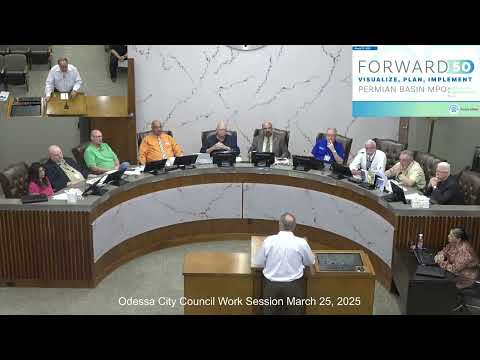
Kevin Walker, an MPO representative, told the Odessa City Council at its March 21 work session that the Midland‑Odessa Metropolitan Planning Organization adopted a new long‑range plan in November and is working to place priority projects into TxDOT’s near‑term program.
Kevin Walker, an MPO representative, told the Odessa City Council at its March 21 work session that the Midland‑Odessa Metropolitan Planning Organization adopted a new long‑range plan in November and is working to place priority projects into TxDOT’s near‑term program.
“The plan is a 3 and a half billion dollar plan over a 25 year period,” Walker said, describing the document the MPO submitted to the U.S. Department of Transportation and the Texas Department of Transportation (TxDOT).
Walker said MPO funding comes from federal gasoline and highway formula funds that the state distributes, and that the MPO prepares a fiscally constrained plan showing how that funding could be spent over 25 years. He said the MPO receives roughly $90 million a year in the region now and used that figure — adjusted with an assumed growth rate — to justify the 25‑year total in the plan.
Why it matters: projects must be programmed through TxDOT into two windows for construction priority — a 10‑year Unified Transportation Program and a narrower four‑year Transportation Improvement Program (TIP). A TIP listing generally signals a project is funded, environmentally cleared and ready for bidding, Walker said.
Near‑term projects Walker highlighted include a roughly $35 million new interchange where US 385 meets Loop 338 scheduled for fiscal 2026, upgrades to Loop 338 (including converting portions to freeway standard), widening FM 866 to four lanes in the county, and safety and alignment work on sections described as 40 Second Street. He said parts of Loop 338 alone represent nearly $1 billion of the MPO’s plan.
Walker also described two “direct‑connect” or flyover projects at the western and eastern ends of State Highway 191 to reduce commuter congestion, and said TxDOT has been directing strategic priority funding to the Permian Basin region over the past several years.
How projects move faster: Walker and other speakers described local contributions as a commonly used lever to accelerate schedules. He said the Odessa and Midland economic development corporations each contributed $15 million to a local fund used to expedite certain projects and short‑term improvements such as signals and minor intersection work. “By contributing the money from a non‑federal source, the game changes,” Walker said.
Council members asked for timing details on specific projects. Walker said the southern US 385/Loop 338 interchange is on the TIP for fiscal 2026 and that some other projects (for example, 40 Second Street) are outside the current four‑year window and likely to advance after 2029. He cautioned that largescale interstate upgrades (I‑14 and I‑27 corridors referenced in the presentation) are beyond the 10‑year window and contingent on additional funding and statewide programming decisions.
Ending: Walker encouraged continued coordination between Odessa, the MPO and TxDOT and emphasized that programming into TxDOT’s windows — and, when possible, adding non‑federal local contributions — is the practical route to speed construction.