Get Full Government Meeting Transcripts, Videos, & Alerts Forever!
Get email alerts on the Right To Repair topic
No spam. Unsubscribe anytime.
Right‑to‑repair bill receives broad support at Senate hearing after House passage
Summary
Engrossed Substitute House Bill 1483 would require original manufacturers to make parts, tools and documentation available to independent repair providers and owners for many digital electronic products beginning Jan. 1, 2026; the bill includes multiple exemptions and enforcement through the Consumer Protection Act.
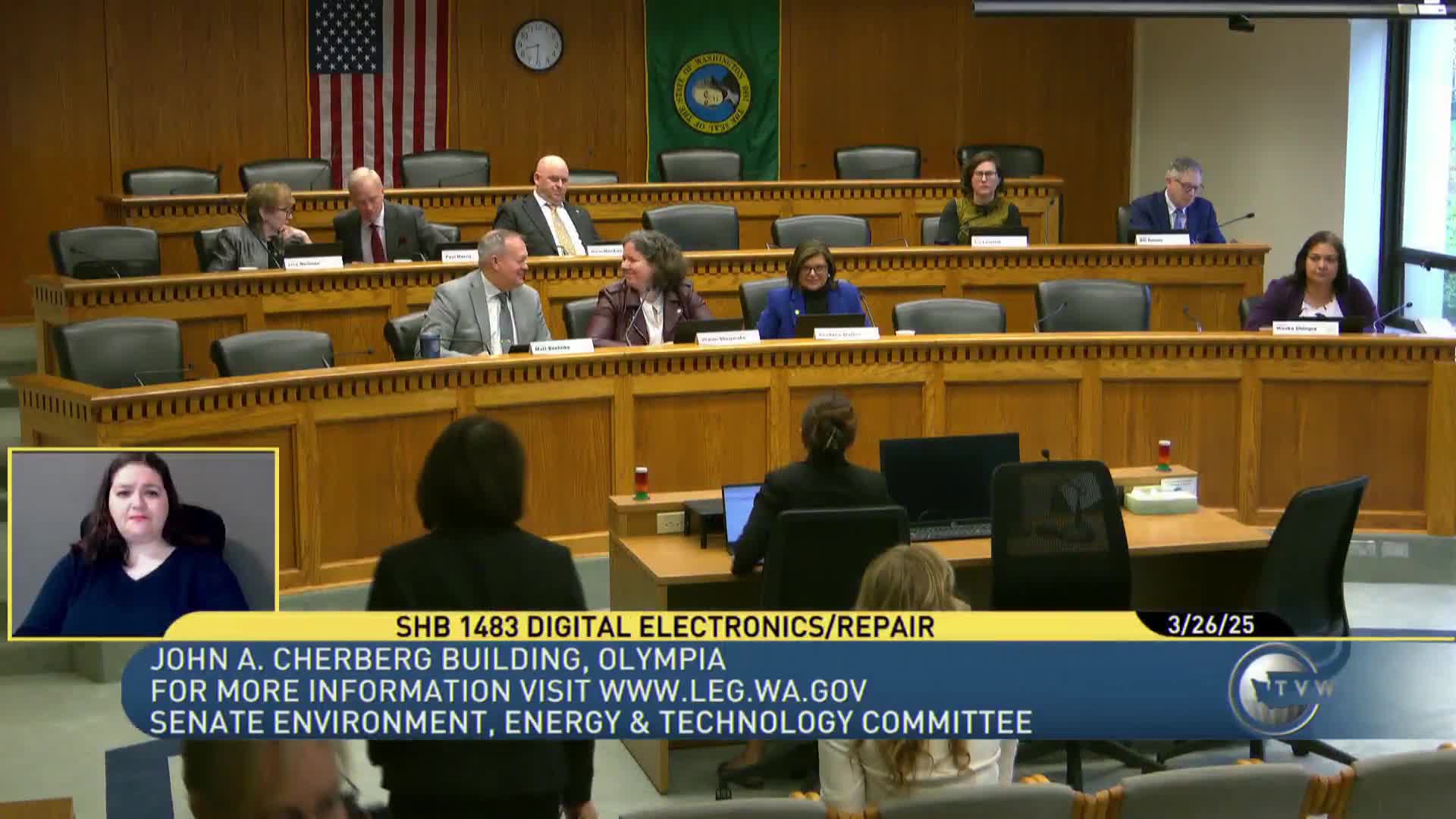
The Senate Environment, Energy & Technology Committee heard testimony on Engrossed Substitute House Bill 1483, the proposed Right to Repair Act for digital electronic products.
Alicia Kinney Clauson, committee staff, summarized the bill’s core provisions: beginning Jan. 1, 2026, an original manufacturer must make parts, tools and documentation available on fair and reasonable terms for diagnosis, maintenance and repair of covered digital electronic products first manufactured or first sold or used in Washington. The staff briefing described limits on parts pairing that prevent replacement part installation and noted exemptions for motor vehicles, agricultural equipment, power and solar equipment and certain life‑safety devices. Enforcement is provided through the state Attorney General under the Consumer Protection Act; the attorney general’s fiscal estimate for 2025–27 was quoted in the briefing.
Sponsor Rep. Mia Gregerson said the measure is ‘‘targeted legislation’’ focusing on electronics and emphasized negotiated amendments that removed medical devices and certain safety systems from the bill’s scope. ‘‘We all own our devices. We struggle to keep them in working order,’’ Gregerson said, arguing the bill advances fairness and accessibility for consumers and small repair businesses.
Multiple consumer‑advocacy and repair‑industry witnesses testified in support. Heather Trim of 0 Waste Washington urged passage as a circular‑economy and climate measure. Charlie Fisher of Washington PIRG cited polling showing broad public support and estimated large household savings if repairs replace new purchases. Sean Sullivan of Google said the company ‘‘strongly supports HB 1483’’ and praised the bill as an inclusive compromise. Small repair‑shop owners testified that access to schematics and parts keeps repairs economically viable and helps consumers make informed decisions about purchases.
Industry witnesses that manufacture electronics endorsed the bill with suggested technical amendments; Lenovo requested alignment of timing and documentation requirements with recently passed laws in other states. Medical‑device manufacturers thanked the sponsor for the bill’s exemption for FDA‑regulated devices and said they are working on clarifying language.
The hearing record shows large numbers of registered supporters who did not testify in person; the committee suspended the public hearing after testimony. No formal committee vote is recorded in the transcript.