Get Full Government Meeting Transcripts, Videos, & Alerts Forever!
Get email alerts on the Clean Buildings Costs topic
No spam. Unsubscribe anytime.
Bill would direct JLARC to report on state agency costs to comply with clean buildings performance standard
Summary
House Bill 1715 would require the Joint Legislative Audit & Review Committee to sample state‑owned covered buildings and report by June 30, 2027 on capital and operating costs to meet the state's clean buildings performance standard; sponsors said the work is needed to plan capital budgets.
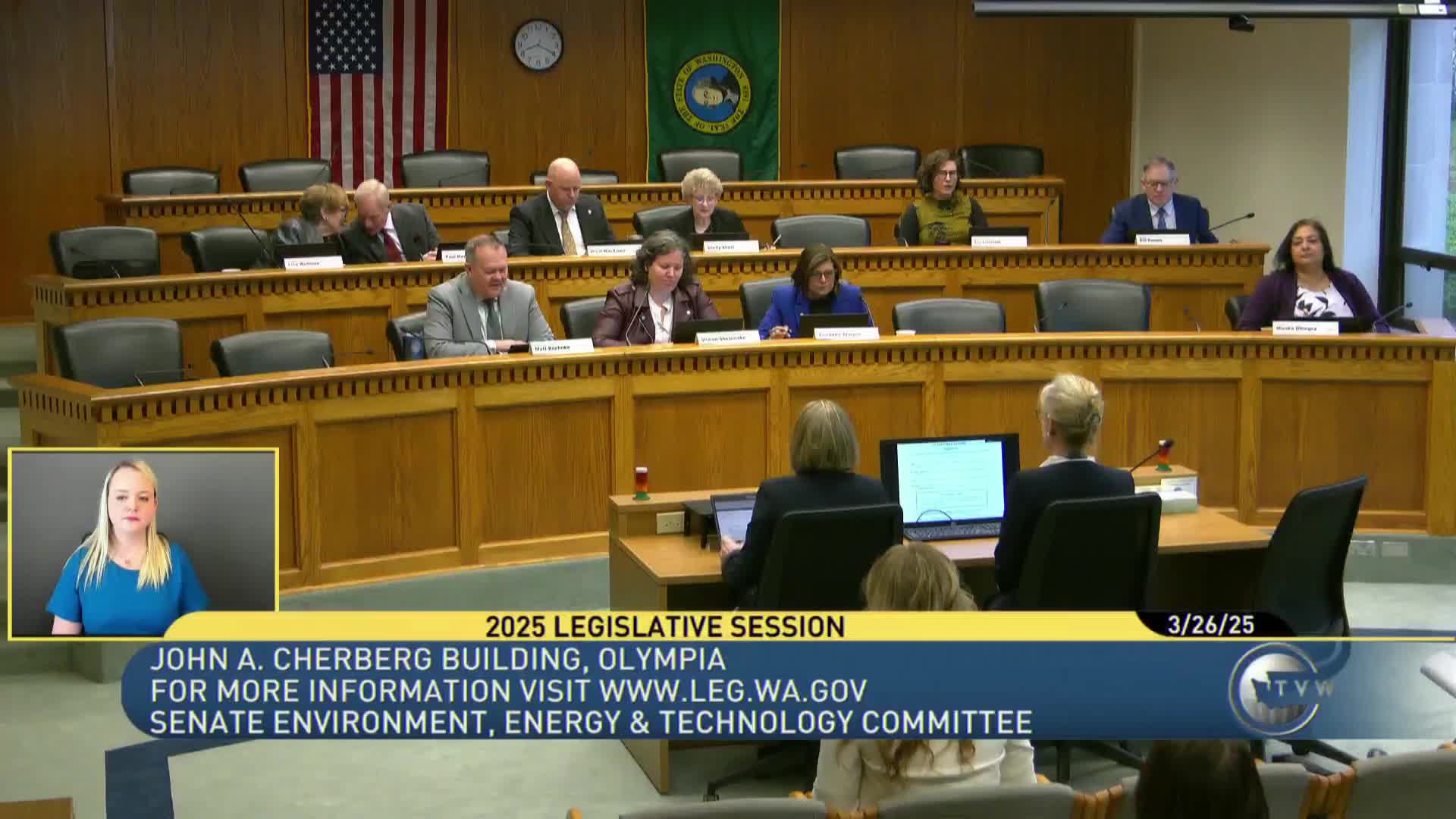
Committee staff briefed the Senate Environment, Energy & Technology Committee on Second Substitute House Bill 1715, which would direct the Joint Legislative Audit & Review Committee (JLARC) to report on the costs for state agencies to comply with Washington’s state energy performance (clean buildings) standard.
Kim Cushing, staff to the committee, said the bill requires JLARC to select a sample of covered state buildings, determine building‑type categories (office, higher education, K‑12, correctional facilities), compile state expenditures for compliance by fiscal year, estimate energy savings and jobs created from capital upgrades, and identify potential funding sources. The report would be due to the legislature by June 30, 2027.
Rep. Deb Dye, speaking for sponsor Rep. Mary Dye, said the state needs ‘‘hard numbers’’ to prepare capital budgets and noted the first compliance dates begin in 2026 for the largest buildings. Dye described examples of recent audit and compliance cost requests from higher education institutions and said the state should plan for sizable capital asks in future capital budgets.
Representatives of Washington State University told the committee WSU owns millions of square feet of building space and would benefit from an independent cost estimate; Connor Hagerty of WSU said the university has done ‘‘back‑of‑the‑napkin’’ estimates but welcomes a neutral JLARC assessment. The public hearing record includes questions from senators about lifecycle emissions, demolition vs. retrofit choices, and whether universities could perform parts of the work internally.
No committee vote or final action is recorded in the hearing transcript; staff closed the public testimony with a large number of registered parties who did not testify noted in the record.