Get Full Government Meeting Transcripts, Videos, & Alerts Forever!
Get email alerts on the Federal Funding Impacts topic
No spam. Unsubscribe anytime.
OSPI, ESD leaders warn federal moves could disrupt school funding and services
Summary
OSPI and ESD officials told the committee that proposed federal executive actions and letters could produce funding and technical‑support interruptions that would ripple through school budgets, meals, special education and Head Start. Officials urged districts to follow state law and plan for multiple scenarios.
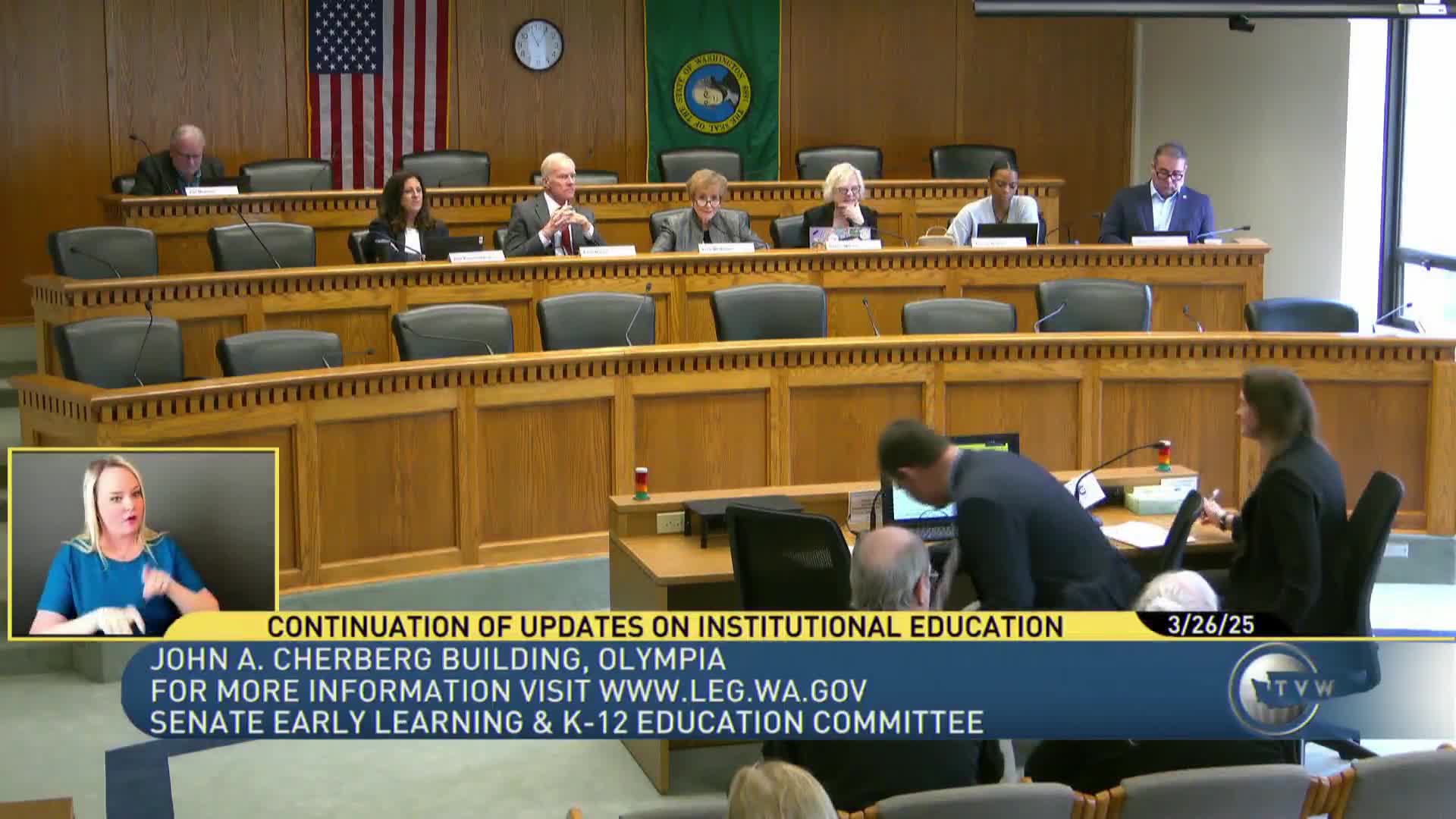
TJ Kelly, chief financial officer at the Office of Superintendent of Public Instruction, and Susan Lathrop, OSPI Assistant Superintendent for Educator Growth and Development, briefed the Early Learning & K–12 Education Committee on possible effects of recent federal executive orders, "dear colleague" letters and other federal actions on Washington public schools.
Kelly told the committee that for the 2023–24 school year total federal revenue to Washington school districts was about $1.9 billion, but that figure included remaining COVID relief funds. Excluding that tail, federal revenue was roughly $1.4 billion—about 7 percent of total school district revenue for 2023–24. Major federal program totals cited in the presentation included the National School Lunch Program ($361 million), Title I ($310 million), special education grants ($275 million) and impact aid ($120 million).
Why it matters: Federal funds support staff and services in small and rural districts and pay for school meals, special education, Title I services and other programs. OSPI and ESD witnesses said interruptions to federal administrative capacity—particularly the grants claim system known as G5—or mid‑year changes to grant conditions could create cash‑flow problems and force local districts to make immediate program and staffing decisions.
What OSPI and ESDs said
- Federal guidance vs. law: Lathrop emphasized that executive orders do not, by themselves, change federal statute. "When in doubt, follow state law," she said, explaining that OSPI is advising districts to continue following state law and existing federal statutes unless the law itself changes.
- Grants and cash flow: Kelly explained that federal grants are reimbursed to districts after they spend money and submit claims through the G5 system; if federal administrative capacity is disrupted or the department stops processing reimbursements, districts could face mid‑year funding gaps and still be contractually obligated to staff and program costs.
- Potential program changes: OSPI identified possible impacts including funding reductions, altered grant requirements, diminished federal civil‑rights technical support, and the risk that block‑granting or altered rules for programs such as the Community Eligibility Program for school meals could change state obligations.
- Geographic and program exposure: Kelly and OSPI staff said federal funding is concentrated in some rural and tribal districts; a federal funding "heat map" presented to the committee showed higher federal revenue shares in parts of Northeast and South Central Washington and along the coast. Kelly said that Title I and special education staff supported with federal dollars represent a material fraction of positions districts currently fund with those grants.
ESD perspective and local examples
Shane Backlund, superintendent of Education Service District 105 (Yakima region), told the committee that ESD 105’s budget depends heavily on federal grants. Backlund said aggregate federal programs account for about 24 percent of funding across all nine ESDs and that, in ESD 105 specifically, federal funding represents approximately 47.17 percent of the ESD’s budget (roughly $29 million), with direct federal grants accounting for about $23.9 million (approximately 37 percent of that ESD’s budget). He listed Head Start, Early Head Start, mental‑health grants, Full Service Community Schools and other federal projects that would be at risk if federal grants were curtailed or delayed.
- Head Start and reapplications: Backlund said Head Start reapplications are pending and that ESD 105’s staff rely on program officers at federal agencies; program officers’ uncertain employment status is causing stress and complicates planning.
Questions from lawmakers
Senators on the committee sought clarification about who controls federal disbursements and what would happen if the federal grants claim system (G5) were disrupted. Kelly said the federal award and the G5 claim system are administered by the U.S. Department of Education and that in prior weeks some states had reported temporary lapses in access to G5. If reimbursements stopped, local districts, not the state, would face mid‑year reductions in available federal funding and would have to consider how to meet contractual obligations for staff and services.
Senator Susan Cortez said she expects "massive, massive cuts" and urged the committee to prepare; Senator Harris asked whether any scenario could result in more federal funding but OSPI said the present outlook is uncertain and the agency is planning for risk rather than assuming increased funding.
OSPI guidance and next steps
OSPI told districts to adhere to state law and existing statutes, to review their budgets and grant dependencies, and to plan for possible mid‑year funding reductions. Kelly said OSPI is analyzing district data, tracking federal program changes, and preparing guidance for districts and the Legislature about possible scenarios. ESDs asked the Legislature to consider state‑level backstops for early learning and mental‑health services should federal funding decline, and urged the committee to work with ESDs and OSPI on sustainable funding models.