Get Full Government Meeting Transcripts, Videos, & Alerts Forever!
Get email alerts on the Asbestos Aggregates topic
No spam. Unsubscribe anytime.
Senate committee hears bill to exempt low‑asbestos commercial aggregates from some labeling and inspection rules
Summary
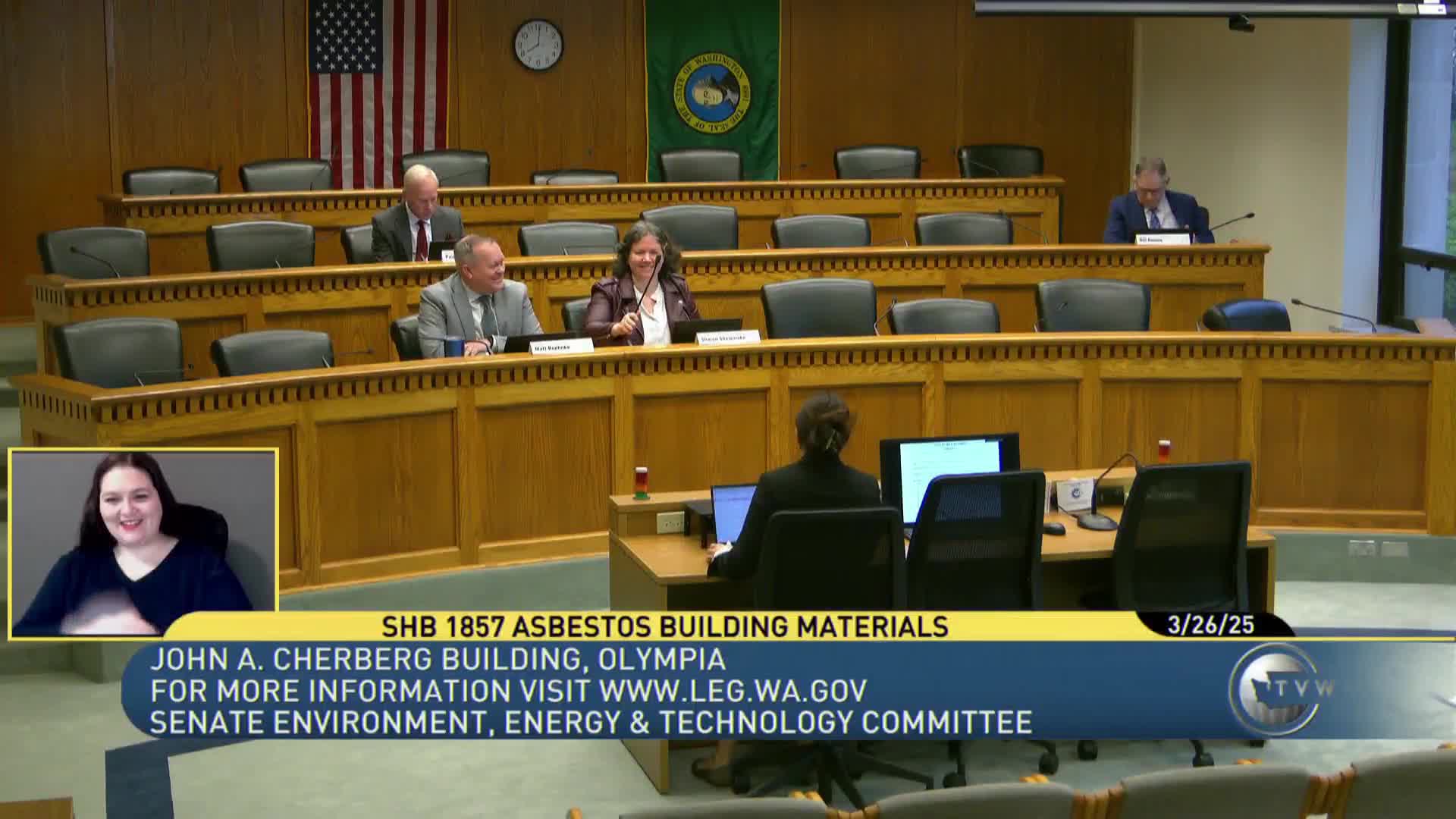
At a public hearing of the Senate Environment, Energy & Technology Committee, staff summarized Substitute House Bill 1857, which would exempt commercial aggregates containing naturally occurring asbestos at 0.25% or less from certain labeling and inspection requirements.
At a public hearing of the Senate Environment, Energy & Technology Committee, staff summarized Substitute House Bill 1857, which would exempt commercial aggregates containing naturally occurring asbestos at 0.25% or less from particular labeling requirements and some inspection and asbestos‑management obligations.
Alicia Kinney Clauson, staff to the committee, told members the bill ‘‘establishes exemptions related to the use of commercial aggregates in building materials and certain asbestos inspection requirements’’ and noted the Department of Labor & Industries and the Department of Ecology currently regulate asbestos in different contexts. She said a fiscal note is available and that the bill “has no fiscal impact.”
Rep. John Lee, prime sponsor, said the measure is intended to allow locally sourced rock to be used in construction without triggering what he described as ‘‘onerous’’ requirements that have forced some producers to import cleaner aggregate from far away. ‘‘This bill's about rocks — it's about aggregates,’’ Lee said, adding that allowing a very small naturally occurring asbestos content would reduce hauling costs and ease construction affordability pressures.
Supporters from industry and labor said the exemption clarifies existing confusion and avoids added costs. Michael Transt, representing the Aggregates & Concrete Association, said asbestos appears naturally in some Washington rock and that worker protections already exist under OSHA and mining safety rules. Ray Dumas of Operative Plasterers and Cement Masons Local 528 said a modest increase to 0.25% ‘‘would help alleviate disruptions or potential unintended cost drivers to building materials like concrete.’’ Heather Tran of 0 Waste Washington said the bill’s 0.25% standard was acceptable but requested identical language be carried through every relevant section of the bill.
No formal vote or committee action was recorded in the hearing; the transcript shows a public hearing was held and then suspended for subsequent business.
Proponents and staff repeatedly emphasized the bill addresses ‘‘naturally occurring’’ asbestos in aggregates and does not authorize adding asbestos to manufactured products. Committee staff noted statutory roles for the Department of Labor & Industries and the Department of Ecology in related regulation.
The discussion included requests for a technical clean‑up to ensure identical thresholds appear in all affected sections of the bill and assurances that existing workplace safety rules remain applicable.