Get Full Government Meeting Transcripts, Videos, & Alerts Forever!
Get email alerts on the Housing Votes Roundup topic
No spam. Unsubscribe anytime.
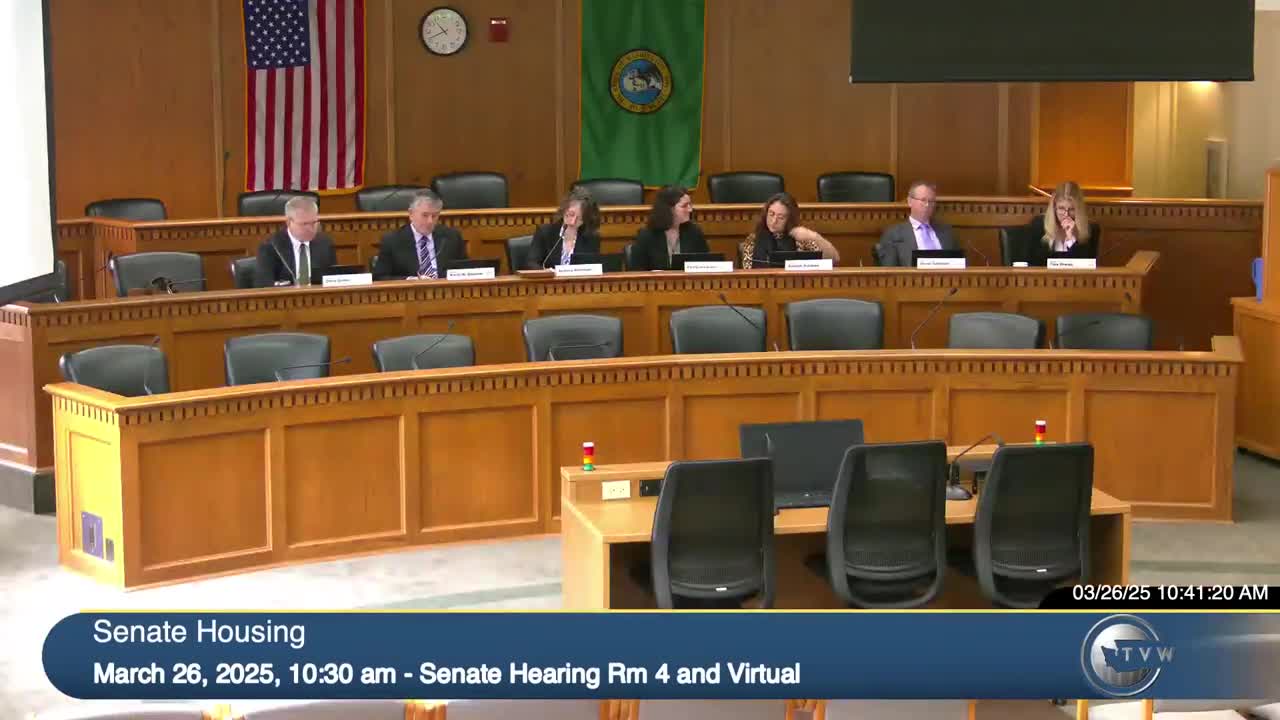
Senate Housing Committee advances several housing bills to committees in single session
Summary
On March 26 the committee moved multiple housing bills forward with limited debate: measures on manufactured-home sales by nonprofits, condominium statute changes, a housing cost-driver study, and administrative lot-splitting were recommended for further action or rules placement.
The Senate Housing Committee considered several additional housing bills on March 26 and moved each forward with either a due-pass recommendation or referral to the rules committee. Staff briefings were provided and the committee recorded votes; transcripts show voice-vote outcomes but do not list numeric tallies for the committee.
Key actions at a glance:
- House Bill 17 60 (manufactured-home sales by nonprofits, community land trusts, resident cooperatives and public housing authorities): Staff described the bill as allowing certain entities to sell up to 12 manufactured homes at cost to low-income households in a 12-month period without being subject to vehicle-dealer licensing and fees. Committee gave the bill a due-pass recommendation to the Rules Committee.
- Engrossed House Bill 14 03 (condominium statutes): Staff summarized changes to implied warranties of quality under the Washington Uniform Common Interest Ownership Act (WUCIOA) and clarified building enclosure and inspection requirements, including exclusions for small condominium buildings and replacements of implied warranties with express warranties and insurance in some cases. The committee adopted a striking amendment (D) with technical changes and recommended the bill for further action.
- Engrossed Second Substitute House Bill 11 08 (task force / cost-driver analysis for housing): The committee adopted a striking amendment (E) that directs the Washington State Institute for Public Policy (WSIPP) to conduct a study and convene a task-force-style stakeholder fact-finding process to identify primary cost drivers for homeownership and rental housing; the committee recommended the bill to Rules. Staff noted the amendment specifies inclusion of accessory dwelling units, middle housing, and co-living spaces in the analysis.
- Engrossed Second Substitute House Bill 10 96 (administrative lot splits to increase housing options): Staff summarized that the bill requires cities subject to middle-housing minimum residential density rules to establish an administrative lot-split review process that may be combined with concurrent residential building-permit review; the committee recommended the bill to Rules.
Votes and procedural notes: For each item above, the committee recorded adoption or rejection of specific amendments in voice votes and then moved the bills to the next committee or to Rules. The transcript records that these bills “passed subject to signatures” or “received a due pass recommendation” where applicable; no numeric committee roll-call tallies were provided in the public transcript.
What to watch next: Each bill will proceed through the legislative process—some to the Rules Committee for floor scheduling, others to Ways and Means if fiscal issues arise. Staff-cited fiscal notes are available in the committee’s electronic bill binder for bills that reported fiscal impacts.