Get Full Government Meeting Transcripts, Videos, & Alerts Forever!
Get email alerts on the Housing Transit Oriented Development topic
No spam. Unsubscribe anytime.
Senate committee advances transit-oriented housing bill after amendment debate
Summary
The committee recommended due pass for substitute House Bill 1491, which sets transit-oriented development requirements, creates a 20-year multifamily tax exemption tied to affordability, and tasks Commerce with technical assistance; one proposed amendment to allow local affordability adjustments failed.
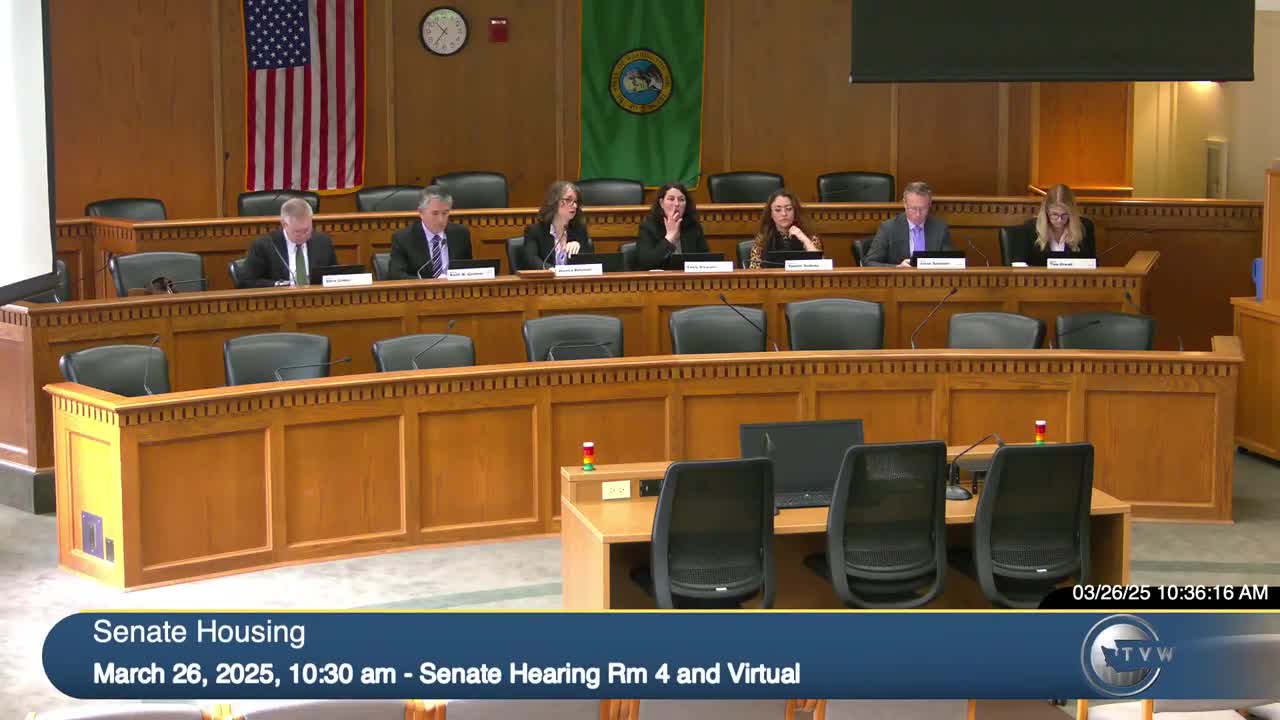
Second Substitute House Bill 1491, a package aimed at promoting transit-oriented housing and a 20-year multifamily tax exemption (MFTE) in station areas, received a due-pass recommendation from the Senate Housing Committee on March 26.
Melissa Van Gorka, staff to the committee, summarized the bill and described the primary elements: local jurisdictions planning under the Growth Management Act would be required to allow residential and mixed-use development at specified densities within station areas; the bill would establish a 20-year MFTE program for qualifying multifamily housing within station areas that meet transit-oriented development (TOD) affordability rules; and the Department of Commerce would develop a model TOD ordinance and administer grant programs to help cities with infrastructure, planning, and staffing.
Why it matters: Supporters said the bill encourages denser housing near transit and includes affordability guardrails intended to produce family-sized and workforce units. Opponents and some committee members raised questions about local flexibility and the timeline and mechanics for measuring affordability in markets where development has not yet occurred.
Amendments and debate: The striking amendment labeled B, offered by Senator Bateman, included several key changes summarized by staff: it updated the definition of a major transit stop to exclude stops that solely serve express bus service; it required cities to allow greater building height and density for projects built with mass timber; it added an additional affordability tier allowing 10% of units to qualify as workforce housing if family-sized units are included; it required a covenant or deed restriction for the MFTE tied to TOD affordability rules; and it reduced certain impact fees by 50% for qualifying projects.
Senator Gildan offered an amendment to the striking amendment (B.1) to allow cities to apply for higher median-income thresholds for affordability beginning in 2027 if no buildings had been constructed in a station area; she said the change would let cities adjust affordability targets when strict standards would preclude development. Senator Gildan described the amendment as a tool so “the affordability levels ratchet to a level where it meets the potential for construction.” Several members expressed concern that the 2027 timeline was too soon and that the evaluation framework was not ready; the committee rejected the B.1 amendment in a voice vote.
Outcome and next steps: The committee adopted striking amendment B and gave the bill a due-pass recommendation to Ways and Means. The transcript records the committee decision as “the bill has passed subject to signatures”; no roll-call tally was provided in the transcript.
Details from staff summary: Van Gorka said a fiscal note estimates a $1,356,000 operating impact this biennium and $602,000 in the 2027–29 biennium to administer Commerce activities, plus potential capital budget impacts if the grant program is funded; local governments estimated roughly $968,000 in impacts and the MFTE program’s fiscal effect was described as indeterminate.
Ending note: Committee members expressed broad support for increasing development near transit while preserving local oversight. The failing of B.1 shows the committee was cautious about adding mechanisms that allow higher affordability thresholds without additional evaluation and time for analysis.