Get Full Government Meeting Transcripts, Videos, & Alerts Forever!
Get email alerts on the Budget Referendum topic
No spam. Unsubscribe anytime.
Board reviews referendum scenarios: $9M baseline, step‑up option, and debate over adding $4M security project
Summary
At a Dec. 2 workshop the district finance team and R.W. Baird presented three nonrecurring referendum scenarios and their modelled tax impacts, and board members debated including a $4 million security project in the ask.
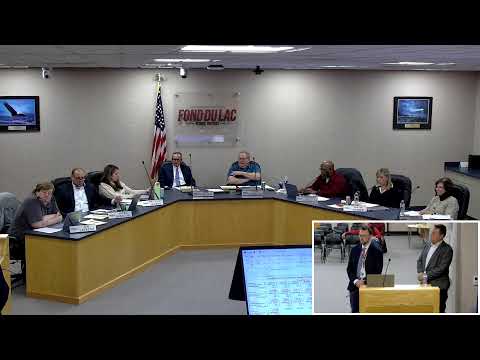
The Board of Education convened a workshop on Dec. 2 to follow up on referendum planning. District finance staff and R.W. Baird financial adviser Todd Hajewski presented three modeled, nonrecurring referendum scenarios and discussed projected tax impacts and assumptions.
What was presented: Mike Gerlach (district administration) and Todd Hajewski (R.W. Baird) summarized three scenarios built from a forecast model: (1) a baseline nonrecurring request of $9,000,000 per year for four years (total $36,000,000); (2) a step‑up nonrecurring plan beginning at $9,000,000 and increasing by $1,000,000 each year (total $42,000,000) to provide greater fiscal stability; and (3) a variant that adds a $4,000,000 security and maintenance project (presented as $2,000,000 in each of the first two years) on top of the $9,000,000 baseline.
Tax impact and assumptions: the presenters used a model that factors property value changes, state equalization aid estimates and typical expenditure pressures (inflation, wages, benefits). The baseline scenario produced an estimated average mill‑rate increase of about $0.50 per $1,000 of assessed value (roughly $50 per $100,000 of home value) under the model’s assumptions. The scenario that included the security project was modeled at roughly $0.66 per $1,000 (about $66 per $100,000) in average impact under the same assumptions.
Why it matters: the board must decide what to ask voters to authorize and whether to include a capital security project in the question. Presenters and board members discussed how the district’s positive state equalization aid status changes how additional levy authority translates to tax impact: because the district is aided, some portion of increased spending is offset by greater state aid under current formula assumptions, which moderates projected local tax increases.
Board discussion: members asked for a concise one‑page comparison of scenarios and clearer taxpayer impacts (for example, dollar amounts per $100,000 of home value). Board members also asked administration to model variants (flat versus step‑up amounts and whether to include the security project). Several board members emphasized the need to be transparent to voters about whether referendum proceeds would be used for ongoing operations, to avoid ambiguity in public communications. No vote or binding decision was taken; the board requested updated scenario materials ahead of further workshops and a decision before statutory deadlines for a possible spring or November referendum.
Next steps: staff will return with simplified comparison tables, clarify the assumptions behind state aid and valuation projections, and (if directed) model a variant that combines the step‑up approach with the security project. The board discussed timing and will continue workshops to finalize the question and plans to inform voters.