Get Full Government Meeting Transcripts, Videos, & Alerts Forever!
Get email alerts on the Weapons Parks 5098 topic
No spam. Unsubscribe anytime.
Committee reports weapons‑in‑public‑places measure after marathon amendments; final vote 8‑5
Summary
Engrossed second substitute Senate Bill 5098, which would restrict weapons in certain public buildings, parks, county fairs and similar places where children are likely to be present, was reported out of committee 8‑5 after more than a dozen amendments were proposed and several clarified scope and exceptions.
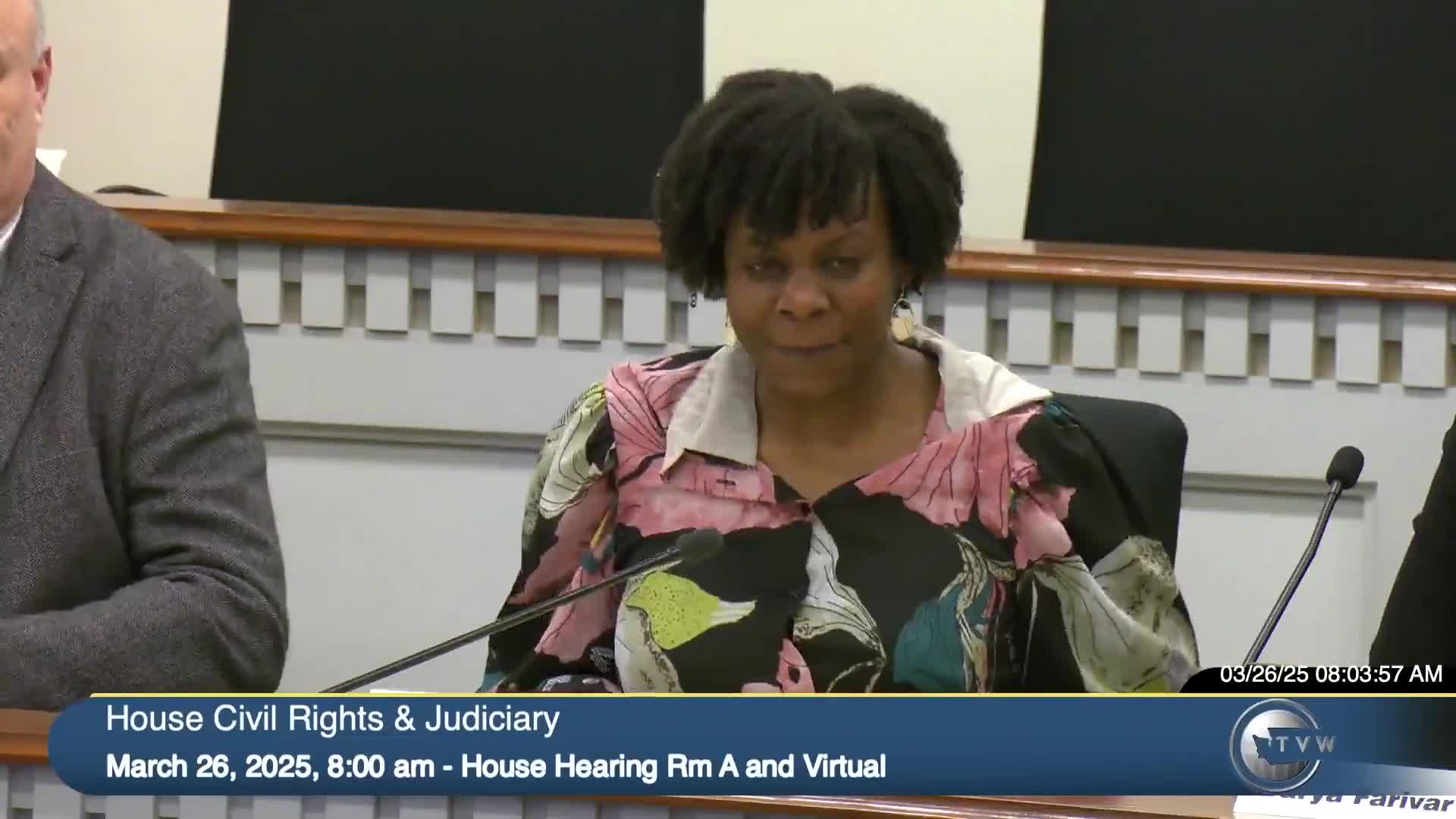
After an extended amendment stage and floor‑style debate, the Civil Rights & Judiciary Committee on March 26 reported Engrossed Second Substitute Senate Bill 5098 out of committee with a due‑pass as amended recommendation on an 8‑5 vote.
Staff summarized the bill and a long list of amendments at the start of the hearing, noting the striking amendment included 18 individual amendment drafts that would add, remove or narrow restrictions and carve out exceptions. The underlying proposal would restrict the possession of weapons on the premises of state or local public buildings, parks or playgrounds where children are likely to be present, and county fair facilities. Among the amendments discussed and rejected or modified were changes removing neighborhood/community/regional qualifiers, carving out swim beaches and performing arts centers, excluding county fairs or excluding firing ranges, adding exceptions for low‑violent‑crime or frontier counties, establishing affirmative defenses when required signage is not posted, modifying penalties so a first violation would be a warning, and removing firearms or knives from the bill's definition of weapon.
Representative Walsh moved several clarifying amendments; Representative Jacobson and others spoke to signage, local burdens and existing gun‑safety training programs. Representative Walsh successfully moved an amendment—BRRRR246—that carved out firing ranges certified by the Washington State Patrol for firearm safety training and live‑fire exercises; that amendment was adopted. The committee also adopted BRRRR247 (addressing hunting and designated federal Pittman‑Robertson funded lands) and other technical changes during the amendment process. Several other amendments were offered and not adopted.
The final roll call recorded these votes: Taylor (aye); Farvar (aye); Walsh (nay, do not pass); Abel (nay, do not pass); Burnett (nay, do not pass); Entenmann (aye); Goodman (aye); Graham (nay, do not pass); Jacobson (nay, do not pass); Peterson (aye); Salahuddin (aye); Tai (aye); Wallen (aye). The announced tally was 8 ayes and 5 nays.
Committee supporters said the bill narrows where weapons are permitted to enhance safety in locations where children are likely to be present and noted exemptions for certified trainers and concealed‑pistol‑license (CPL) holders were included in the draft. Opponents — including several representatives from rural districts — said the bill was a one‑size‑fits‑all approach that would unduly burden rural counties, county fairgrounds and lawful gun‑owners and argued enforcement, signage and funding implications needed more work. The committee adopted a series of carve‑outs and technical edits before reporting the bill out.