Get Full Government Meeting Transcripts, Videos, & Alerts Forever!
Get email alerts on the Wa Cares Trust topic
No spam. Unsubscribe anytime.
Committee hears industry and agency support for changes to WA Cares trust program
Summary
House committee heard testimony on engrossed Substitute Senate Bill 5291, which makes multiple changes to the Long-Term Services and Supports Trust (WA Cares) including adjustments to vesting, benefit indexing, enforcement, and a statutory framework for private supplemental policies.
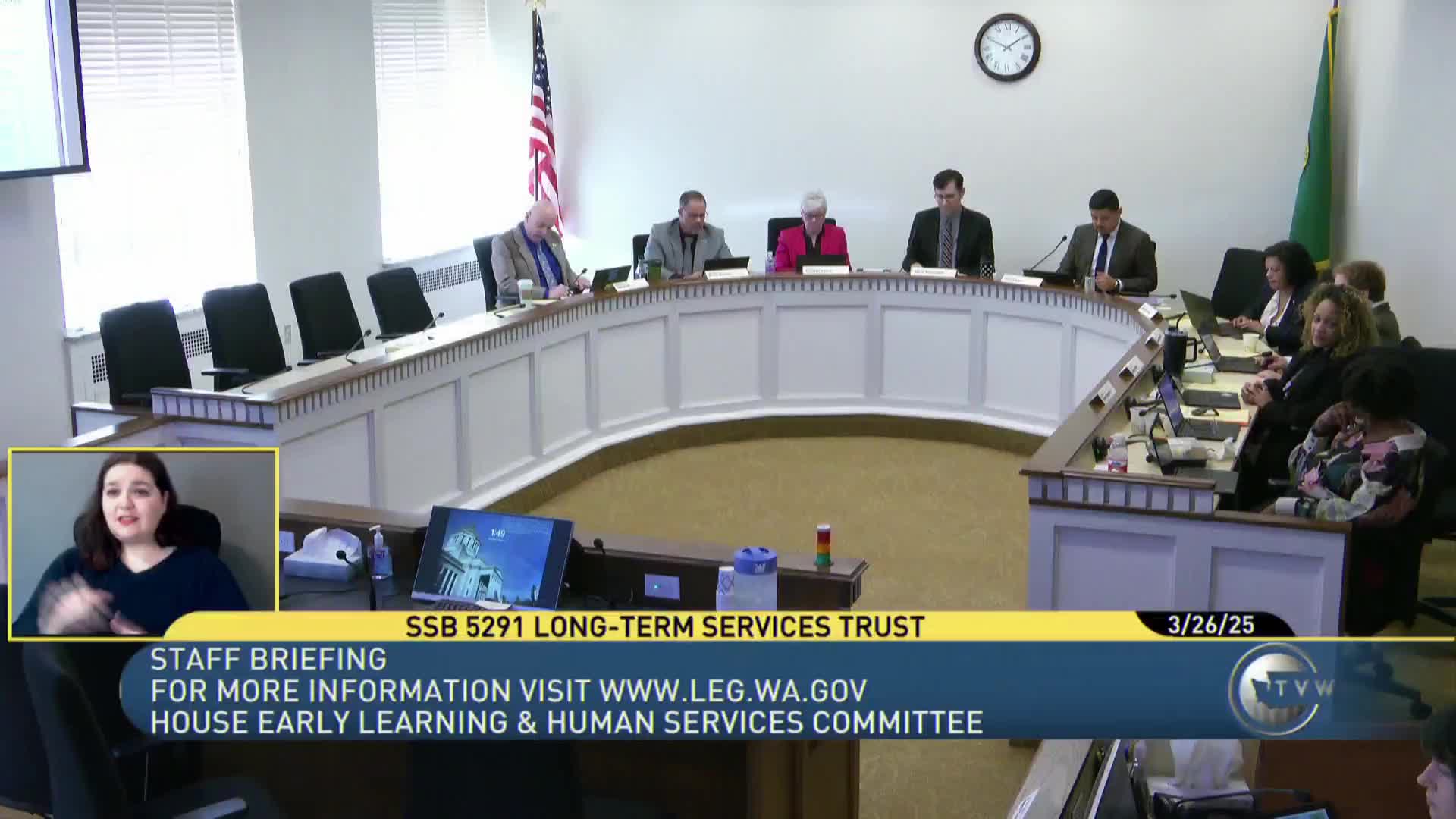
The House Early Learning & Human Services Committee took public testimony on engrossed Substitute Senate Bill 5291, which would modify Washington’s Long‑Term Services and Supports Trust Program (commonly called WA Cares). Committee staff outlined the program’s current structure and the bill’s proposed changes; stakeholders from the Office of the Insurance Commissioner, the Department of Social and Health Services (DSHS), insurers and aging-sector groups testified in support with recommendations.
O’Meara Harrington, committee staff counsel, briefed the committee on the trust program’s existing features: a premium assessment of 0.58% on employee wages, vesting rules (qualifying after three of the last six years or a total of 10 years with no more than a five‑year interruption), benefit units convertible to dollars at $100 per unit with a lifetime maximum of 365 units (reported current benefit equivalent $36,500 adjusted for inflation), and an initial premium start date of July 1, 2023 with benefits available on July 1, 2026. Harrington said the bill would make multiple changes including simplifying vesting, removing the five‑year interruption limit for a 10‑year vesting path, setting annual benefit adjustments by the Consumer Price Index (rather than the Trust Council), creating an enforcement structure for premium collection, and authorizing a statutory framework for supplemental private long‑term‑care insurance.
Agency and industry witnesses said the bill addresses real-world problems identified during program rollout. Tyler Langford of the Office of the Insurance Commissioner (OIC) said OIC supports the bill’s consumer protections for the new class of supplemental policies and that the proposed rules should help integrate private products with WA Cares benefits. Ben Vecchi, director of the WA Cares fund at DSHS, said the bill’s statutory framework for supplemental products would encourage insurers to develop policies that “seamlessly extend” WA Cares benefits and could lower consumer costs because WA Cares covers the first tranche of risk. Vecchi also noted the bill would allow some previously exempt workers who bought private policies to rejoin WA Cares and would authorize a pilot of up to 500 people in early 2026 to test administrative operations.
Insurers and intermediaries urged particular clarifications. Felicia Spivak of Trustmark Insurance said the bill should include a recertification requirement so people who originally claimed an exemption by buying private coverage would provide proof they still maintain qualifying policies. Steven Foreman of Long Term Care Associates urged rulemaking that preserves the elements necessary for partnership‑qualified policies that protect against Medicaid spend‑down; he argued that if supplemental policies could be designed to preserve Medicaid asset protection they would attract more buyers.
Representatives of LeadingAge Washington and Area Agencies on Aging voiced support for simplifying vesting rules to account for career interruptions for caregiving, service members and education, and for ensuring continuity of care protections in supplemental policies.
Testimony described technical details and program mechanics but did not include a committee vote during the hearing. Stakeholders asked the committee to adopt the bill’s changes to improve portability, simplify vesting and enable a regulated supplemental market backed by consumer protections.