Get Full Government Meeting Transcripts, Videos, & Alerts Forever!
Get email alerts on the Early Childhood Courts topic
No spam. Unsubscribe anytime.
Committee hears support for expanding early childhood courts from age 3 to 6
Summary
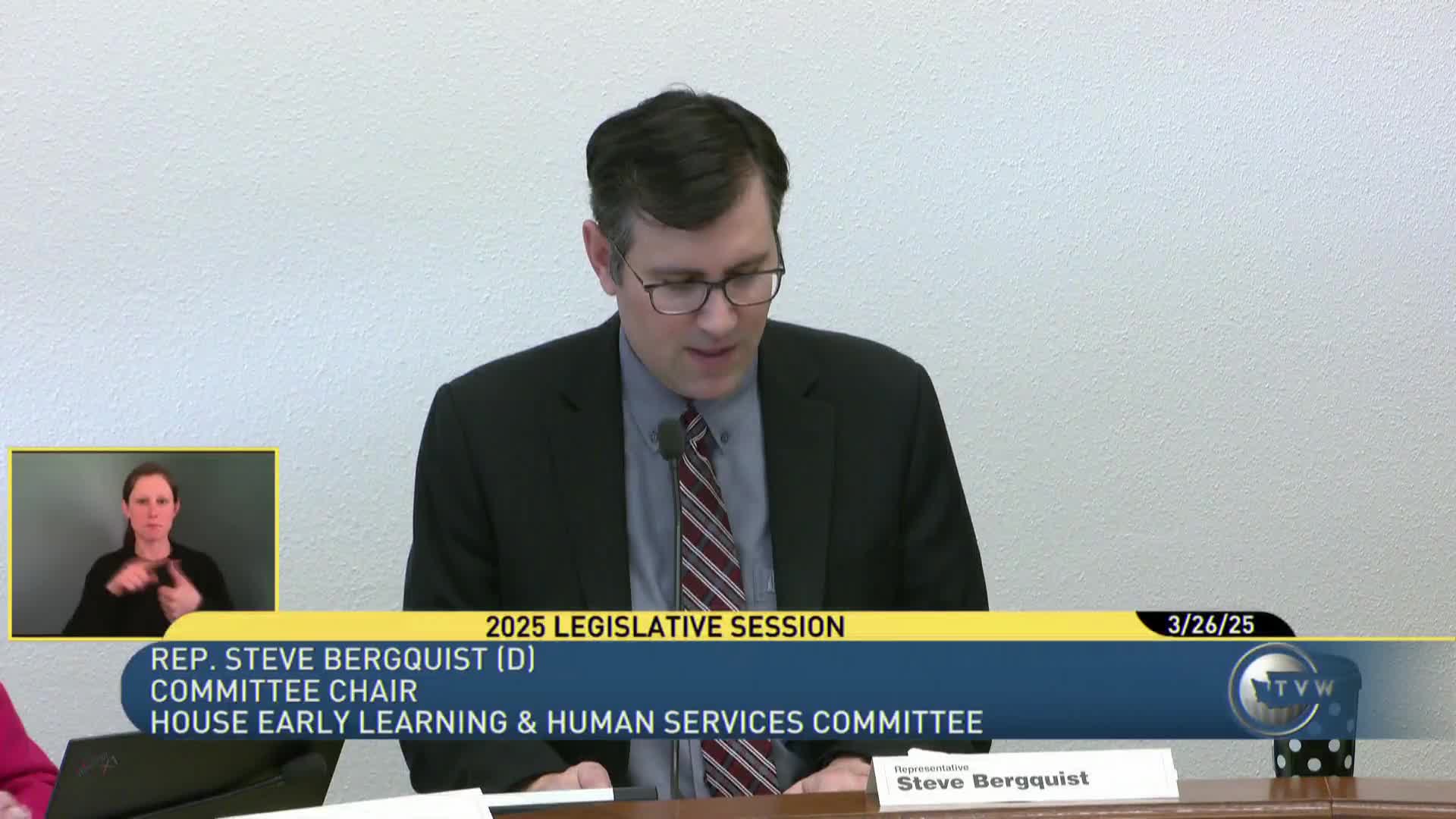
Substitute Senate Bill 5149, which would expand eligibility for Washington’s early childhood courts (ECCs) from children under age 3 to children under age 6, drew unanimous public support during a hearing before the House Early Learning & Human Services Committee.
Substitute Senate Bill 5149, which would expand eligibility for Washington’s early childhood courts (ECCs) from children under age 3 to children under age 6, drew unanimous public support during a hearing before the House Early Learning & Human Services Committee.
The bill was introduced to the committee by Luke Wickham, committee counsel, who described the statutory framework for ECCs, including required memoranda of understanding with the Department of Children, Youth and Families (DCYF), a community coordinator, frequent status hearings, family team meetings, individualized case plans for parents and judicial training requirements. Wickham said existing ECCs operate in five Washington counties: Clark, Kitsap, Pierce, Thurston and Spokane.
Supporters told the committee expanding the eligible age range would let courts serve more families using federal grant funding already in place through September 2027. Amelia Watson, a supervising attorney with the Washington State Office of Public Defense Parents Representation Program, said OPD and the Center for Children and Youth Justice submitted joint amendment language “to reduce barriers to entry and support procedural fairness for families of color.” Watson said ECCs can increase reunifications and asked the committee to adopt the jointly recommended amendments.
Rosalyn Guillen, statewide coordinator for ECCs and Indian Child Welfare courts at the Administrative Office of the Courts, said the bill “does not create a new program” but updates RCW 2.301 to raise the eligible age to under 6 and better align statute with the dependency population. Guillen told the committee that children from birth through age 5 make up nearly 60 percent of dependency filings statewide and that the dependency population under age 6 is 55 percent nonwhite. She said program data show higher reunification and lower adoption rates in ECCs compared with standard dependency cases.
Parents and people with lived experience also testified in support. Elizabeth Belew described entering an ECC in Spokane while using fentanyl, saying the ECC coordinator arranged psychotherapy, material supports and advocacy that she credited with helping her reunify with her children. Other testifiers described ECC community coordinators providing supplies, concrete supports, connections to services, and ongoing follow-up.
Advocates including the Center for Children and Youth Justice said ECC sites are not operating at full capacity and that the statutory change is necessary to permit use of existing federal HRSA grant funds to serve more families. Nicholas Oakley of CCYJ said pilot ECCs were designed to serve a capacity of roughly 20 families per site and that expanding the age limit would increase the number of families served without new state appropriation.
No formal committee action on SB 5149 occurred during the hearing; committee staff and testifiers indicated amendment language had been submitted to staff for committee consideration.
If adopted, the bill would broaden the statute governing ECCs (referenced in testimony as RCW 2.301) to extend eligibility from children under age 3 to children under age 6; the committee heard testimony that judicial officers who preside in ECCs must participate in an initial eight‑hour training and an additional eight hours of continuing education annually.
Supporters asked the committee to consider amendment language submitted jointly by OPD and CCYJ to address enrollment and procedural fairness issues for families of color. Committee members asked no substantive questions during the hearing portion and concluded public testimony before moving to other agenda items.