Get Full Government Meeting Transcripts, Videos, & Alerts Forever!
Get email alerts on the Federal Education Policy topic
No spam. Unsubscribe anytime.
State higher-education officials warn federal moves could disrupt aid, research and college programs
Summary
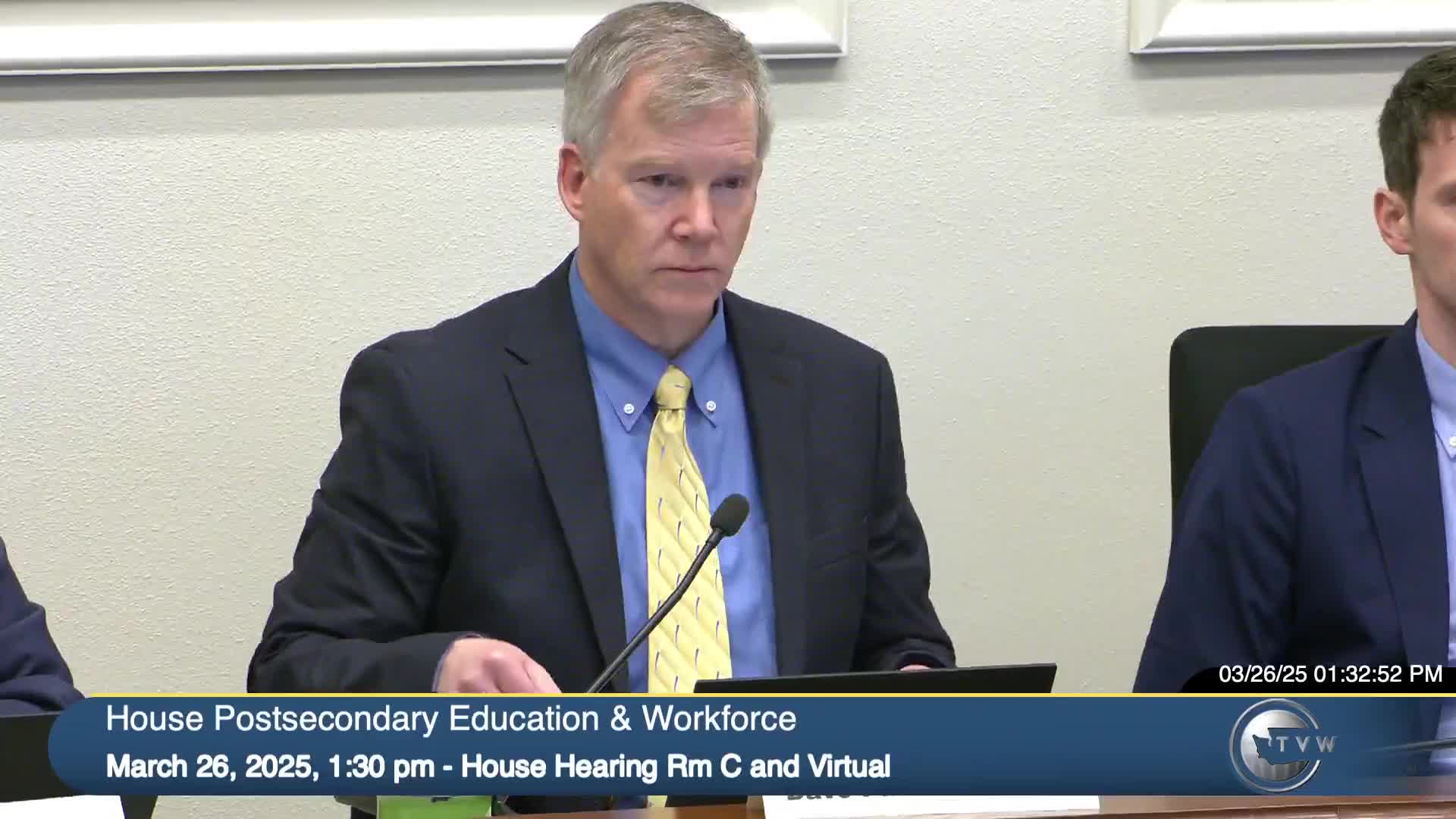
Officials from Washington’s higher-education system told the House Postsecondary Education & Workforce Committee on March 26 that recent federal actions and personnel reductions at the U.S. Department of Education are creating uncertainty for student aid, research grants and college programs statewide.
Officials from Washington’s higher-education system told the House Postsecondary Education & Workforce Committee on March 26 that recent federal actions and personnel reductions at the U.S. Department of Education are creating uncertainty for student aid, research grants and college programs statewide.
Joel Anderson, assistant director of external affairs at the Washington Student Achievement Council, told the committee the federal Title IV programs that supply Pell grants, federal loans and Federal Work-Study support tens of thousands of Washington students and that recent federal changes have already raised processing and program concerns. "Many of the changes we are seeing right now at the federal level are very new, they are ongoing, and admittedly there's a lot of information I don't have right now," Anderson said.
Anderson said data from the 2023–24 academic year show more than 83,000 Washington students received Pell grants totaling almost $390 million, with an average award of about $4,700. He said nearly 79,000 students took out federal loans last year with "a little over $13,000" the average federal loan amount, and that the state has about 790,000 student loan borrowers with nearly $29 billion in outstanding debt. He warned that paused or frozen federal repayment and discharge programs can cascade into broader access problems because some forgiveness paths require participation in other, underlying repayment programs.
"We're concerned about delays in FAFSA processing, particularly among applications that are stuck," Anderson said, noting reports that as many as 500,000 applications nationally were frozen and that, following staff reductions, the council has received no reliable updates about the department's capacity to resolve those cases.
Chris Bailey, interim executive director of the Washington State Board for Community and Technical Colleges, said Washington’s 34 community and technical colleges serve just under 300,000 students and rely on roughly $360 million a year in federal funds. "That's not insignificant," Bailey said, adding that more than half of that funding is related to federal financial aid and student loan programs while the rest supports grants and programs tied to completion and workforce preparation.
Will Durden, director of Basic Education for Adults at the state board, outlined specific federal programs the colleges worry could be affected: Basic Education for Adults (approximately $13.7 million in federal funds), Perkins career-technical education funding (about $14 million to the community-college share), Basic Food Employment and Training (reimbursements of roughly $15 million in fiscal year 2024 that supported about $30 million in total spending) and WorkFirst workforce funds (about $16 million). Durden said reductions in the Department of Education workforce and stop-work orders on research and technical-assistance contracts have eliminated regional points of contact and paused training and monitoring activities that colleges rely on.
"The federal grant freeze and further executive orders have created a cascade of uncertainty and risk that implicates all of our federally funded programs," Durden told the committee.
Melissa Beard, director of legislative affairs for the Council of Presidents, said the state’s public four-year institutions are seeing grant activity slow or halt, including stop-work orders and terminations. She described both direct research costs and "indirect" or facilities-and-administration reimbursements that universities rely on to maintain labs and support distributed costs for federally funded projects. Beard said the University of Washington and Washington State University employ thousands of people on federally funded projects and that research funding also supports regional institutions and undergraduate opportunities.
Committee members pressed officials on immediate effects: whether automatic loan payments might continue, how quickly federal funding streams could be clawed back under a continuing resolution, and whether colleges could sustain programs if grant money were reduced midyear. Officials said many answers remain unknown and that contingency planning at the college and state board level is still in early stages.
The state student loan advocate at WASAC, Anderson said, handles borrower complaints and data and can be asked to follow up on individual account questions. Bailey said the system has asked every college to audit federal funding exposure and is beginning contingency planning, but noted that uncertainty makes budgeting and staffing difficult.
Officials and committee members also raised program‑specific concerns: potential disruption to FAFSA processing, paused research grants including projects tied to the value of postsecondary credentials, reduced employer willingness to partner with federally funded programs, and the loss of regional Department of Education staff who had provided compliance and technical support.
The presenters urged legislators to track constituents' concerns and promised follow-up on data points the witness organizations did not have at the hearing.
Ending: The committee paused to move into executive session; state higher‑education witnesses said they would provide additional follow‑up material to lawmakers and to the WASAC student‑loan advocate for individual borrower inquiries.