Get Full Government Meeting Transcripts, Videos, & Alerts Forever!
Get email alerts on the Corrections Jail Searches Prea topic
No spam. Unsubscribe anytime.
Committee hears supporters and critics of bill aligning jail search rules with federal PREA standards
Summary
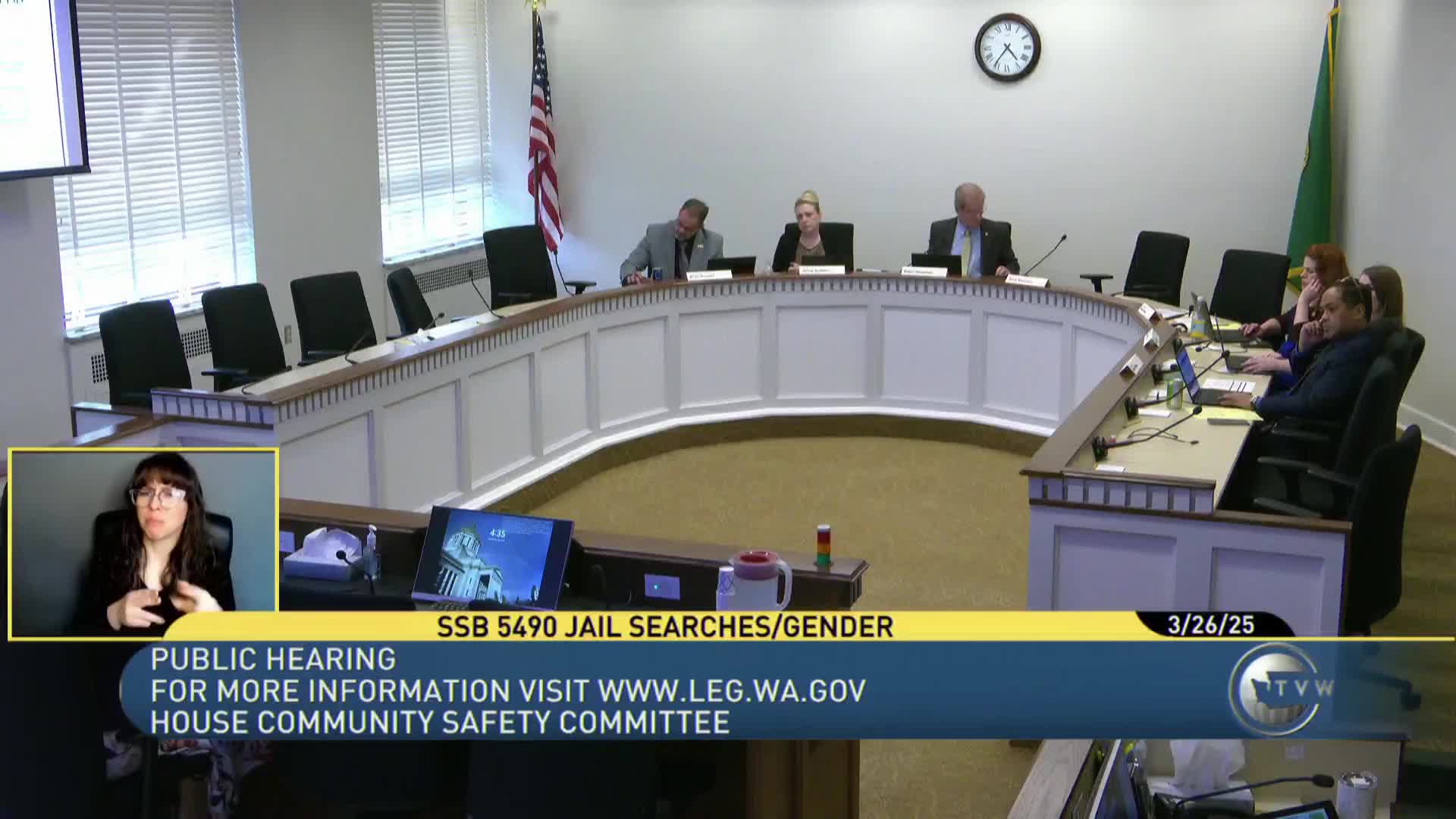
Substitute Senate Bill 54‑90 would require local jail administrators to adopt search policies for transgender and intersex persons that conform with PREA and state law, the House Community Safety Committee heard March 26.
Substitute Senate Bill 54‑90 would require local jail administrators to adopt policies for conducting searches of transgender and intersex people in custody that align with the federal Prison Rape Elimination Act (PREA) and Washington law, the House Community Safety Committee heard March 26.
The bill’s staff summary said applicable law already sets standards for strip and body‑cavity searches, including that cavity searches be performed under sanitary conditions by licensed medical professionals and that searches generally be performed by persons of the same sex as the person being searched, except for licensed medical professionals. SB 54‑90 would offer specific options for searches of transgender or intersex persons, including allowing the detained person to choose the gender of the person conducting the search, to request a medical professional, to have the search performed by female staff, or to have the search conducted in accordance with the person’s stated gender identity. The bill also would prohibit searches conducted solely for the purpose of determining genital status.
Why it matters: Supporters said local jails lack uniform policies and that transgender and intersex people are at elevated risk of abuse during custody searches. Opponents and some stakeholders raised operational and legal questions about staff safety, the role of medical professionals, and potential constitutional implications for corrections practices.
Sen. Monica Dinger, sponsor of the Senate bill, told the committee the measure “is simply codifying into state statute the protection of the federal policy as it currently exists” and extending those protections to jails where PREA standards were not uniformly implemented.
Mark Stern, a correctional physician and former assistant secretary for health care at the Washington State Department of Corrections, cautioned that requiring medical professionals to take a forensic role could harm medical confidentiality and patient trust. Stern suggested making a medical professional option voluntary for the person being searched, or considering changes in a future session if broader edits are required.
James McMahon, policy director with the Association of Sheriffs and Police Chiefs, said the bill addresses non‑contact strip searches and noted existing law treats cavity searches as medical procedures. McMahon and other law enforcement representatives urged careful drafting to avoid running afoul of case law such as Jordan v. Gardner and to protect correctional staff from being required to perform searches that could create workplace safety or constitutional issues.
Testimony in support came from people with lived experience and advocates. Renee Knight, who said she was born intersex and spent 20 years in Washington’s penal system, described being housed in a male facility and subjected to harassment and assault until policy changes under PREA were implemented in the Department of Corrections. Knight urged the committee to “pass senate bill 54 90 as written and without unnecessary amendments.”
Jenna Comstock of Q Law Association and Haley Akingay, executive director of Beyond These Walls and a formerly incarcerated transgender woman, also testified in favor, citing higher rates of sexual victimization among incarcerated transgender people and urging uniform standards across local jails. Kirkland Councilmember Neil Black said Kirkland requested legislation and urged its passage so jails can use “best practices” that consider dignity and safety.
What was not decided: The committee concluded the public hearing on SB 54‑90 without taking executive action on the bill during the same meeting. Committee staff said the bill is identical to a version previously passed out of the committee and that options for searches are detailed in the bill analysis.