Get Full Government Meeting Transcripts, Videos, & Alerts Forever!
Get email alerts on the Middle Housing topic
No spam. Unsubscribe anytime.
Mill Creek planners briefed on state middle-housing rules; staff seeks simpler ADU/density approach
Summary
Mill Creek Planning Commission members on March 20 heard a staff briefing on proposed code amendments to comply with Washington state middle-housing laws, covering unit limits, ADU allowances, administrative design review and parking near frequent-transit stops.
Mill Creek Planning Commission members on March 20 heard a staff briefing on a package of code amendments intended to make the city comply with recent Washington state laws that require cities to allow “middle housing” types in single-family areas and expand accessory dwelling unit (ADU) allowances.
Staff focused on three state bills — HB 1110, HB 1337 and SB 5258 — and walked the commission through proposed changes to Titles 4, 14, 16 and 17 of the Mill Creek municipal code, including unit-lot subdivision procedures, administrative (staff) design review for middle housing, revised parking rules near frequent-transit stops and an increase in maximum ADU size from 800 to 1,000 square feet.
Why it matters: The changes would alter how many homes can be built on many residential lots, affect homeowner associations that restrict ADUs or “middle housing,” and change review processes for multi-unit infill. Staff said Middle Housing compliance must be submitted to the state commerce department later this spring, and the city is aiming to finish the local code edits and send them for certification.
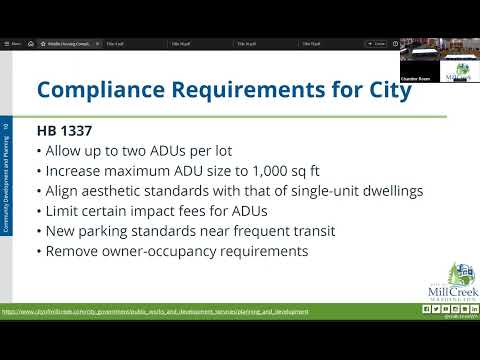
Justin, planning staff, opened the presentation by defining middle housing: “Middle housing is a form of housing that's compatible with single family homes in scale and form,” and noted that roughly “almost 20% of the housing stock is actually middle housing” in Mill Creek. He told commissioners the city must adopt changes required by HB 1110 (minimum units per lot and streamlined review), HB 1337 (ADU rules, including allowing two ADUs on qualifying lots and limiting certain fees) and SB 5258 (measures related to condominiums and townhouses).
Key changes staff reviewed
- Minimum units per lot: HB 1110 requires municipalities to allow at least two dwelling units on lots zoned for single-unit dwellings. Staff said the draft code computes allowed density by multiplying lot size by zone density, then applies exceptions so small lots still meet a floor of two units. Commissioners raised concern that the mixed options for counting ADUs toward density were confusing; staff said they would simplify the approach.
- ADUs: HB 1337 requires cities to allow up to two ADUs on qualifying lots, remove owner-occupancy rules and limit some fees. Staff recommended increasing the ADU maximum living area to 1,000 square feet (from 800) and removing owner-occupancy requirements. Justin explained that the ADU size limit refers to living area, not lot coverage, and that the increase was a required change in the bill. He also said staff can still limit ADU impacts through setbacks, height limits and other bulk standards.
- Unit-lot subdivision: To allow fee-simple ownership of individual units in horizontally arranged middle housing (for example, cottages or townhome-style units that share a parent lot), staff proposed a unit-lot subdivision procedure. Under that approach the parent parcel must meet the city’s overall lot coverage, setbacks and open-space requirements even if individual “unit lots” deviate from some standards to enable ownership of a single dwelling unit and small private yards.
- Design review and parking: HB 1110 requires many middle-housing types to be reviewed administratively rather than by a design review board. Staff proposed moving related design-review rules into Title 17 and consolidating standards in one location. Parking minimums would be converted into a table and reduced near frequent-transit stops as required by state law. Staff noted ambiguity in the state definition of a “major transit stop” and said they would seek clarification from the Department of Commerce.
HOAs and exemptions
Staff emphasized a recurring practical constraint: homeowners associations (HOAs) that had covenants barring ADUs or middle housing in place before July 23, 2023, remain exempt from some aspects of the new state rules. Justin said, “HOAs that had that banned middle housing before the effective date of HB 1110, HB 1337 are exempt,” and that the city does not enforce private covenants; enforcement of HOA covenants would remain a private matter. The commission was told the city’s roster of HOAs is out of date, that roughly 70% of residential land is under HOA governance (a rough estimate), and staff is working to rebuild contact records and identify which covenants contain pre-2023 restrictions.
Policy choices and next steps
Commissioners asked staff to simplify how ADUs are counted against density so the rules are easier for homeowners, developers and permitting staff to apply. Justin described a “modified option” staff prepared but said a pure Option 1 — counting ADUs toward the minimum-unit calculation and keeping one ADU allowed on every lot — would be easier to explain and implement. Several commissioners expressed a preference for a simpler rule set rather than a more complex hybrid.
Staff told the commission it plans to return with revised code language. The schedule presented calls for a Planning Commission public hearing in April and a recommendation to the City Council, with Council adoption expected in May so the city can seek Department of Commerce certification ahead of the state deadline this summer.
Votes at a glance
- Approval of Feb. 20, 2025 meeting minutes: Motion made and seconded; voice vote; approved. (Motion text: “Motion to approve the meeting minutes.” Mover: not specified; second: not specified; detailed roll-call tallies not recorded.)
What the commission directed staff to do
Commissioners asked staff to: simplify the density/ADU calculation to make it easier to implement and explain; clarify the definition and trigger for “major transit stop” with Commerce; restore or publish clear cross-references so the public can readily see changes in Titles 4, 14, 16 and 17; and return with a draft resolution and marked-up code for the April hearing.
The study session ended without formal action on the code amendments; staff will bring revised language and a draft resolution for a public hearing and formal recommendation to council in April.