Get Full Government Meeting Transcripts, Videos, & Alerts Forever!
Get email alerts on the District Budget topic
No spam. Unsubscribe anytime.
Evergreen CFO: clean audit but district faces $10 million shortfall this year; board warned to prepare $5.2M in reductions
Summary
At the March 25 board meeting, Chief Financial Officer Jennifer Jacobson reported a clean state audit and presented fiscal projections showing a projected $10 million deficit for 2024-25, a likely budget-extension request, and a recommended $5.2 million in reductions for 2025-26 unless additional state funding arrives.
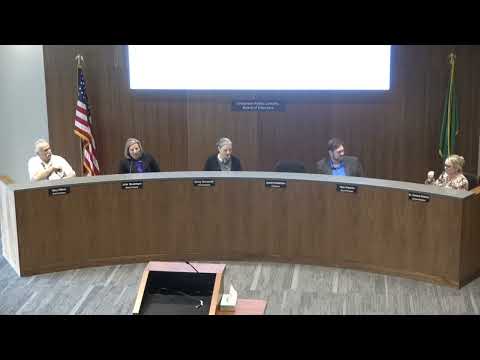
At the Evergreen School District board meeting on March 25, Chief Financial Officer Jennifer Jacobson reported a clean state audit and warned the board the district expects to incur about a $10,000,000 deficit this fiscal year and will likely need a formal budget extension.
Jacobson said the State Auditor’s Office concluded an 8–10 week review with an exit conference in mid‑March and issued no findings or management letters for the district’s 2023–24 audit. “A little over a week ago, we had our exit, and we had a clean audit with no findings or management letters to report,” Jacobson said.
The audit news contrasts with the district’s operational projections. Jacobson said revenue is tracking slightly below the adopted budget—about $425 million in projected revenue against a $428 million budget—and expenditures are likely to exceed the board‑approved spending authority of $432.8 million. She told the board that, because of higher special education costs, the district now expects roughly a $10 million deficit rather than the $4 million shortfall projected earlier.
Jacobson said two main budget deviations are driving the pressure: higher-than-expected enrollment in certain programs and rising special education costs. She reported about 50 additional full‑time‑equivalent (FTE) students in the Running Start program and growth at Cascadia Tech Academy; those funds flow through state apportionment and off to Clark College for Running Start credits. On special education, she said enrollment and needs have increased, requiring the district to add certificated and classified staff and to contract for paraeducators. Jacobson said an extra contract for paraeducator coverage would cost roughly $1,500,000 if 30 spots were filled for the year.
Jacobson said the district maintains a restricted food service reserve of about $3,000,000, funded by USDA program dollars that can be used only for Child Nutrition Services. She said the district is using some of that reserve to replace equipment and update the Evergreen cafeteria.
On reserves and fund balance, Jacobson said the district now projects an ending fund balance of about $22,000,000, which would bring the unrestricted portion to roughly 4% of expenditures—below the board policy target of 5%. She said she consulted ESD 112 and was told that temporarily missing the 5% target is acceptable if the district has a clear plan to rebuild the reserve.
Looking to 2025–26, Jacobson presented two scenarios. Under a no‑new‑state‑funding scenario and after implementing about $5,200,000 in reductions, the district would still face a roughly $5,000,000 deficit next year and see its unrestricted fund balance fall to about 2.7%. With an assumed $5,000,000 of additional state funding—her midrange estimate based on competing House and Senate proposals—the district could present a near‑balanced budget for 2025–26 while remaining below the 5% reserve threshold but trending toward recovery by 2026–27 when full levy increases flow in.
“Scenario two is with additional state funding, with $5 million we would have basically a balanced budget for next year,” Jacobson said, noting the district expects to start receiving the full levy amounts in tax collections affecting fiscal year 2026–27.
To close portions of the projected gap, Jacobson described planned actions: $2,000,000 in personnel reductions largely via attrition, a $1,000,000 pause on curriculum purchases, implementation of a zero‑based budgeting process across departments, a review and renegotiation of vendor contracts (including ABM), and an in‑depth special education review and monitoring effort. She said some positions will not be replaced and work will be redistributed where feasible.
Jacobson emphasized the district is being cautious because the Legislature’s final funding picture remains uncertain: “I feel like 5,000,000 is a very conservative estimate for that,” she said of the 2025–26 state funding assumption and added that the district will wait for clearer revenue signals before making deeper, permanent cuts.
Board members pressed for details. Director Perkins asked whether Title I is the largest Title fund; Jacobson replied, “Title I. Yeah. I believe it’s about $6,000,000.” When asked whether the roughly $5,000,000 in special‑education federal funding is connected to the safety‑net calculations, Jacobson said the district expects $2,700,000 to $3,000,000 in safety‑net funding this year and additional IDEA funding.
Jacobson also flagged cash‑flow risk months in July and August and the potential need for an interfund loan from the capital projects fund if state payments shift later in the year; she noted the Legislature is considering moving a larger share of apportionment into July and August, which would amplify cash‑flow pressures for districts.
What happens next: Jacobson said the district will prepare a budget‑extension request for the board within the coming months and continue to refine a list of $5.2 million in recommended reductions should the Legislature not provide additional funding. She told the board the district will continue careful monitoring and will bring specific proposals back for board approval.
—
Votes and procedural notes from the meeting: the board received the CFO’s report; no formal budget action was taken at this session. The board did approve routine consent items earlier in the meeting.