Get Full Government Meeting Transcripts, Videos, & Alerts Forever!
Get email alerts on the Criminal Justice OVI topic
No spam. Unsubscribe anytime.
Committee hears testimony to refocus marijuana OVI law on impairment rather than metabolite levels
Summary
Proponents of Senate Bill 55 told the Ohio Senate Judiciary Committee the state’s per se approach to marijuana-related OVIs relies on non-impairing metabolites and suggested the bill would allow metabolite evidence to support an inference of impairment while preserving law enforcement roadside tools.
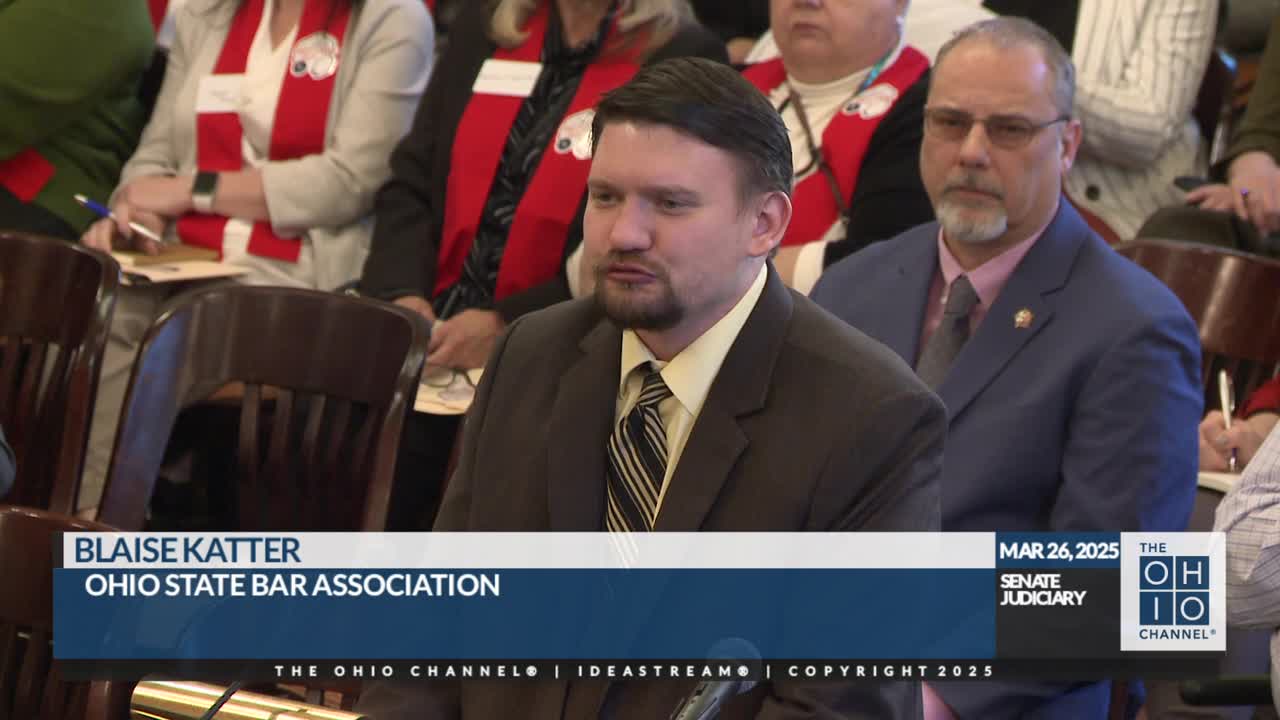
Attorney Blaise Katter, appearing for the Ohio State Bar Association, urged the committee to change how Ohio handles marijuana-related OVI prosecutions by shifting the evidentiary focus from long-lasting metabolites to impairment.
Katter said Ohio currently criminalizes the presence of a marijuana metabolite — carboxy-THC — under a per se standard, and that metabolite can remain in the body "for days, weeks, and in some cases, even months after use." He argued that the metabolite does not reliably indicate impairment and that Ohio already tests for the inactive metabolite rather than the active delta-9 THC. "The per se law... is criminalizing the mere inactive or non psychoactive ingredient, the marijuana metabolite, which is called carboxy THC," Katter said.
Katter described Senate Bill 55 as a compromise that would preserve law enforcement's roadside investigations and training (standardized field sobriety tests, ARIDE and DRE programs) while allowing test results to be admitted as part of an evidentiary inference about impairment rather than as conclusive proof of guilt. He compared the change to the jury instruction that can accompany a refusal to submit to chemical testing, saying the presence of metabolites could be treated as evidence the trier of fact may weigh.
Committee members asked several technical questions. Vice Chair Reynolds and Senator Gavarone (spelled in the transcript "Gavirone") expressed concern about retroactive relief for people previously convicted under the older per se standard; Katter said unwinding past convictions would be difficult but suggested targeted relief for administrative records (for example, BMV records or license suspensions) might be a feasible approach to ameliorate collateral consequences.
Katter and other witnesses discussed national scientific work, including a 2017 NHTSA report to Congress that Katter cited as concluding no clear numeric threshold for impairment exists; he said oral-fluid testing that measures delta-9 THC may be useful to show recent use but not as a per se impairment standard.
Other proponent testimony came from Hannah Cubbins of Americans for Prosperity Ohio, who said SB55 "provides a long overdue update to Ohio law regarding OVI statutes in the era of legal adult use cannabis" and stressed balancing public safety with the science of metabolization. The committee left SB55 at a second hearing with no committee vote recorded.