Get Full Government Meeting Transcripts, Videos, & Alerts Forever!
Get email alerts on the Scholarship Reform topic
No spam. Unsubscribe anytime.
Senate bill creates monthly scholarship payments, student ID tracking and stabilization fund to align funding with school choice
Summary
SPB 7030 would separate Family Empowerment Scholarship funding from FEFP, require monthly scholarship payments and student IDs for scholarship recipients, expand a stabilization fund and place new documentation, auditing and background-check requirements on scholarship-related providers.
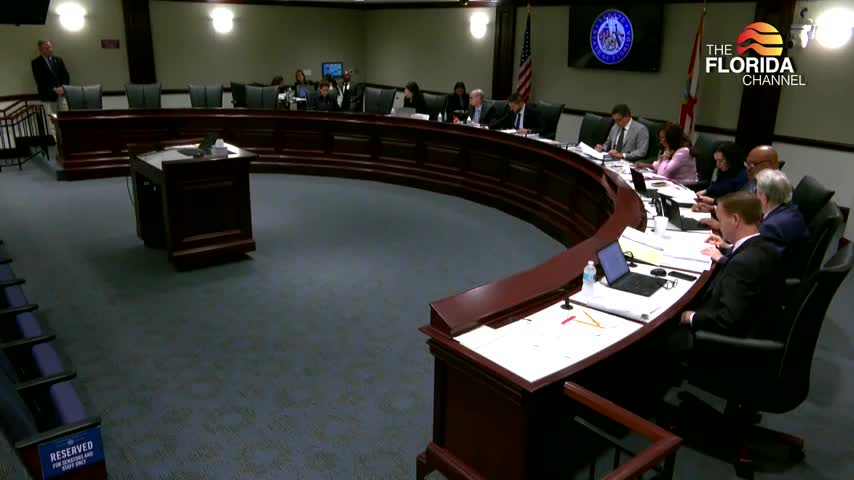
Senate Proposed Bill SPB 7030, presented in the Appropriations Committee by Senator Gates, would restructure how scholarship funding and student tracking operate in Florida's changing school-choice environment by making the Family Empowerment Scholarship a separate state-funded categorical, establishing fall and spring application windows, assigning persistent student identification numbers for scholarship recipients, and shifting payments from quarterly to monthly installments with a front-loaded first payment for certain homeschool families.
Sponsor's summary: Senator Gates said the bill is intended to make funding follow the student more reliably, reduce sudden budget shortfalls for school districts and choice providers, and create uniform administrative procedures across scholarship programs. "We're asking here that everyone in the scholarship program, no matter what scholarship they're participating in, would get a student I.D. Number just like students in neighborhood public schools so that when the student moves back and forth, we're able to track where they are to make sure the money follows the student," Gates told the committee.
Why it matters: Committee sponsors described the measure as a comprehensive response to rapidly increasing participation in scholarship programs and declining district enrollment in many counties. The bill contains operational changes to administration, auditing, and payment timing that would affect districts, private schools, scholarship-funding organizations and families.
Major provisions described by the sponsor and staff: - Funds the Family Empowerment Scholarship as a separate state-funded categorical outside the FEFP calculation; the committee packet sets award levels consistent with the chair's budget summary. - Creates an education enrollment stabilization fund and expands its eligible uses to help districts with sudden declines; fiscally constrained small districts could receive a 25% declining-enrollment supplement (one year), other districts up to 10% (one year), per the sponsor's description. - Institutes fall and spring application windows and a single application for all scholarship programs; requires additional residency documentation and verification against DOE enrollment files. - Directs the Department of Education to assign a single student ID for scholarship recipients that follows the student across providers and requires a standard withdrawal form and verification of continued eligibility prior to each payment. - Changes scholarship payment schedules from quarterly to monthly, aligns district payments to monthly cycles, and allows a front-loaded first payment (double payment) for homeschooling families to cover upfront curriculum and start-up expenses; payments would be trued up at year end. - Prescribes that funds placed in a scholarship account for students with unique abilities remain with the student until age 22 if used for education or training that leads to employment, rather than reverting to the state immediately when a student re-enters public school. - Requires background checks for any individual or entity that receives state funds to instruct students; the sponsor described a level-2 check requirement and said the Department of Law Enforcement conducts checks in employer contexts. - Requires the Auditor General to conduct an annual FTE audit of scholarship programs and obliges scholarship-funding organizations (SFOs) to return funds as a result of audit findings; it also calls for a uniform reimbursement and invoicing process.
Committee debate and public testimony: Members raised operational questions about background-check scope (who must be checked in co-ops and residential settings), who bears background-check costs, how reimbursements are processed, data-sharing safeguards, residency verification deadlines and the bill's effective date (July 1). Senator Osgood urged broader consideration of funding across all education systems; Senator Simon and others emphasized the need for a "runway" to implement universal school choice.
Public testimony: Steve Hicks, chief operations officer for Center Academy Schools and president of the Florida Coalition of Scholarship Schools, said his organizations worry the bill would create excessive administrative requirements that smaller private schools and parents may not be staffed to meet and urged revisions to avoid unintended consequences. David Sykes waived in support and Step Up for Students was discussed as a primary administrator of scholarship payments.
Committee action: Senator Gates moved to submit SPB 7030 as a committee bill; the motion passed. The roll call recorded one "No" vote from Senator Osgood and recorded "Yes" votes from other members, and the committee reported SPB 7030 favorably.
Next steps: Committee staff and sponsors indicated willingness to continue working with members and stakeholders to refine background-check provisions, documentation deadlines and operational procedures as the bill moves through the legislative process.