Get Full Government Meeting Transcripts, Videos, & Alerts Forever!
Get email alerts on the Medicaid Work Requirements topic
No spam. Unsubscribe anytime.
Ohio Senate Committee backs resolution urging federal approval of Medicaid work requirements
Summary
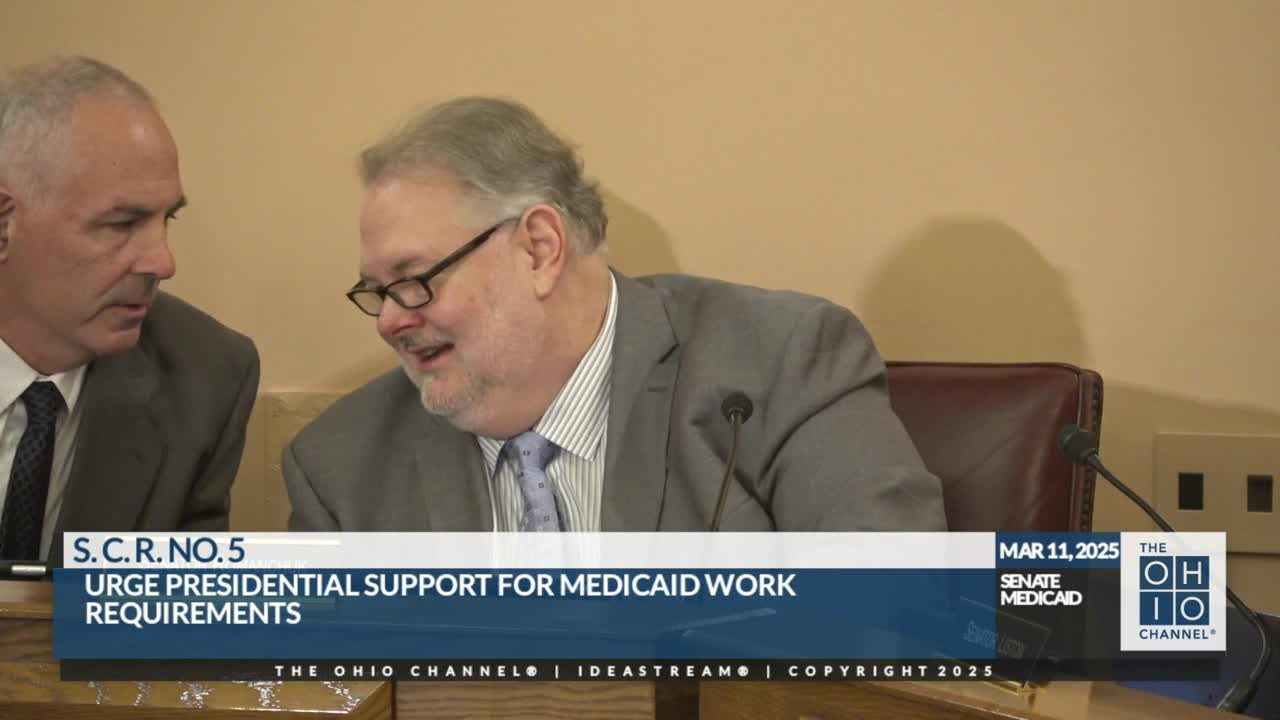
The Ohio Senate Medicaid Committee on a voice/roll call vote this morning favorably reported Senate Concurrent Resolution 5 to the Senate Rules and Reference Committee, urging the president and federal regulators to approve Ohio’s request to impose work and related eligibility criteria for certain adult Medicaid expansion enrollees.
The Ohio Senate Medicaid Committee on a voice/roll call vote this morning favorably reported Senate Concurrent Resolution 5 to the Senate Rules and Reference Committee, urging the president and federal regulators to approve Ohio’s request to impose work and related eligibility criteria for certain adult Medicaid expansion enrollees (the so‑called Group 8 population).
The resolution asks federal officials to approve a Section 1115 waiver that would require adult expansion enrollees to meet one of several criteria—be employed, be at least 55 years old, be enrolled in school or occupational training, be participating in substance‑use treatment, or have intensive physical health care needs or serious mental illness—before continuing Medicaid coverage. "An individual must satisfy at least one of the following criteria," Ohio Department of Medicaid Director Maureen Corcoran told the committee, and the department has submitted the waiver application to the Centers for Medicare & Medicaid Services (CMS).
Why it matters: committee members and witnesses said the proposal aims to encourage employment and reduce long‑term program dependence, but witnesses disagreed about whether work requirements actually increase employment and raised concerns about administrative burden and access to exemptions.
Witnesses summarized competing evidence. Reyes Hedderman Jr., vice president for policy at the Buckeye Institute, argued the Affordable Care Act’s Medicaid expansion reduced labor supply and said work requirements can increase hours and lifetime earnings for some enrollees. "We find that implementing Medicaid work requirements has the potential to raise the usual weekly hours between 22 and 25 hours," Hedderman testified. By contrast, Zach Reit, senior director of strategic initiatives at the Ohio Association of Food Banks, warned Ohio’s proposed structure creates a "pre‑enrollment work requirement" that could leave people without a way to document a disabling condition because they lack coverage. "They could be denied coverage because they didn't have health coverage to prove that they have a health condition," Reit said.
Beau Mouton of FGA Action urged the committee to support the resolution as a pathway to self‑sufficiency, saying the policy is "not about taking health care away from those who truly need it. It's about encouraging those who can work to work." Director Corcoran described the department’s implementation plans and federal timeline: Ohio submitted the waiver and entered a federal public‑comment period that the department said will close on April 7; if CMS negotiation and approvals proceed on schedule, Corcoran said, "the first demonstration year would begin on Jan. 1, 2026."
Committee members pressed witnesses and the director on specifics: how many people could be affected, how the department would notify enrollees, and what administrative burden counties and managed‑care plans would face. Corcoran told senators the department estimates about 62,000 individuals could be disenrolled over the upcoming biennium if the waiver is approved and implemented as planned, and noted many Group 8 enrollees already are in managed care and that the department plans outreach similar to the public‑health emergency redetermination efforts.
The committee also discussed program design choices and supports. Reit advocated aligning any Medicaid work requirement with SNAP work rules and adding investments in job training, tenancy supports, care coordination, and other services to help enrollees meet requirements. Hedderman and others cited academic and CBO studies that they said show expansion and benefit cliffs can reduce work effort; multiple witnesses and senators said results in different states have been mixed.
The committee motion to "favorably report SCR 5 to Rules and Reference" was made by Senator Huffman and carried in the committee; the clerk recorded individual votes during roll call and the chair stated, "The resolution passes and will be referred to the Senate Committee on Rules and Reference." The committee asked the Department of Medicaid to continue negotiating with CMS, to finalize operational details during the waiver review, and to develop communication and outreach plans before implementation.
Ending: With the committee vote, SCR 5 moves to the Senate Rules and Reference Committee for further consideration. The department and stakeholders said CMS negotiation, subsequent federal conditions, and the department’s operational plans will determine the timing and the exact scope of any eligibility changes, and that additional details and public comments are still pending.