Get Full Government Meeting Transcripts, Videos, & Alerts Forever!
Get email alerts on the Medicaid Work Requirements topic
No spam. Unsubscribe anytime.
Ohio Senate committee backs resolution urging presidential support for Medicaid work requirements
Summary
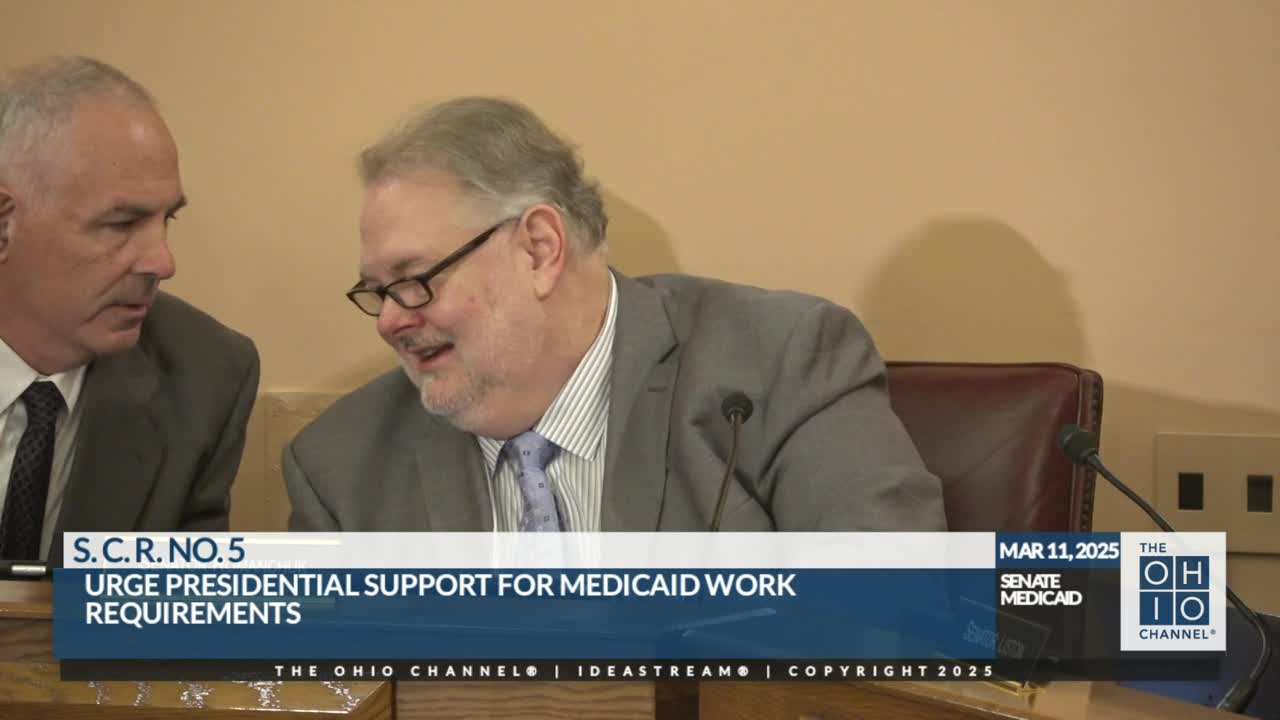
The Ohio Senate Medicaid Committee voted to favorably report Senate Concurrent Resolution 5 on a party-line motion, referring the resolution to the Senate Committee on Rules and Reference after testimony and questioning about Ohio’s proposed Medicaid work requirements and the federal waiver process.
The Ohio Senate Medicaid Committee voted to favorably report Senate Concurrent Resolution 5 on a party-line motion, referring the resolution to the Senate Committee on Rules and Reference after testimony and questioning about Ohio’s proposed Medicaid work requirements and the federal waiver process.
The resolution urges the president and the Centers for Medicare & Medicaid Services to approve Ohio’s request to require certain adults in the state’s Medicaid expansion population to meet work or activity criteria to maintain eligibility. The committee considered testimony from policy advocates, hunger-relief officials, conservative advocates and Maureen Corcoran, director of the Ohio Department of Medicaid.
Why it matters: The resolution supports a waiver that, if approved by CMS, would change eligibility rules for Ohio’s Medicaid expansion population (commonly called “group 8”), potentially affecting tens of thousands of enrollees and triggering new administrative steps for renewals and documentation.
Reyes Hedderman Jr., vice president for policy at the Buckeye Institute, told the committee that expanding eligibility under the Affordable Care Act reduced labor supply and that applying work or activity requirements could increase work hours and lifetime earnings for some enrollees. "Medicaid income eligibility creates an incentive to reduce work in order to remain eligible for Medicaid," Hedderman said, citing national and state-level academic studies and Congressional Budget Office analysis.
Zach Reit, senior director of strategic initiatives for the Ohio Association of Food Banks, urged aligning any Medicaid requirement with existing SNAP work rules and warned that the waiver as written could create a "pre-enrollment work requirement" that would make it difficult for people to obtain medical documentation needed for exemptions. "As Ohio's proposed work requirement is currently structured, it would be very difficult for an individual to get a diagnosis of mental health, substance use, or other medical condition in order to be properly exempted without absorbing significant out of pocket costs," Reit said.
Beau Mouton of FGA Action supported the resolution and said the policy is meant to give a pathway to self-sufficiency: "By requiring able-bodied adults on Medicaid to engage in work, job training, or education, we're giving them a path forward," he told the committee. Mouton said individuals with disabilities and primary caregivers would be exempt, and he cited Arkansas figures he said showed some enrollees found employment after a work requirement was imposed.
Maureen Corcoran, director of the Ohio Department of Medicaid, said the General Assembly enacted House Bill 33 to add the statutory eligibility limitation now codified in Ohio Revised Code 5166.37 and that the department formally submitted a waiver application to CMS on Feb. 28. Corcoran told senators that the waiver application has entered the federal public comment period and that Ohio anticipates, if timelines align, a first demonstration year start of Jan. 1, 2026. "About 62,000 would be, potentially disenrolled over the course of this upcoming biennium," Corcoran said, describing the department’s current estimate.
Committee members pressed witnesses and the director on empirical evidence, administrative burden and implementation. Senator Theresa Gavarone (Chair Romanchuk) and other senators asked whether previous state experiments, including Arkansas and studies in Tennessee and Wisconsin, showed clear employment gains. Hedderman and Mouton pointed to studies and examples they said supported work incentives; other senators and Reit noted mixed results and emphasized barriers such as transportation, housing and access to diagnosis and treatment that could limit beneficiaries’ ability to meet requirements.
Corcoran described the practical timing and safeguards the department expects to use if a federal waiver is approved: eligibility would typically be assessed at the enrollee’s routine 12‑month renewal; the department would provide opportunities for additional documentation and appeals (she said processes commonly allow several weeks for additional documentation); and the state would coordinate outreach with managed care plans, local workforce boards and community organizations, drawing on practices developed during redeterminations after the COVID public health emergency.
Action at the hearing: Senator Steve Huffman moved to favorably report SCR 5 to Rules and Reference. The clerk conducted a roll call; the transcript records named votes including at least a group of senators recorded as voting yes and at least two recorded as voting no. The committee chair announced that "the resolution passes and will be referred to the Senate Committee on Rules and Reference." The motion was entered into the committee record as approved; the transcript does not include a complete roll-call list in the record provided.
What remains unanswered: CMS must complete its review and negotiation process after the federal public comment period closes on April 7. If CMS approves the waiver, many implementation details — such as exact enrollment timelines, documentation standards, state-run exemptions and the department’s communication plan — will be resolved during CMS negotiations and through rulemaking and operational plans the department develops with counties and managed care plans.
The committee hearing combined policy arguments about work incentives and economic effects with practical questions about state implementation and supports. Corcoran and witnesses recommended additional investments in workforce and social‑needs supports to help enrollees meet new requirements; food‑bank testimony urged aligning Medicaid rules with SNAP to reduce administrative duplication.
The committee’s favorable report sends SCR 5 to Rules and Reference for further consideration by the full Senate. The waiver application process and the federal review will determine if and when the state may impose the new eligibility conditions.