Get Full Government Meeting Transcripts, Videos, & Alerts Forever!
Get email alerts on the Short Term Rentals topic
No spam. Unsubscribe anytime.
Local officials, tourism and township groups urge committee to reject bill that would bar local short‑term rental rules
Summary
More than a dozen municipal and tourism representatives told the Senate Local Government Committee that Senate Bill 104 would strip cities, villages and townships of zoning tools to manage short‑term rentals, harming neighborhood stability, housing supply and public safety even as many witnesses supported platform collection of lodging taxes.
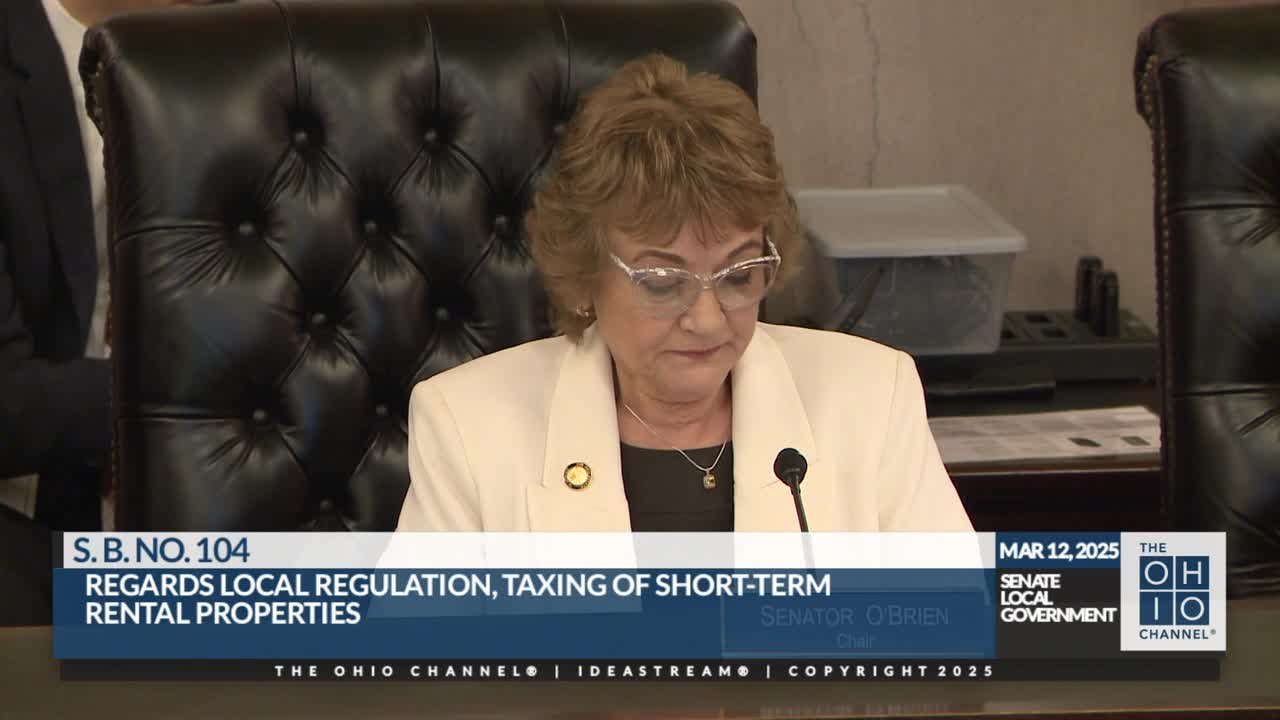
Senate Local Government Committee members heard more than two hours of opposition testimony on Senate Bill 104 on the bill—s third hearing, with local officials, township associations, convention and visitors bureaus and tourism leaders urging the committee to preserve municipal home rule.
Witnesses said the bill would prevent local governments from using zoning, registration and inspection to manage short‑term rentals where they create nuisances, safety risks or reduce long‑term housing stock. Several witnesses said they support requiring platforms to collect and remit lodging taxes but opposed the bill—s broad ban on local regulation.
The Ohio Municipal League—s Bevin Schneck said the measure would "keep local decision makers from making these local decisions" and asked senators to oppose the bill. "The Ohio Municipal League urges your opposition to Senate Bill 104," Schneck said.
Representatives of Ohio—s townships and many cities said the statewide preemption would be especially damaging in smaller communities and seasonal tourism areas. Kyle Brooks of the Ohio Township Association warned that "this bill would effectively strip over half of Ohio's townships of their zoning authority," while Ron Ehrbar, mayor of Kelly's Island, said island infrastructure such as septic systems require local oversight.
Tourism and visitors bureau witnesses said short‑term rentals are an important part of Ohio—s travel economy but argued local rules are needed to protect neighborhoods and housing. Beth Carmichael of Trumbull County Tourism described a pattern she said has unfolded in some neighborhoods: "At first, it's just the occasional visitor, but soon new groups arrive every few nights. Late night noise, overflowing trash, and congested streets become the new norm and your sense of community fades." Carmichael and other tourism officials urged treating short‑term rentals as businesses that should collect the same lodging and sales taxes as hotels.
Several mayors and council members described neighborhood incidents they said motivated local ordinances. Paul Kumar, mayor of Bay Village, recounted a 2019 incident in which an absentee owner—s rental drew a large party: "Close to 500 people showed up for the birthday party at this house," he said, describing the resulting police response and cleanup costs the city absorbed. Lyndhurst Mayor Patrick Ward and Bexley Mayor Ben Kessler described local registration, inspection and owner‑occupancy limits they have used to balance homeowner income and neighborhood stability.
Municipal speakers also criticized the bill's proposed $20 annual registration fee as too low to cover enforcement costs. Kyle Brooks said the OTA supports registration in principle but "we believe this fee is insufficient to cover the administrative costs townships may occur, and we would recommend a higher annual fee." Several communities cited their current fees: Lyndhurst charges $100 per year for rental registration; Gahanna uses $150 every two years for a single‑family home.
Multiple witnesses asked the legislature to preserve local zoning processes and conditional uses so communities can tailor rules to local geography, seasonal tourism demand and housing needs. Catherine Dale, zoning and planning administrator for Danbury Township, said the bill would effectively rezone "all residential property in the state of Ohio to allow for a very specific type of commercial use" and warned it would remove tools used to address repeat nuisance properties.
Speakers representing convention and visitors bureaus, including Andrew Herff and Dee Grossman, said they support extending lodging tax collection and closing sales‑tax loopholes for platforms but not at the expense of local regulatory authority. "If you take those tools away, what tools are left?" Andrew Herff asked, urging legislation that preserves enforcement options for local governments.
The committee did not take a vote on Senate Bill 104 during the session. After hearing dozens of in‑person witnesses, Chair Cheryl O'Brien closed the third hearing and adjourned the committee.
The hearing record shows consistent themes: broad support among tourism interests for platform tax remittance, broad opposition among local officials to state preemption of zoning and enforcement tools, and widespread calls for higher registration fees and inspection authority than the bill currently provides.