Get Full Government Meeting Transcripts, Videos, & Alerts Forever!
Get email alerts on the Traffic Safety topic
No spam. Unsubscribe anytime.
Witnesses urge Ohio to shift focus from THC metabolites to impairment in OVI cases
Summary
At a second hearing on Senate Bill 55, defense attorneys, advocates and policy groups urged the Senate Judiciary Committee to change how Ohio treats marijuana evidence in OVI prosecutions, arguing current per se rules rely on long-lasting metabolites that do not indicate impairment.
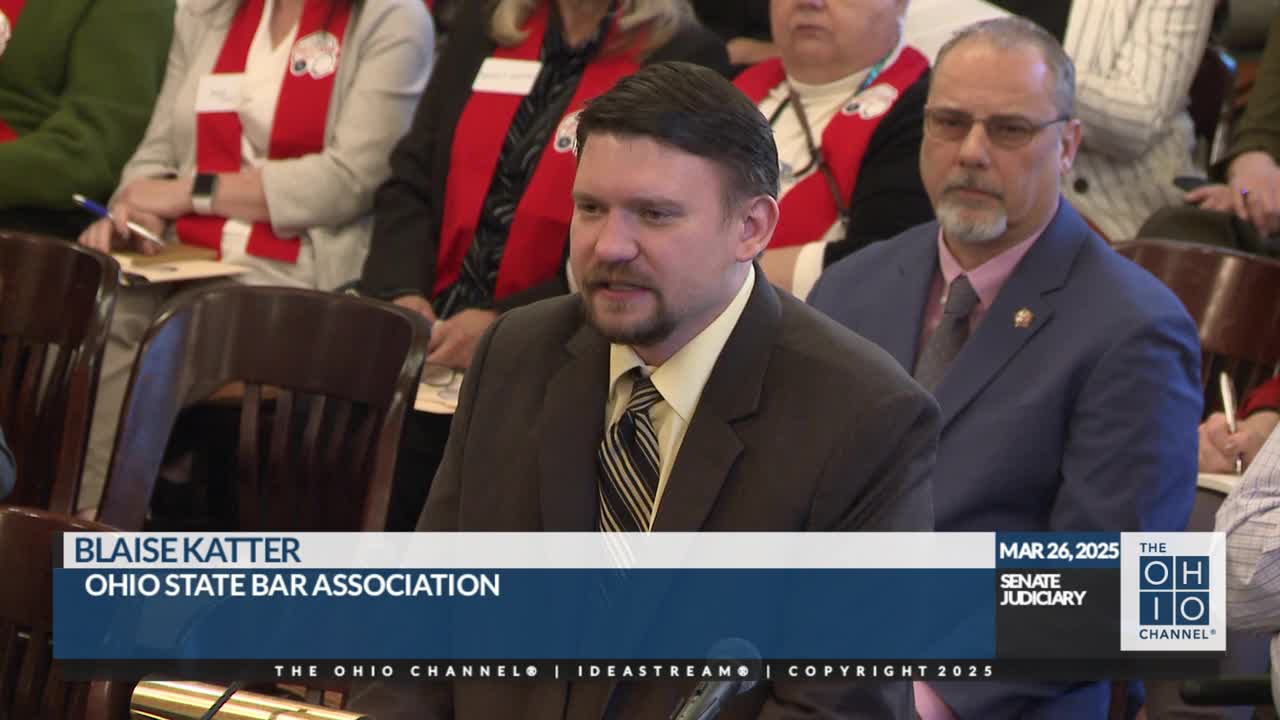
Attorney Blaise Katter, appearing on behalf of the Ohio State Bar Association, told the Senate Judiciary Committee that Senate Bill 55 seeks to refocus OVI prosecutions on impairment rather than the mere presence of marijuana metabolites.
"It is criminalizing the mere inactive or non psychoactive ingredient, the marijuana metabolite, which is called carboxy THC," Katter said. He explained that carboxy THC can remain in the body for days, weeks or months after use, whereas the active ingredient delta-9 THC produces impairment for a far shorter period.
Katter described the scientific difficulty of establishing a per se impairment threshold for marijuana that would mirror alcohol’s predictable blood-alcohol levels. He said a 2017 National Highway Traffic Safety Administration report to Congress concluded there is no reliable single number that predicts impairment for marijuana.
Under current Ohio law, Katter said, the presence of a metabolite can be treated as conclusive proof of an OVI without other evidence of impairment. "The prosecutor would stand up and say, I don't need to show that the person's impaired," he told the committee, and he cited Ohio Supreme Court precedent limiting the use of evidence about sobriety in per se tests.
Katter described Senate Bill 55 as an attempt to provide prosecutors and jurors with better evidentiary tools to determine impairment while preserving law-enforcement roadside investigations such as standardized field-sobriety tests and Drug Recognition Evaluator (DRE) evaluations. He said the bill would allow an inference to be drawn from chemical tests that can be weighed by the trier of fact rather than operating as an automatic conviction based solely on metabolite presence.
Other proponent witnesses — Hannah Cubbins of Americans for Prosperity and later questions from committee members — echoed the need to align statutory language with scientific evidence and to avoid criminalizing lawful adult cannabis use when the person is not impaired.
Committee members asked about retroactivity and thresholds. Katter said unwinding prior convictions would be difficult in practice and suggested targeted relief for collateral consequences, such as administrative licensing records, could be one approach. He also discussed oral-fluid testing and the difficulty of identifying a universal numeric threshold for impairment.
Ending: The committee took proponent testimony; no vote was recorded. The bill remains under committee consideration.