Get Full Government Meeting Transcripts, Videos, & Alerts Forever!
Get email alerts on the Police Quotas topic
No spam. Unsubscribe anytime.
Police unions and advocates back bill to ban ticket and arrest quotas after whistleblower testimony
Summary
At a second hearing on Senate Bill 114, proponent testimony — including a former patrol commander who said a quota ended his career — urged lawmakers to prohibit quotas and create anonymous reporting to the attorney general.
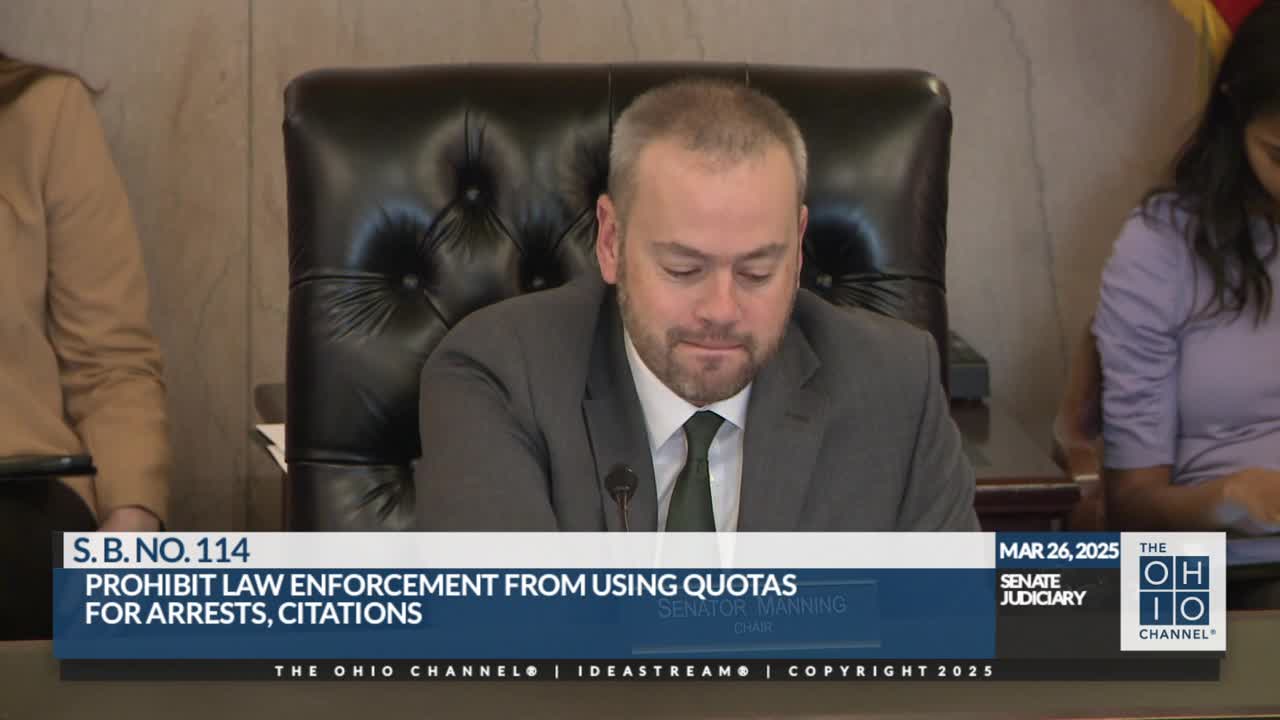
The Senate Judiciary Committee held a second hearing on Senate Bill 114, which would prohibit ticket and arrest quotas in Ohio law enforcement agencies and provide an anonymous reporting mechanism to the attorney general for alleged quota use.
Emily Cole, executive director of Ohio Families Unite for Political Action and Change (OFUPAC), testified the bill would reduce unnecessary interactions between officers and Ohioans and help prevent revenue generation from becoming a policing priority. She said: "Productivity in a department should never be tied to police enforcement mechanisms," and described quotas as counterproductive to public safety.
Law-enforcement unions testified in support. George Sokolakis, director of organization for the Ohio Patrolmen’s Benevolent Association, said quotas exist in many agencies even when not labeled ‘‘quotas’’ and described disguised systems using performance standards, log‑sheet metrics, or incentive pay. The Fraternal Order of Police’s Travis Parker and the Ohio PBA supported the measure’s anonymous reporting and accountability provisions.
Lieutenant Leonard Mazzola (ret.) of Independence delivered extended proponent testimony describing his experience: he said a performance standard requiring officers to write 10 tickets per month with a 90‑day rolling assessment was implemented in his department after a directive from leadership; media coverage followed and, he said, he was subjected to polygraph testing, disciplinary threats and an ultimatum to resign that ended his career. Mazzola said he filed suit and ultimately received a settlement, and he urged the committee to prohibit quotas as unethical and harmful to community trust.
Committee members asked about how supervisors would ensure officers perform their duties without numeric targets. Witnesses said strong leadership, supervisory ride‑along and non‑numeric performance measures are alternatives. The chair recorded the hearing as the second hearing on Senate Bill 114; no committee vote was taken.