Get Full Government Meeting Transcripts, Videos, & Alerts Forever!
Get email alerts on the Police Quotas Ban topic
No spam. Unsubscribe anytime.
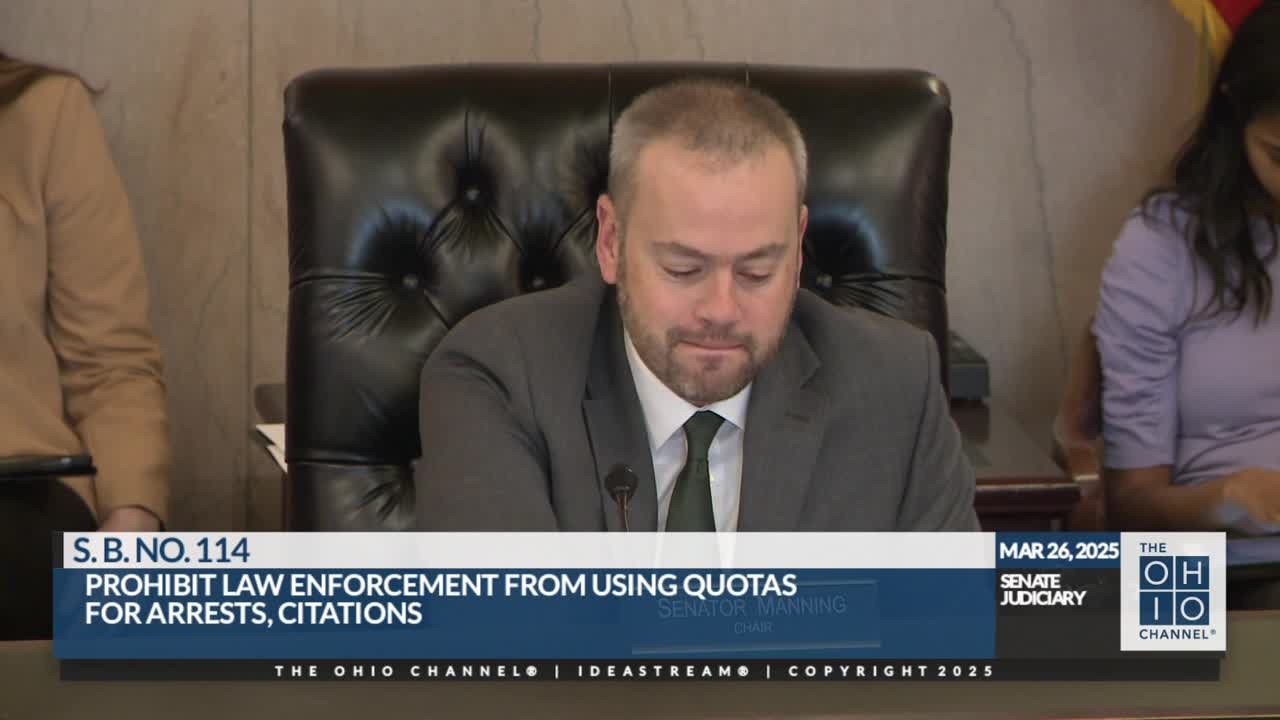
Former officer, unions and advocates back bill to ban police ticket and arrest quotas in Ohio
Summary
Police unions, advocacy groups and a former patrol commander urged the Senate Judiciary Committee to ban ticket and arrest quotas, which witnesses said remain embedded in agency culture and can be disguised as performance standards.
Victims' families groups, police unions and a former patrol commander urged the Senate Judiciary Committee to pass Senate Bill 114, which would prohibit ticket and arrest quotas and create an anonymous reporting and investigation process through the attorney general.
Emily Cole of Ohio Families Unite for Political Action and Change told the committee the bill would reduce unnecessary police interactions and stop departments from prioritizing revenue over public safety. Labor and police organizations — including representatives of the Ohio Patrolmen’s Benevolent Association and the Fraternal Order of Police — described quotas as unethical and pro‑revenue practices that persist despite not being openly labeled as "quotas." George Sokolakis, director of organization for the Ohio PBA, said quotas are sometimes hidden as "performance standards" or embedded in evaluation systems and that "they are alive and well."
Former Independence patrol commander Leonard Mazzola described his experience: he said his department implemented a performance standard that required each officer to write 10 tickets per month on a 90‑day rolling assessment. Mazzola said the patrol division's ticket production increased 27% while labor hours dropped 9.7%; he reported being singled out after media exposure and said he resigned in 2019 under pressure after internal discipline and polygraph tests. "Ticket quotas are unethical and immoral and need to be against the law in the state of Ohio," Mazzola told the committee.
The bill would permit officers to report suspected quota policies anonymously to the attorney general for investigation, witnesses noted, and include protections against retaliation. Committee members asked how police supervisors would otherwise ensure officers perform core duties; union witnesses said strong leadership and supervision, rather than numeric targets, are the appropriate management tools.
The committee recorded the session as the second hearing on Senate Bill 114; no committee vote was taken.