Get Full Government Meeting Transcripts, Videos, & Alerts Forever!
Get email alerts on the Policing topic
No spam. Unsubscribe anytime.
Law‑enforcement unions and victims of quotas testify in favor of bill to ban ticket and arrest quotas
Summary
The Senate Judiciary Committee heard proponent testimony on Senate Bill 114, which would ban ticket and arrest quotas in Ohio law‑enforcement agencies and allow anonymous reporting to the attorney general for suspected quota use.
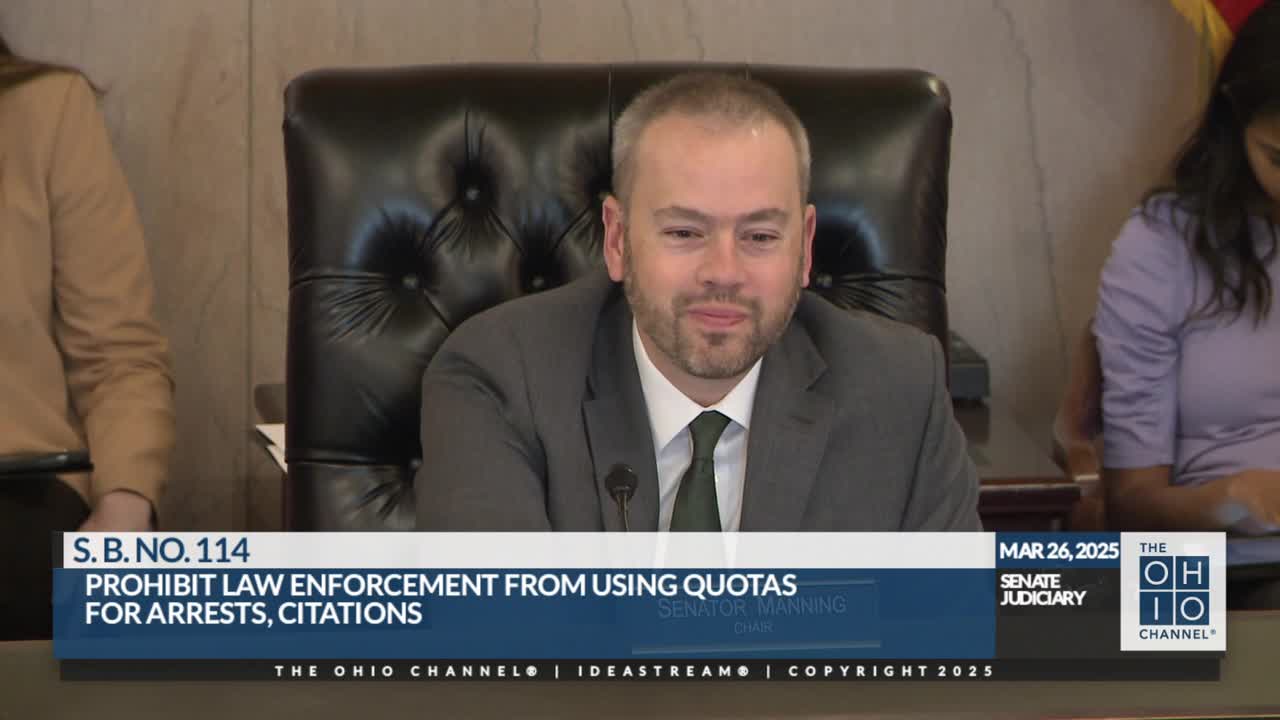
The Senate Judiciary Committee took proponent testimony on Senate Bill 114, a bill to prohibit ticket and arrest quotas by Ohio law-enforcement agencies and to create an anonymous reporting route to the attorney general for officers who believe quotas are in use.
Multiple law‑enforcement organizations supported the bill. George Sokolakis of the Ohio Patrolmen’s Benevolent Association said quotas are “alive and well” despite being widely condemned and argued their existence undermines trust between police and communities. “There is no safety based justification to them at all,” Sokolakis said, and described quotas disguised as “performance standards,” evaluation metrics or unsigned directives that pressure officers to issue citations to meet numeric targets.
Travis Parker of the Fraternal Order of Police said quotas shift an officer’s discretion away from public‑safety decisions and toward meeting arbitrary numerics, and praised the bill’s anonymous reporting and investigation provisions. Sergeant Leonard Mazzola of the Independence Police Department recounted his experience as a patrol commander, saying a quota implemented by his department in 2018 forced him into a career‑ending conflict with the chief and the mayor. Mazzola described disciplinary actions, polygraph testing and a subsequent federal lawsuit and settlement tied to his refusal to enforce a quota; he told the committee the practice damaged public trust.
Committee members asked whether a quota finding could invalidate an arrest or citation. Witnesses said the bill’s primary remedy is administrative—investigation and discipline at the agency level—and they were not certain a quota would necessarily alter the admissibility of evidence in an individual criminal case. Chair Manning and others said the state’s troopers manage traffic enforcement without quotas and attributed quota use to leadership failures in some local jurisdictions.
Proponents urged passage to protect officers from being treated as revenue generators and to reinforce that policing decisions should be driven by public safety. The committee recorded SB 114 as having had a second hearing; there was no committee vote during the session.