Get Full Government Meeting Transcripts, Videos, & Alerts Forever!
Get email alerts on the Marijuana Ovi Law topic
No spam. Unsubscribe anytime.
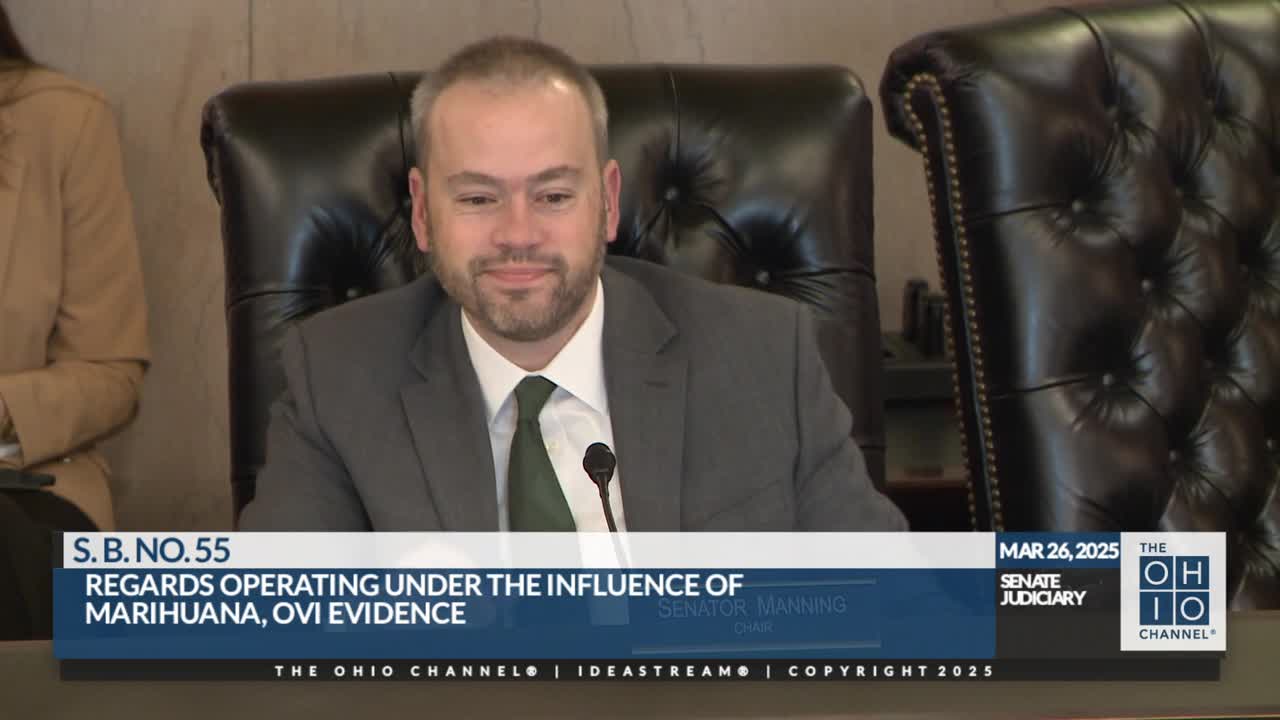
Proponents tell judiciary committee bill would refocus Ohio OVI law to impairment, not metabolites
Summary
Attorney Blaise Katter and other proponents testified in favor of Senate Bill 55, which would change how marijuana-related evidence is used in OVI prosecutions by allowing certain test results (including metabolites and oral-fluid measures) to support an inference of recent use or impairment rather than serving as a per se basis for conviction. K
Attorney Blaise Katter, testifying on behalf of the Ohio State Bar Association and criminal-defense interests, urged the Senate Judiciary Committee to reframe Ohio’s approach to marijuana-impaired driving in Senate Bill 55 so that prosecutions focus on impairment rather than the mere presence of metabolites in a person’s body.
"It is criminalizing the mere inactive or non psychoactive ingredient, the marijuana metabolite, which is called carboxy THC," Katter told the committee. He said Ohio currently allows evidence of that metabolite to function as a per se proof of an OVI offense, even though carboxy THC is non‑psychoactive and can remain in fat cells for days, weeks or months after use.
Katter summarized the scientific and policy problem as one where per se thresholds work for alcohol but not for cannabis: alcohol levels correlate predictably with impairment, but "there is no number that can be a one size fits all" for marijuana, he said. He cited the National Highway Traffic Safety Administration’s 2017 report to Congress, which he said concluded that science cannot identify a single numeric threshold for impairment.
Under SB 55, proponents described, metabolite and other test results would be admissible to create an inference of recent use or impairment to supplement — not supplant — field observations and other impairment evidence. Katter said the bill would permit such test results to be weighed by the trier of fact without requiring expert testimony to admit them, drawing a comparison to the existing refusal instruction that permits juries to infer consciousness of guilt where a driver refuses testing.
Committee members asked several technical and policy questions. Sen. Reynolds (vice chair) and others expressed concern about people already convicted under the current per se structure and asked whether the bill could provide retroactive relief. Katter responded that unwinding past convictions would be “an extreme difficulty” in most cases and said targeted relief to administrative records — for example, license-related entries at the Bureau of Motor Vehicles — might be a more practical remedy than wholesale vacatur of convictions.
Sen. Gavirone asked about blood tests that identify active delta‑9 THC and why a proposed threshold might be increased from 2 to 5 (units discussed in testimony as nanograms). Katter explained that some studies show frequent users can have resting delta‑9 blood levels in the 5–15 nanograms range and that delta‑9 concentrations can persist or fluctuate due to fat-cell release, so numeric thresholds are an imperfect proxy for impairment.
Hannah Cubbins, legislative director for Americans for Prosperity Ohio, also testified in favor of SB 55, saying the bill balances public safety and the science of cannabis metabolization and helps avoid convictions of legally allowed consumers who are not impaired.
The committee recorded the session as SB 55’s second hearing; no vote or amendment was taken at the meeting.