Get Full Government Meeting Transcripts, Videos, & Alerts Forever!
Get email alerts on the Impaired Driving And Cannabis topic
No spam. Unsubscribe anytime.
Committee hears experts on bill to change how marijuana tests are used in OVI cases
Summary
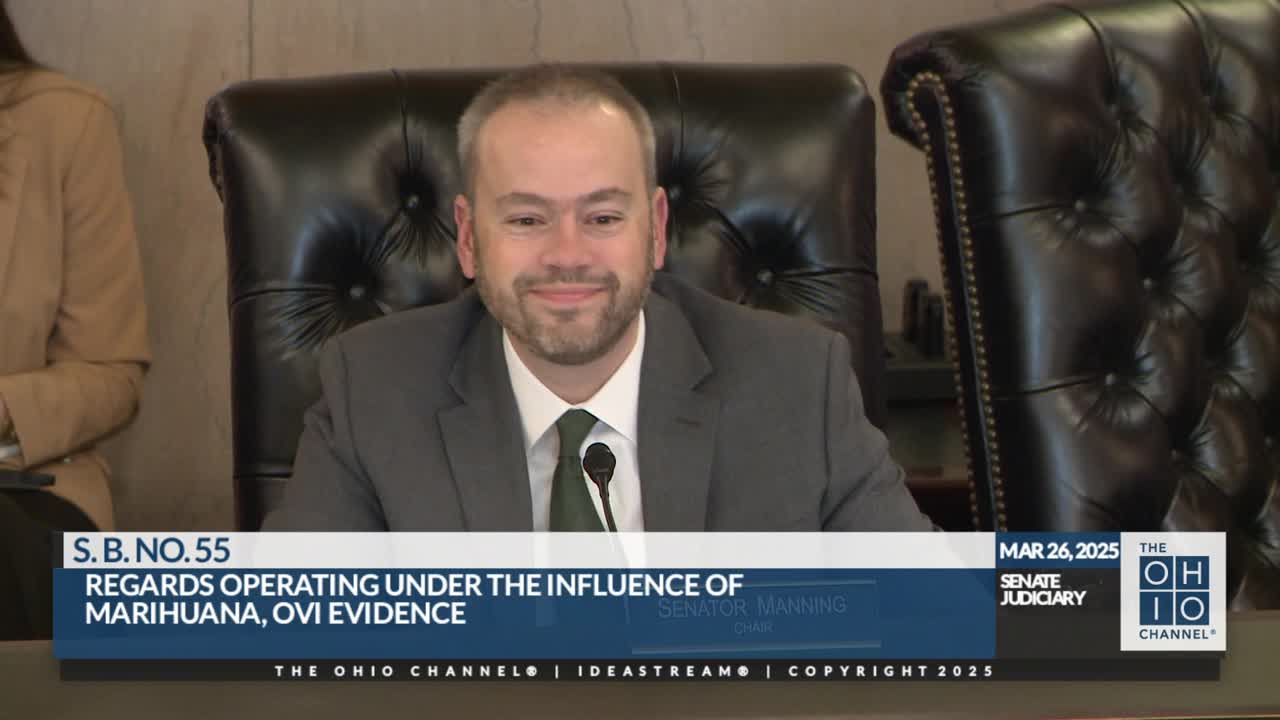
At a second hearing on Senate Bill 55, the committee heard proponent testimony arguing the presence of marijuana metabolites should not be treated as per se proof of impairment and that the bill would refocus prosecutions on observed impairment.
The Senate Judiciary Committee held a second hearing on Senate Bill 55, a measure proponents say modernizes Ohio’s OVI law to reflect scientific limitations in correlating marijuana metabolites to impairment. Attorney Blaise Katter, testifying on behalf of the Ohio State Bar Association, and other proponent witnesses told the committee that current per se rules can criminalize individuals who are not actually impaired at the time they drove.
Katter told the committee he represents criminal-defense practitioners and described the scientific dispute around marijuana testing. He said Ohio currently treats the carboxy‑THC metabolite — a non‑psychoactive residue of delta‑9 THC — as evidence that can establish guilt under per se rules even when a person is not impaired. He referenced the National Highway Traffic Safety Administration’s (NHTSA) report to Congress (February 2017), saying that agency found no consensus on a numeric threshold of THC that reliably predicts impairment: "NHTSA's report to congress in 02/2017 said, with no ambiguity, it simply cannot be done," Katter said.
Katter argued the bill would preserve law-enforcement roadside investigations and standardized field sobriety testing while allowing laboratory measures to be admitted into evidence as an inference supportive of impairment rather than conclusive proof. He said the bill aims to give juries and negotiators a fuller evidentiary picture without converting metabolite presence into an automatic conviction. He also discussed emerging technologies such as oral‑fluid testing and the need to consider a broader universe of cannabis‑derived molecules beyond delta‑9 THC.
Hannah Cubbins, legislative director for Americans for Prosperity Ohio, testified in support and said the bill strikes a balance between public safety and current scientific understanding: "The mere presence of THC in a person's system is not an indication they are experiencing impairment at the time of a drug test," she told the committee.
Committee members asked about retroactivity and the potential for relief to people previously convicted under the current per se standard. Katter said unwinding past convictions would be difficult in practice and suggested targeted relief for administrative records (for example, BMV records or license suspensions) could be a feasible way to ameliorate some collateral consequences rather than wholesale retroactive relief.
The chair recorded the session as the second hearing on Senate Bill 55; no committee vote was taken.