Get Full Government Meeting Transcripts, Videos, & Alerts Forever!
Get email alerts on the OvI Marijuana Evidence topic
No spam. Unsubscribe anytime.
Lawyers, advocates debate marijuana "per se" tests as committee hears bill to refocus OVI evidence
Summary
Attorney Blaise Katter urged the Senate Judiciary Committee to refocus Ohio law on impairment rather than relying on long‑lasting marijuana metabolites as per‑se proof of driving while impaired.
Attorney Blaise Katter, testifying for the Ohio State Bar Association, urged the committee to shift Ohio's impaired-driving law away from treating nonpsychoactive marijuana metabolites as per se proof of impairment and toward evidence focused on actual impairment.
Katter told the Senate Judiciary Committee that Ohio currently treats carboxy‑THC — a metabolite left in the body long after the intoxicating effect of delta‑9 THC has ended — as conclusive evidence under the per‑se standard. "NHTSA's report to congress in 02/2017 said, with no ambiguity, it simply cannot be done," Katter said, arguing there is no single blood or fluid concentration that reliably predicts impairment the way blood‑alcohol levels do.
Katter said the bill would preserve law enforcement's roadside investigative tools — standardized field sobriety tests, ARIDE and Drug Recognition Evaluation training and probable‑cause arrests — while allowing laboratory or oral‑fluid measures to be admitted to support an inference of recent use or recency, not to act as sole proof of impairment. He described the proposal as an evidentiary compromise that could allow metabolite or oral‑fluid results to be weighed by a trier of fact without functioning as an automatic conviction.
Other proponents echoed that view. Hannah Cubbins of Americans for Prosperity and other witnesses said metabolism varies widely by person, frequency of use and body composition. Katter and others cited studies and presentations showing frequent users can have baseline delta‑9 THC in blood in the mid single digits: Katter referenced a resting range "between 5 and 15 nanograms" in some studies of frequent users and said one reason the metabolite rule is problematic is that fat‑stored THC can reenter the bloodstream with weight loss or exercise.
Committee members asked about retroactivity and relief for people previously convicted under the per‑se standard. Katter said unwinding past convictions would be "an extreme difficulty" in practice but suggested targeted relief — for example, administrative‑record remedies at the Bureau of Motor Vehicles — might ameliorate collateral consequences without reopening broad numbers of cases.
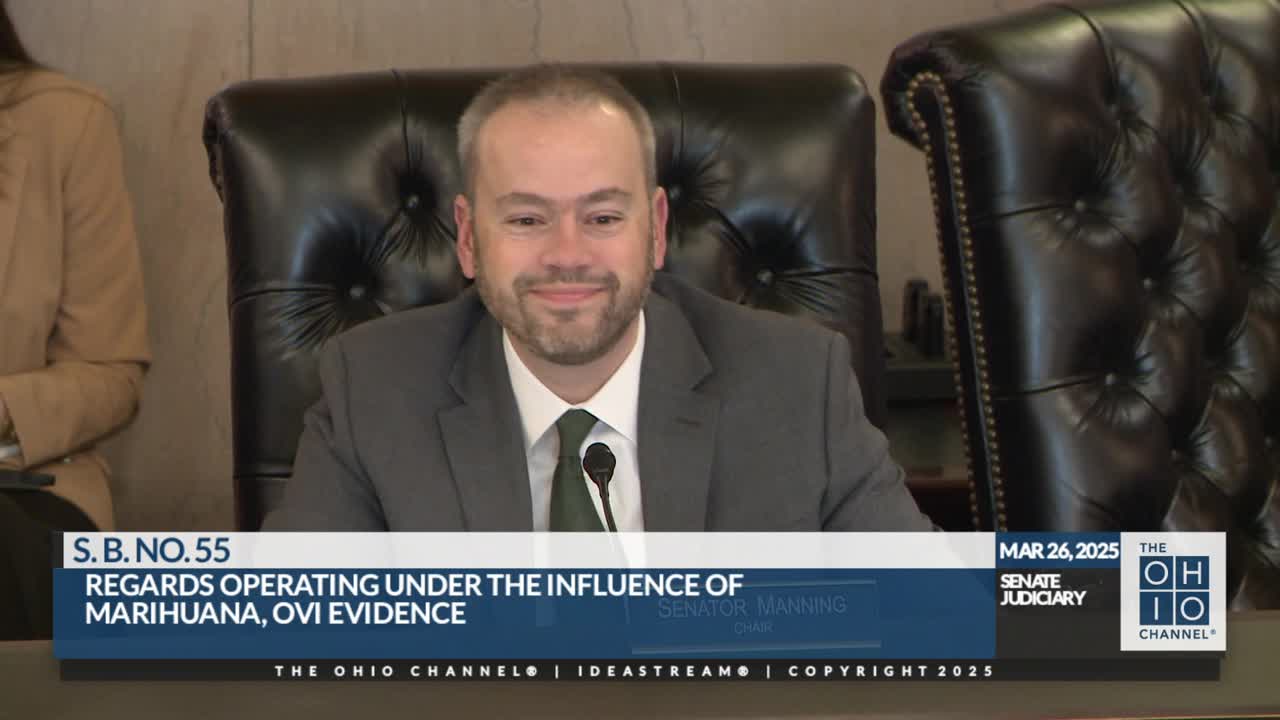
No committee vote was taken. The committee recorded the session as the second hearing on Senate Bill 55.