Get Full Government Meeting Transcripts, Videos, & Alerts Forever!
Get email alerts on the Public Safety topic
No spam. Unsubscribe anytime.
Panel hears testimony on changing Ohio’s marijuana OVI rules to emphasize impairment over metabolite presence
Summary
The Senate Judiciary Committee received proponent testimony on Senate Bill 55, which would change how marijuana-related impaired-driving cases are proved by emphasizing impairment and allowing certain test results to support inferences of recent use rather than serving as automatic per se proof.
The Senate Judiciary Committee received proponent testimony on Senate Bill 55, which would revise how marijuana-related impaired-driving cases are proved in Ohio.
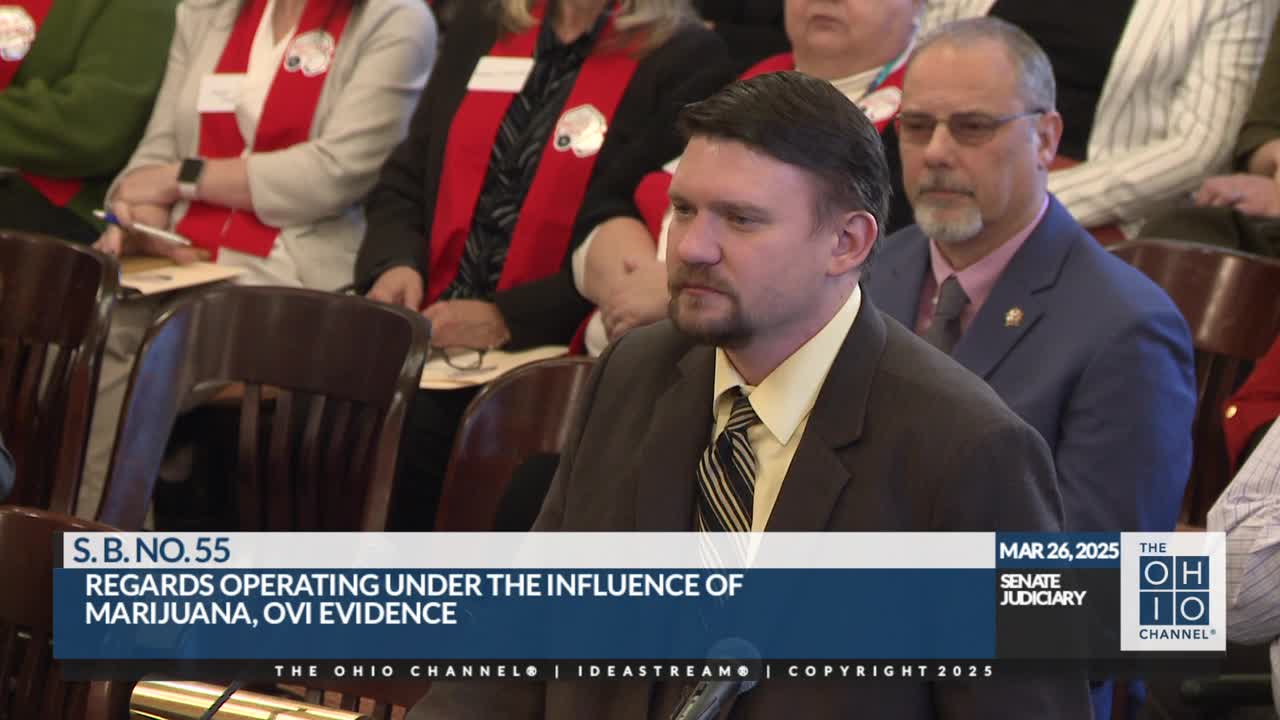
Attorney Blaise Katter, testifying on behalf of the Ohio State Bar Association, told the panel that current Ohio law criminalizes the presence of the marijuana metabolite carboxy‑THC and that the state’s per se approach can convict people absent evidence of impairment. “It is criminalizing the mere inactive or non psychoactive ingredient, the marijuana metabolite, which is called carboxy THC,” Katter said. He explained that carboxy‑THC can remain in the body for days, weeks or months after use, especially in frequent users, and therefore a numeric threshold for that metabolite does not reliably indicate current impairment.
Katter said SB 55 aims to refocus prosecutions on whether a driver is actually impaired. He described the bill as an “evidentiary” reform that would allow test results—including blood and emerging oral‑fluid measures—to be offered to support an inference of recent use and possible impairment, rather than serving as an automatic per se proof of OVI. He said the bill would preserve law enforcement’s roadside investigations and training tools, while giving prosecutors additional evidence to present to a jury or during plea negotiations.
Katter emphasized scientific limitations: he cited the National Highway Traffic Safety Administration’s 2017 report to Congress, saying the agency concluded that no single numeric cutoff reliably predicts impairment from cannabis. He also noted Ohio Supreme Court precedent that limits irrelevant evidence in per se proceedings. Committee members asked technical and remedial questions about retroactivity and thresholds. Vice Chair Reynolds raised concerns about people already convicted under the older standard and asked whether relief or expungement might be appropriate; Katter said unwinding prior convictions would be “an extreme difficulty” and that targeted relief (for example, administrative-record remedies at the Bureau of Motor Vehicles) might be more feasible.
Other proponent witnesses included Hannah Cubbins of Americans for Prosperity Ohio, who said the bill “strikes an important balance between maintaining public safety and recognizing the science of cannabis,” and several witnesses who urged inclusion of oral‑fluid testing and thoughtfully chosen thresholds for inference. The committee recorded the matter as having had its second hearing; no committee vote was taken during the session.
The hearing record includes technical claims about baseline levels of delta‑9 THC in frequent users (witnesses cited ranges and a testing methodology they said researchers use to determine “resting” levels), and proponents repeatedly recommended that any numeric thresholds align with existing per se standards to reduce disruption of enforcement practice. Those numeric proposals were discussed in general terms; the hearing did not produce a final, agreed numeric threshold or retroactivity mechanism.