Get Full Government Meeting Transcripts, Videos, & Alerts Forever!
Get email alerts on the Video Record Fees topic
No spam. Unsubscribe anytime.
Sen. Hicks Hudson opens hearing on bill to bar law-enforcement fees for videos depicting individuals
Summary
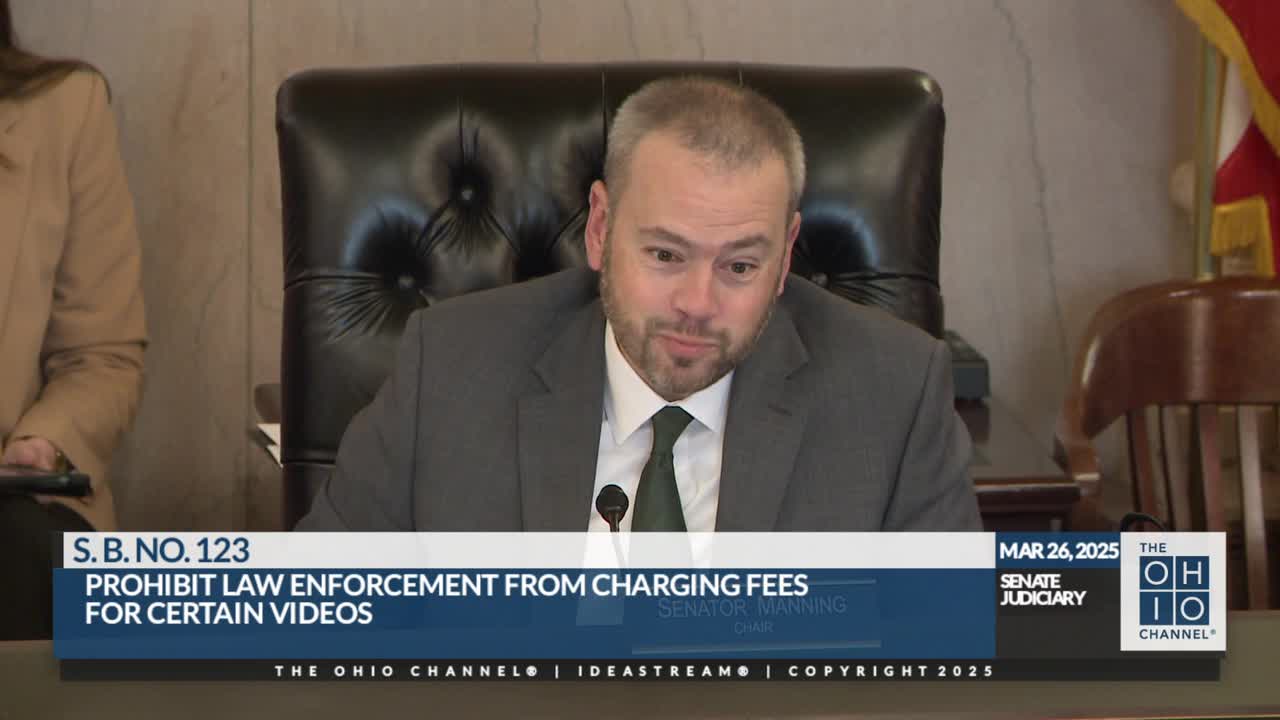
Sen. Hicks Hudson, the ranking member on the Senate Judiciary Committee, gave sponsor testimony at the committee’s hearing on Senate Bill 123, which would prohibit law-enforcement agencies from charging fees to prepare or produce video records when the requester is an individual known or presumed to be depicted in the video or a close representative such as a spouse or parent.
Sen. Hicks Hudson, the ranking member on the Senate Judiciary Committee, gave sponsor testimony at the committee’s hearing on Senate Bill 123, which would prohibit law-enforcement agencies from charging fees to prepare or produce video records when the requester is an individual known or presumed to be depicted in the video or a close representative such as a spouse or parent.
Hudson told the committee the bill is intended to limit the financial burden on people appearing in government-produced video footage and to correct an unintended consequence from recent legislation. "This bill would prohibit law enforcement from charging fees... The senate bill 123 prohibits a video record for inspection or production when the requester of the video record is an individual known or presumed to be depicted in the video or a representative," Hudson said during her sponsor remarks.
The bill responds to a change placed into law during the close of the prior General Assembly, which Hudson described as part of House Bill 315. Under that change, she said, a law-enforcement agency may determine actual costs for preparing video records "including all costs incurred in reviewing, blurring, or otherwise obscuring, redacting, uploading, or producing the video records, including but not limited to the storage medium on which the record is produced, staff time, and any other relevant overhead necessary to comply with the request." Hudson argued that provision could impose "exorbitant" costs on individuals who wish to obtain footage that depicts them.
Hudson acknowledged smaller agencies may face staffing or technical constraints and said the bill seeks to balance agency costs with individuals’ access. "I do understand that there is a need to consider, moderate cost to smaller agencies who may not have the bandwidth or the wherewithal to do that. But I think we have to balance that with the idea of an individual who is depicted in these videos from being able to obtain that information," she said.
Hudson also distinguished requesters who seek footage for publication or personal promotion from individuals who are seeking their own footage to defend themselves or investigate potential wrongdoing. The bill would narrow who may be charged preparatory fees, she said, to avoid sweeping affected individuals into a category intended to address third‑party commercial requests.
The committee did not take a vote; the chair closed the hearing by recording that SB 123 "will stand as the first hearing on Senate Bill 123." No formal action or committee amendment was recorded at the hearing.
Ending: The committee accepted Hudson’s sponsor testimony and recorded the item as the bill’s first hearing; committee members asked no follow-up questions on the record during the session.