Get Full Government Meeting Transcripts, Videos, & Alerts Forever!
Get email alerts on the Clean Energy topic
No spam. Unsubscribe anytime.
District committee and consultants outline path to 50% carbon-neutral operations by 2035
Summary
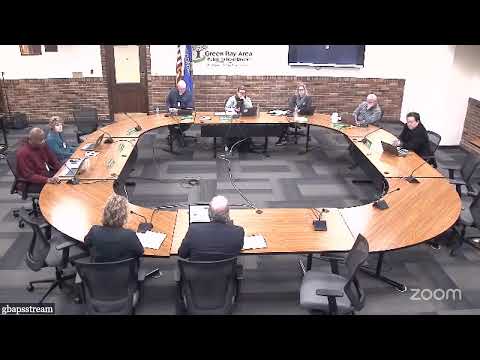
District officials and members of the Clean Energy Advisory Committee presented a recommendation and roadmap on Jan. 13 aimed at reaching the district's interim clean-energy targets, including a 50 percent carbon-neutral operations goal by Feb. 1, 2035.
District officials and members of the Clean Energy Advisory Committee presented a recommendation and roadmap on Jan. 13 aimed at reaching the district's interim clean-energy targets, including a 50 percent carbon-neutral operations goal by Feb. 1, 2035.
The presentation, led by McKinstry consultants Scott Johnson and Ryan Hoth and introduced by Cale Polchinski, Green Bay Area Public School District chief operating officer, summarized a greenhouse-gas baseline, five strategy pillars (on-site solar, facility electrification, fleet electrification, facility improvements, and off-site carbon-free purchases) and immediate next steps for implementation.
Why it matters: the committee's work maps technical options to district facilities and budgets and seeks to align capital-planning decisions with the board's sustainability resolution. Board members and students on the committee said visible projects such as solar arrays would help public communication and engagement.
Key findings and recommendations
McKinstry presented that about 58 percent of the district's emissions currently come from electricity use and about 42 percent from fossil fuels. The consultants estimated the district could provide roughly 60 percent of its electricity with on-site solar arrays sited across the portfolio, while the remaining electricity would require off-site carbon-free procurement with local utilities. To eliminate fossil-fuel emissions, McKinstry recommended systematic electrification of building systems and fleet.
McKinstry proposed phasing electrification with the assumption of converting two buildings per year starting in 2028 and converting roughly five percent of the non-student-transport fleet per year. The presentation stressed coordinating upgrades with capital-replacement cycles (for example, installing solar during planned roof replacements) to reduce incremental costs.
Near-term actions proposed
- Continue prioritizing energy efficiency across the portfolio, including monitoring-based commissioning and retro-commissioning of lower-performing buildings. - Develop an electrification roadmap and cost estimate (scope, sequencing, and capital needs) to support budgeting decisions. - Increase district solar capacity at good candidate sites and consider grant or federal funding now available to help offset installation costs. - Stand up a waste-diversion committee to build data on recycling and pilot improvements. - Institute annual greenhouse-gas quantification and public dashboards to track progress and engage students, staff and the community.
Student and community engagement
Several student members of the Clean Energy Advisory Committee spoke at the meeting. Tatum Eisenreich and Kendall Blahnik (students on the committee) described their participation and encouraged continued student recruitment to increase visibility and community alignment. Board members and staff praised the students' work and urged continued public education and intergovernmental coordination with the City of Green Bay.
Costs and funding
McKinstry noted that federal incentives and grant opportunities may provide substantial near-term funding for solar projects and estimated potential federal support in the low millions; consultants urged acting promptly while funds are available. District staff and board members discussed timing, prioritization and how the strategy must be folded into the district's master facility planning and referendum-funded projects.
Next steps
District staff will use the committee recommendations to refine capital planning and to return to the board when specific funding or timetable decisions are needed. The district intends to use the Clean Energy Advisory Committee and consultant work to inform project sequencing and to identify funding pathways.