Get Full Government Meeting Transcripts, Videos, & Alerts Forever!
Get email alerts on the Constitutional Amendment Article V topic
No spam. Unsubscribe anytime.
Ohio GOP sponsors call for Article V convention to seek balanced budget, limit federal power, and impose term limits
Summary
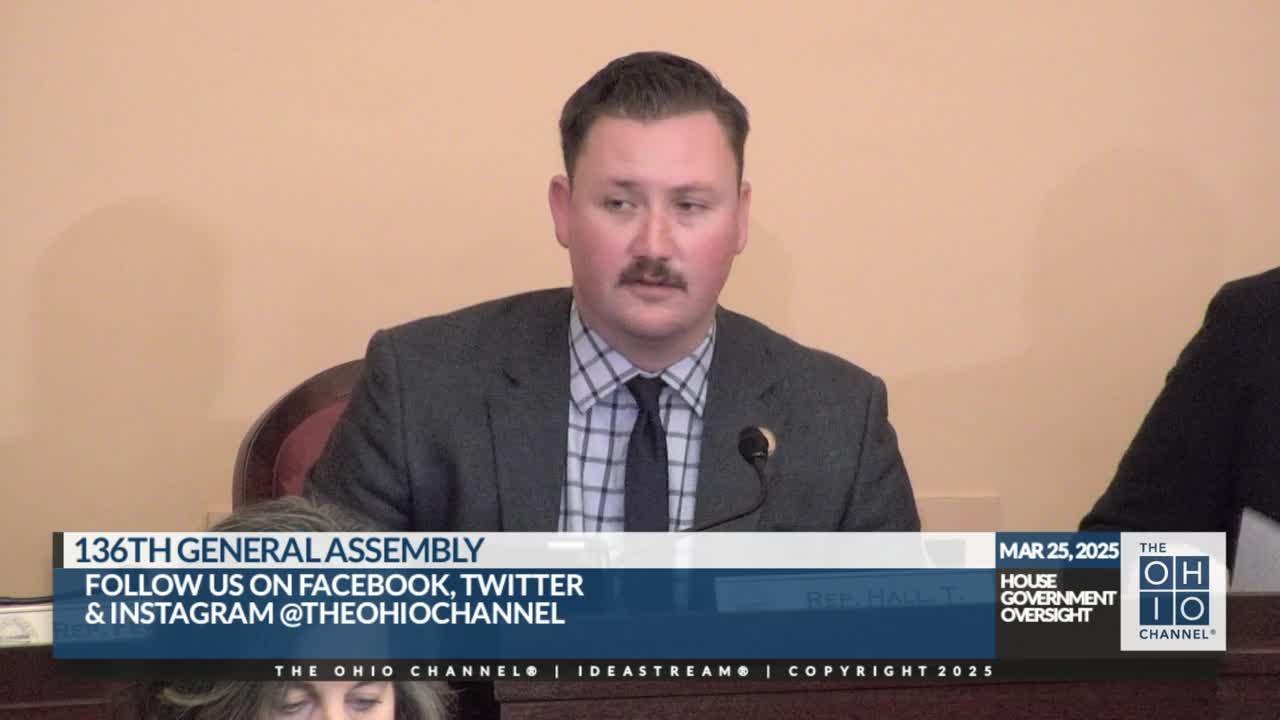
Representative McLean, sponsor of House Joint Resolution 2, told the House Government Oversight Committee the resolution “issues a call for a convention of states under article 5 of the US constitution to propose amendments regarding limited subjects.”
Representative McLean, sponsor of House Joint Resolution 2, told the House Government Oversight Committee the resolution “issues a call for a convention of states under article 5 of the US constitution to propose amendments regarding limited subjects.”
The resolution would ask Ohio to join other states in a call for an Article V convention limited to three subjects: imposing fiscal restraints (including a balanced-budget amendment), limiting federal power and jurisdiction, and establishing term limits for federal officials, sponsors said.
The proposal matters because an Article V convention requires two-thirds of states (34) to pass similar calls and three-fourths of states (38) to ratify any amendments, making the process consequential and rare. Sponsors said the measure would pressure Congress to act and, if necessary, invite states to propose amendments through the convention mechanism.
Committee members questioned how delegates would be kept to the stated subject matter and how the process would avoid a so-called runaway convention. Representative Burrows asked whether delegates could change the scope once at a convention; McLean replied the intent is that the convention would be called on “specific subject matter” and that objections could be raised to out-of-bounds topics. McLean acknowledged there is legal debate among scholars about whether an Article V convention could stray from the call and said proponents expect to bring legal experts to testify before the legislature.
Members also pressed sponsors on protection for existing federal programs. Representative Rader asked how Social Security and Medicare would be safeguarded; Representative Willis, a co-sponsor, pointed to the constitutional ratification bar, saying any amendment would still need approval by 75% of the states. Sponsors repeatedly said they are not prescribing specific amendment language and that individual states and the convention delegates would determine details such as term-limit lengths.
Skeptical lawmakers raised historical and practical concerns. Representative Troy and others warned that past constitutional change has been rare and that the convention mechanism carries legal and political risk. Several members asked sponsors to provide precedents and legal analyses; sponsors said they would supply lists of past state convention calls, mock‑convention results, and expert testimony.
Sponsors and several committee members also discussed the political context: supporters argue the federal government has grown too large, citing a national debt figure mentioned in testimony ($36,000,000,000,000), while critics said deficit spending has historically funded emergencies such as World War II and the Great Depression and expressed concern about unintended effects on entitlements or emergency powers.
The hearing concluded with sponsors offering to return with additional information, legal analyses, and proposed procedures for how delegates would be selected and bound. No vote was taken at the hearing.
Ending: The committee moved on after the hearing; sponsors said they expect more testimony in coming months and offered to supply legal and historical materials to the committee.