Get Full Government Meeting Transcripts, Videos, & Alerts Forever!
Get email alerts on the Government Oversight topic
No spam. Unsubscribe anytime.
Bill would bind Ohio delegates to Article V convention with oath, recall procedure and felony penalty
Summary
House Bill 67 would create state statute defining delegate selection, recall, oath and criminal penalties intended to keep Ohio delegates within the subjects set by the General Assembly if an Article V convention is called. Sponsors said the bill sets an odd-number delegation, advisory committee and limits on amendments delegates may consider.
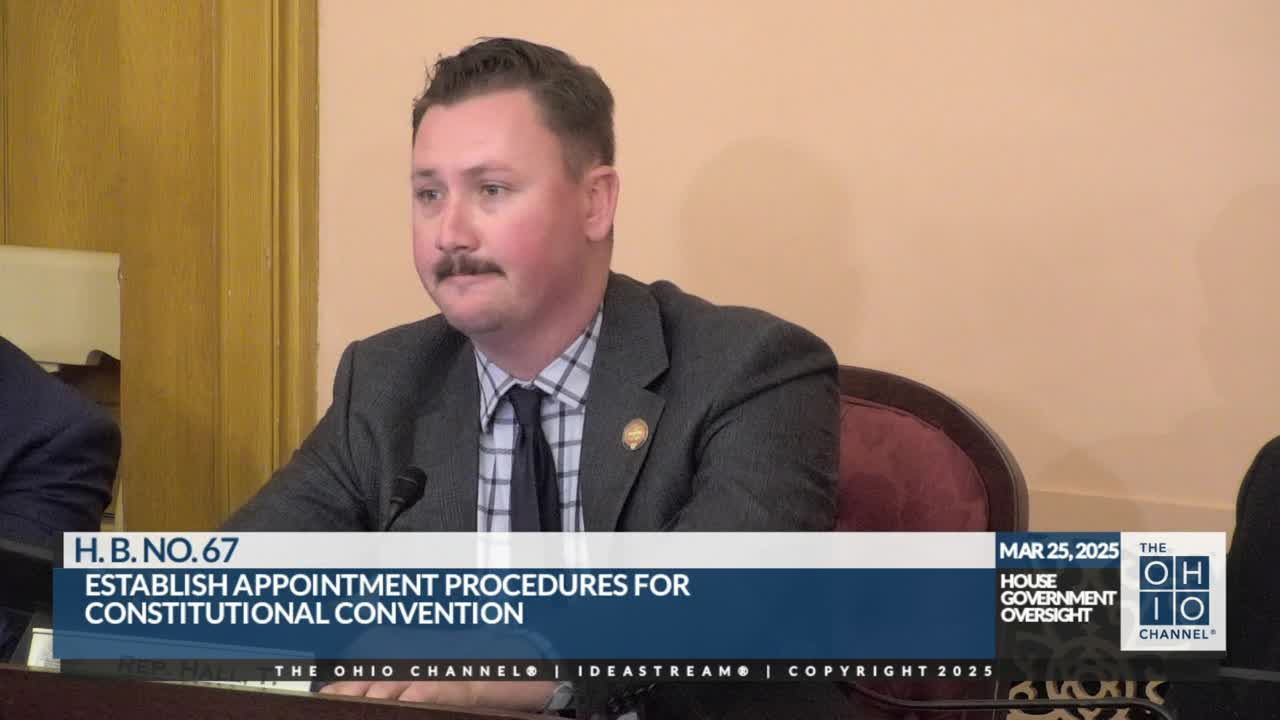
Sponsors told the House Government Oversight Committee that House Bill 67 would establish state law to govern any Ohio delegation to an Article V convention, including selection procedures, an odd-numbered delegation, eligibility rules, compensation, a recall process, an oath and criminal penalties for violations.
“...this defines the number of delegates sent to a convention. We define it as an odd number,” Representative MacLean said while summarizing HB 67. He said the bill would create an advisory committee to oversee delegates and would make certain actions by delegates a felony of the third degree if they violate their oath.
Under the text described by sponsors at the hearing, HB 67 would: set a selection process and eligibility requirements for delegates; authorize compensation; require an oath of office; permit legislative recall if delegates stray from authorized instructions; create an advisory commission appointed by legislative leadership; and prohibit delegates from proposing or voting on changes to the Bill of Rights and several enumerated amendments (sponsors cited the 13th, 14th, 15th, 19th and several 20th-century amendments by number).
Sponsors described the penalty for an unauthorized delegate action as a third-degree felony and said the statute would give Ohio mechanisms to remove or recall a delegate who votes outside the state’s instruction. “This does allow them to receive compensation for their time in attending the convention,” MacLean said, adding the bill “spells out the delegate roles” and provides an advisory committee.
Committee members pressed sponsors on the legal authority to bind a single state’s delegates when delegates from other states would not be similarly constrained. Representative Gross asked what legal authority would permit Ohio to require delegates to follow instructions; sponsors replied HB 67 would create Ohio statutory authority in the Ohio Revised Code and would include recall and criminal penalties under state law.
Representative Rader questioned why appointment power for the advisory commission rested with majority leadership and whether the minority party or public input would be included; sponsors said the bill reflects how the legislature exercises its authority and can be amended to change selection mechanics. Representative Troy and others warned of partisan consequences if appointment authority rests with a single party, and sponsors reiterated that ratification thresholds and multi-state requirements remain high.
Sponsors promised to provide a fuller list of other states’ faithful-delegate statutes and to invite legal experts for proponent and opponent testimony in future hearings. The committee concluded the first hearing on HB 67 without a vote.