Get Full Government Meeting Transcripts, Videos, & Alerts Forever!
Get email alerts on the Regional Water Infrastructure topic
No spam. Unsubscribe anytime.
Pawauque Basin regional water system construction underway; county briefed on schedule, cost and interconnect plans
Summary
Bureau of Reclamation-led Pawauque Basin Regional Water System is under construction and Santa Fe County staff briefed commissioners on phase-by-phase progress, the project ceiling and the planned interconnect with the county water system.
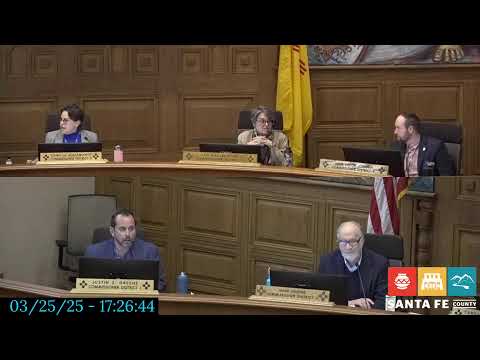
Santa Fe County project staff told commissioners March 25 that construction of the Pawauque Basin Regional Water System — part of the Pojoaque (Pawauque) Basin water settlement — is underway, with substantial work completed on the intake and water-treatment facilities and additional phases planned to bring treated Rio Grande water to Pueblos and Santa Fe County users.
The presentation, delivered by Scott Casement, Santa Fe County project manager for the Pawauque Basin work, outlined the system’s scope (intake/collector wells on the Rio Grande, a water treatment plant, 151 miles of transmission/distribution pipelines, six pump stations and multiple storage tanks) and the phased construction schedule. Casement said phase 1 is roughly 48% complete and estimated a phase-1 finish of August 2027; phase 2 design and procurement are advancing with staged construction expected through 2028. Phase 3 (distribution to individual connections) remains in scoping and depends on landowner participation and well-election decisions under the settlement.
Why it matters The project will deliver up to 2,500 acre-feet per year of consumptive water and create a regional resource that the county and four Pueblos will operate through a regional authority once agreements and operating plans are finalized. Casement described an interconnect and reverse-flow design that will allow the system to tie into the county water system near Tesuque; the interconnect will help address water-quality concerns caused by long residence times in distribution mains and give the region additional operational flexibility.
What the county reported Casement told commissioners that hundreds of easements are required; phase 1 requires 70 easements, and county staff are procuring right-of-way-acquisition services. He also reported updated cost indexing: a county share indexed through 2023 was approximately $21.4 million (to cover the county’s upsizing and interconnect work), while the Bureau of Reclamation’s project ceiling was recently indexed from $522 million to $734 million and could reach an estimated $777.5 million by 2026 using project-specific escalation rates. Casement said some non-contract costs remain to be resolved by BOR and partners.
The board and staff are coordinating outreach: county staff will host open houses and water fairs in April and May to explain the project, assist landowners with well elections under the AMIT settlement, and gather distribution preferences. Casement said construction partner CDM Smith has provided a draft operations & maintenance plan that local partners are reviewing and that an operations agreement between the county and the pueblos is in preparation for governing-body consideration.
Ending Commissioners thanked staff for the update and asked that the presentation be shared with the county Water Policy Advisory Committee; staff said quarterly written reports and the Bureau of Reclamation’s quarterly documents will accompany future briefings.