Get Full Government Meeting Transcripts, Videos, & Alerts Forever!
Get email alerts on the Comprehensive Plan Infrastructure topic
No spam. Unsubscribe anytime.
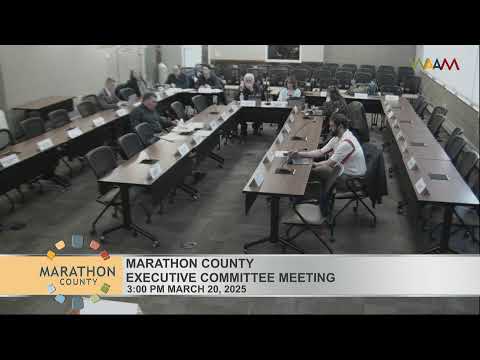
Executive Committee reviews working draft of Chapter 8 of Marathon County comprehensive plan
Summary
CPZ Director Lori Kimmons presented updates to Chapter 8 (infrastructure) including transportation, airports, utilities, stormwater, energy, telecom and solid waste; committee members raised issues about all-season roads, PFAS, multimodal shoulders and transit options.
The Marathon County Executive Committee reviewed a working draft of Chapter 8 of the county comprehensive plan — the infrastructure chapter — during its April 10 meeting. County Planning and Zoning (CPZ) Director Lori Kimmons presented updates that reflect completed plans and evolving topics such as stormwater management, renewable energy and broadband expansion.
Kimmons told the committee, “So this month, we're bringing to you the working draft of chapter 8.” She said the draft incorporates several completed plans since the 2016 comprehensive plan, including a roadway safety plan, two airport master plans, a 2022 stormwater quality management plan and the solid waste strategic plan. Kimmons said the draft also expands sections on natural gas and renewable energy, updates telecommunications and broadband text, and adds background and operational detail for the county landfill and solid waste operations.
Committee members asked for detailed additions and clarifications. Supervisor Robinson urged clearer information on the county road network and the status of roads that are all-season versus weight-restricted, noting the county manages roughly 600 miles of roads and that eligibility for the Agricultural Road Improvement Program (ARIP) depends on road status. Robinson said, “I think from the county roads perspective, you've got 600 miles, and I think we've been looking at the lane miles, which translates into a significant large number. But I think it would be helpful to have a discussion about the the status of the roads relative to all season versus weight restricted roads because I I think that's important as we begin to look at the ARIP dollars.”
Robinson also recommended the chapter address shoulder paving, rumble strips and accommodations for bicyclists and nonmotorized users, and to capture growing ATV/UTV use on county roads. Supervisor Frederick noted the earlier county discussion and direction on rumble strips and recommended keeping that language. Vice Chair Dickinson asked that Robinson’s recommendations be routed back to the appropriate committees for review with data, saying, “The recommendations, made by supervisor Robinson, should be put to the appropriate committee for them to review as opposed to just put into, the work that Laurie is doing.”
Kimmons said the draft keeps transit as an issue that remains important for seniors and aging populations, but noted regional partners are considering point-to-point microtransit rather than expanding fixed-route service. She also said Central Wisconsin Airport (CWA) raised concerns about pilot and aircraft shortages and the possibility of revenue guarantees or other incentives to attract service.
Members raised environmental and public-health concerns tied to infrastructure. Several speakers mentioned PFAS as an evolving issue for stormwater and solid waste management; one committee member suggested that communities have had exceedances of federal standards in municipal water supplies and that PFAS also appears in biosolids and effluent. The committee discussed exploring wellhead protection cooperation among municipalities and the western side of the county where water availability is limited.
Kimmons said objectives in the chapter mostly remain unchanged, but staff are discussing wording changes to distinguish items the county can ensure (for example, compliance with state codes for certain systems) versus matters the county can only promote or influence, and several departments proposed adding an objective addressing long-term sustainability of operations.
The presentation drew no formal vote; Kimmons and committee members agreed the draft will return to appropriate standing committees (highways, solid waste, airports, infrastructure) for further review. Kimmons said work will continue and that the full draft will be returned later in the year.
The Executive Committee’s next meeting is scheduled for April 10, 2025, at 3 p.m., when members said the county will review chapters on public safety and land use next.