Get Full Government Meeting Transcripts, Videos, & Alerts Forever!
Get email alerts on the Animal Waste Ordinance Winter Spreading topic
No spam. Unsubscribe anytime.
Marathon County committee hears months-long debate over winter manure spreading; staff to form stakeholder work group
Summary
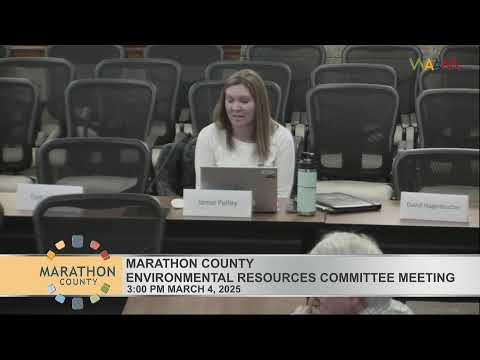
The Environmental Resources Committee on March (month) heard extended public comment and a staff briefing on possible amendments to the county animal waste ordinance addressing winter manure spreading, but took no formal vote to change rules.
The Environmental Resources Committee on March (month) heard extensive public comment and a staff briefing on possible amendments to the county’s animal waste ordinance focused on winter manure spreading and phosphorus runoff concerns.
Committee chair Jake Loggin Hahn said the item was being discussed for education and information only and that no decision would be made at the meeting. He moved the item earlier on the agenda because “we have so many people here that are interested in this topic today,” and the committee agreed to proceed to public comment and staff presentations.
The public comment period included seven speakers who described a mix of concerns: potential damage to local roads from added hauling if farms are required to build storage, odors and health worries from paper mill biosolids, the economics of required manure pits for small farms, and interest in buffers and nutrient management plans as alternatives. Dean Beck, Towne Easton chairman from the Town of Houston, said small dairies are “vital to our community” and warned that forcing storage requirements could push some farms out of business. James Gunnerson, a resident of Reebok, described the smell and local impacts from paper mill waste applied on fields and asked for testing. Randy Wolcouch, a town of Marathon farmer, said winter spreading supports organic vegetable growers who rent his ground and that a blanket ban would harm small diversified farms.
Conservation staff summarized technical work requested at the committee’s prior meeting. Kirsty (conservation staff) and Matt (conservation staff) told the panel that staff estimated roughly 9,000,000 gallons of manure would need short-term storage for the February–March period if all dairy-haul farms without storage abstained from spreading. They reported reviewing about 94 potentially idle storage sites countywide and preliminarily identifying 44 that, based on permit records and aerial photos, could be candidates for temporary use; those 44 sites represented an estimated 25,100,000 gallons of storage capacity. Staff emphasized the mapping was a tabletop analysis and that landowner willingness to lease storage had not been tested.
Speakers and stakeholder groups urged a range of responses. Dwight Tull, Marathon County Farm Bureau director, said the Farm Bureau supports compliance with nutrient management plans but cannot support a countywide, mandatory winter-spreading ban without more cost-sharing and stakeholder involvement. Ben Niffenegger, executive of Valley Improvement Company which manages the Big O'Plain Dam, said phosphorus runoff from landscape sources has driven the reservoir’s water-quality problems and called for “common sense ordinance revisions and programs to address phosphorus runoff issues.” John Kennedy, vice president of the Big O'Plains Citizens Organization, said past local studies repeatedly point to nutrient loading from runoff as the primary driver of harmful algal blooms and low winter oxygen.
Committee members pressed staff on timelines and next steps. Staff said they will continue stakeholder outreach, received additional written letters that are subject to county distribution rules, and can expand water-quality monitoring if the committee or board allocates funds for more sampling. Staff told the committee they will keep public comment open on this topic through April 1 and will compile written and oral comments submitted so far.
Committee discussion produced several points of agreement and direction without a formal ordinance vote. Members generally supported further negotiation with farmers and other stakeholders rather than imposing a countywide immediate ban. The committee asked staff to form a stakeholder work group to meet over the spring, to return summaries of comments, and to bring progress updates to the committee at future meetings. Chair Hahn said staff should distribute the compiled public comments to committee members and consider buffer incentives, stepped permitting, and expanded nutrient management planning as potential, more flexible options.
The committee did not adopt any ordinance amendments at the meeting; it directed staff to continue outreach and technical work and to bring recommendations back for further committee consideration.