Get Full Government Meeting Transcripts, Videos, & Alerts Forever!
Get email alerts on the Energy And Public Utilities topic
No spam. Unsubscribe anytime.
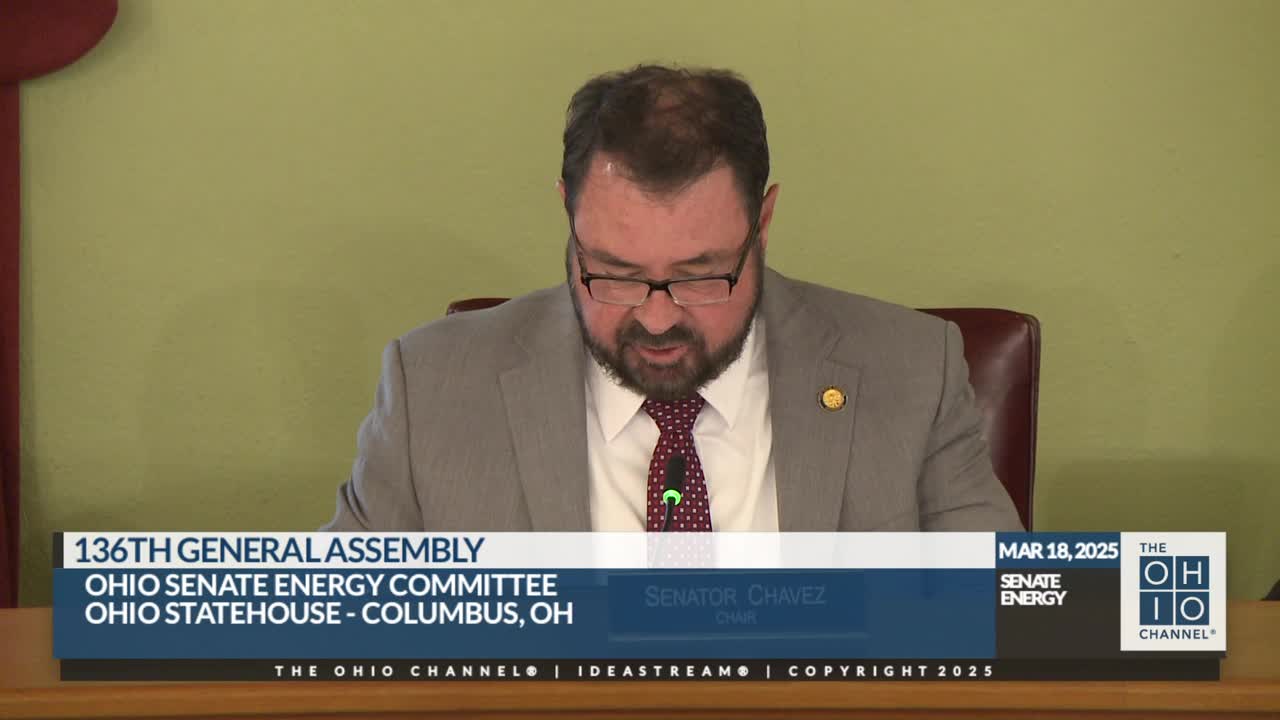
Senate Energy Committee advances substitute Senate Bill 2 after debate on contracts, OVEC recovery and utility generation
Summary
The Senate Energy Committee voted to report substitute Senate Bill 2 to Rules and Reference after testimony from utilities, manufacturers, environmental groups and others. Testimony focused on contracts under Ohio Revised Code 4928.47, the phase-out of OVEC cost recovery and limits on utility-owned behind-the-meter generation.
The Senate Energy Committee voted to favorably report substitute Senate Bill 2 to the Committee on Rules and Reference on a unanimous roll call after a hearing that included testimony from utilities, manufacturers, environmental advocates and energy-policy groups.
The bill, as amended to version 5 during the hearing, changes rate-making procedures, establishes annual true-ups of forecasted costs, limits utility ownership of new behind-the-meter generation to projects already in operation before the bill’s effective date, and ends cost recovery for OVEC (Ohio Valley Electric Corporation) subsidies immediately in the bill’s current form.
Why it matters: The legislation would reshape how Ohio utilities recover costs and bid service offers, affect how data-center and other large commercial customers obtain power, and change the treatment of certain legacy generation costs that have been passed to retail customers for years.
Frank Stregari, vice president of external affairs for AEP Ohio, testified in opposition to the current substitute and told the committee that the bill’s restrictions on agreements under Ohio Revised Code 4928.47 risk unlawfully impairing existing contracts. “This current law is the essence of customer choice,” Stregari said, adding that AEP entered contracts using that statute with CoLogix Johnstown LLC and Amazon Data Services and that the bill’s language would bar agreements unless the supplying facilities were already in operation before the bill’s effective date. He told the committee an immediate end to OVEC cost recovery would require AEP Ohio to write off about $52,000,000 in unrecovered costs and could raise utilities’ cost of capital, which utilities ultimately recover from ratepayers.
Other witnesses offered differing views. Kim Boiko, a partner with Carpenter Lips testifying for the Ohio Manufacturers Association, praised the bill’s end to OVEC subsidies and the limits on utility ownership of generation, saying the version passed by the committee “does not repeal 49 28.47” and that the statute as written constrains utility ownership. Robert Kelter, managing attorney at the Environmental Law & Policy Center, supported eliminating ESP cases and riders and urged clearer direction in the bill for annual true-ups and commission hearings to ensure utilities do not over-recover forecasted spending. Melville Nickerson, director of government affairs for NRG (Central Region), argued the bill promotes competition and gives consumers choices on suppliers and billing options.
Randy Emenger of the Energy Policy Network pressed the committee on resource adequacy, warning that Ohio and the PJM region face elevated risk of shortfalls during peak demand and that much of the planned replacement capacity is intermittent wind and solar. He recommended policies to repower and upgrade existing baseload plants, require replacement base-load capacity before plant retirements, and incentivize demand reduction programs.
Committee actions during the hearing included adopting a working substitute (0333-5) and agreeing to Amendment O2-63, which adds provisions on nontraditional billing, flexible payment schedules and expedited disconnection for certain mercantile customers; both were adopted without recorded objection during the proceedings. Later, Vice Chair Landis moved to favorably report substitute Senate Bill 2 to Rules and Reference; the committee approved the motion on a roll call with the following recorded yes votes: Chair Chavez; Vice Chair Landis; Ranking Member Smith; Senators Serino; DeMora; Lang; Manchester; Reineke; Schaeffer; Timken; Weinstein; Wilkin.
The testimony revealed several areas the committee may still consider: whether contracts entered under Ohio Revised Code 4928.47 should be explicitly grandfathered, the time period for any transition away from OVEC cost recovery, more specific procedural language for annual true-ups and hearings before the Public Utilities Commission of Ohio (PUCO), and protections to prevent discriminatory interconnection practices for data centers. The bill as passed out of committee will be harmonized by LSC per the committee’s permission and is next before Rules and Reference.
Votes at a glance: - Motion to adopt substitute bill 0333-5 as the working document — adopted without recorded objection. - Motion to adopt Amendment O2-63 (adds nontraditional billing methods, flexible payment schedules, expedited disconnection provisions for mercantile customers) — adopted without recorded objection. - Motion to favorably report substitute Senate Bill 2 to Committee on Rules and Reference — approved on roll call (unanimous yes recorded).
The committee chair closed the hearing after LSC was authorized to harmonize amendments; further action will proceed through Rules and Reference and the full Senate.