Get Full Government Meeting Transcripts, Videos, & Alerts Forever!
Get email alerts on the Instructional Hours topic
No spam. Unsubscribe anytime.
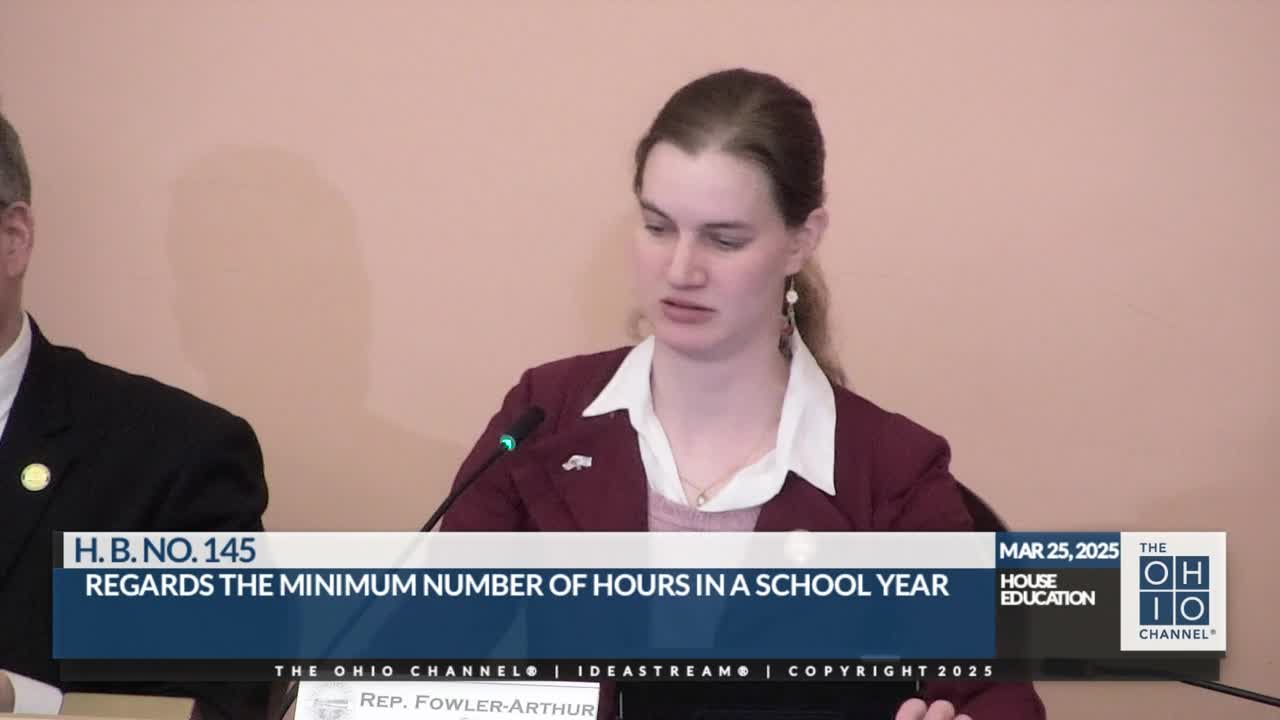
House committee hears bill to add instructional hours for Ohio students
Summary
House Bill 145, sponsored by Representative Byrd, would increase required instructional hours for Ohio public school students by 53 hours. Sponsors said the change would reverse part of a 2014 reduction from days to hours; committee members asked about implementation, teacher contracts and costs. No committee vote was taken.
Representative Byrd presented sponsor testimony on House Bill 145, which would increase the required minimum instructional hours for Ohio public school students by 53 hours.
“If this bill were to pass and add 53 hours, we'd go from 1,001 hours in grades 7 through 12 and 910 hours for grades K to 6 to 1,054 hours,” Representative Byrd said. He described the change as an effort to return instructional time that he said was lost when the General Assembly in 2014 changed the requirement from a 180-day standard to an hours-based standard. Byrd said the prior change “took away anywhere from 20 days to 14 days” of instruction depending on district schedules and said time in front of teachers “matters.”
Byrd cited comparative figures for other states and countries, saying Kentucky requires 1,062 hours, Michigan 1,098, West Virginia 1,080 and Texas 1,260; he also referenced South Korea as an international comparison. He cited research he said supports more instructional time, including a 1963 study by John and James Carroll (often cited as Carroll’s model of school learning) and work by the National Center on Time and Learning.
Committee members raised implementation questions. Representative Miller asked how districts could balance additional instructional hours with teachers’ professional development and existing unfunded mandates; Byrd said some districts may already include noninstructional days in teacher contracts and that local bargaining agreements should be considered, and he welcomed amendments addressing collective-bargaining timelines. Representative Robinson asked whether the timeline would allow schools to prepare; Byrd said he believed the bill could be implemented for the 2026–27 school year if enacted in time but said he would be open to adjustments.
Members also discussed workload and compensation. Representative Miller pressed whether additional time would require additional compensation for teachers; Byrd said, “Do I think teachers should be compensated? Absolutely. Their time is valuable.” He added that some local contracts already cover more school days and that sponsors would work on language allowing existing collective-bargaining agreements to run their course before imposing changes.
The hearing included multiple questions about daily schedules, bus windows, lunch and other operational impacts; Vice Chair Odioso asked whether the bill would affect daily orders such as start and end times and bus schedules. Byrd told members that local districts would retain flexibility over how to use added hours (longer days versus fewer noninstructional days). The hearing concluded with committee Q&A; no committee vote occurred on the bill during the session.